


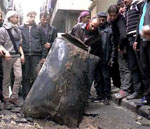
 AP: They are known as barrel bombs – makeshift, shrapnel-packed explosive devices that Syrian forces have been dropping on rebel-held neighborhoods from helicopters. Residents have another name for them: “barrels of death.”
The Associated Press
By Ryan Lucas
BEIRUT (AP) — They are known as barrel bombs – makeshift, shrapnel-packed explosive devices that Syrian forces have been dropping on rebel-held neighborhoods from helicopters. Residents have another name for them: “barrels of death.”
It’s a crude term for a crude weapon.
For nearly two months, President Bashar Assad’s government has conducted an intensive air campaign against parts of the northern city of Aleppo. Over the past six days alone, the airstrikes have killed at least 250 people, according to activists. At the same time, the military has stepped up air raids on the Damascus suburb of Daraya.
Activists say the vast majority of the attacks have been conducted with barrel bombs.
A look at the weapon:
WHAT ARE BARREL BOMBS?
The term is bit of a misnomer, but it arose when these weapons were first used in mid-2012, and it has stuck. They are containers – old oil drums, barrels, storage tanks, welded metal cylinders – that have been packed with hundreds of kilograms (pounds) of explosives, fuel and scrap metal, such as ball bearings, nails, saw blades or bits of rebar.
They are then loaded onto Syrian military helicopters and pushed out of the rear door. They have no guidance mechanism, so they just tumble through the sky and explode wherever they land.
The bombs have evolved since the Syrian government first started employing them.
In their early incarnations, they had a simple wick that a crewman lit before the canister was pushed out, said Elliot Higgins, who has analyzed amateur videos to track the use of weapons in Syria and runs the Brown Moses Blog.
The Syrians tinkered with the design and now build them with impact trigger mechanisms and tailfins to improve their reliability.
And in the past six to eight weeks, Higgins said, they appear to have settled on a more uniform design: a large metal cylinder around 3 feet wide and 6 feet tall (2 meters by 3 meters). In some cases, these are packed with up to 2,000 pounds of explosives, according to an analysis by weapons expert Richard M. Lloyd posted on the Brown Moses Blog.
The use of these weapons has drawn sharp criticism from the U.S., its allies, and human rights groups. “It’s a rudimentary bomb that, in the way the Syrian government is using it, is inherently indiscriminate,” said Lama Fakih, a Syria researcher with Human Rights Watch.
WHY IS ASSAD’S MILITARY USING THEM?
The Syrian government has not publicly addressed its reliance on barrel bombs. Some observers have suggested that their increasing use indicates Assad’s air force is running low on traditional ordnance. But the Syrian military can still count on a steady supply of standard munitions from its allies, Russia and Iran, which would undercut that theory.
Hisham Jaber, a retired Lebanese army general who heads the Beirut-based Middle East Center for Studies and Political Research, said the appeal of barrel bombs from the government perspective is probably twofold: They’re cheap, and they’re destructive.
Another theory, this one put forward by Higgins, is that these weapons provide an effective way for the military use its transport helicopters in an attack capacity.
WHAT SORT OF DAMAGE HAVE THEY DONE?
The bombs have had a devastating effect. Videos posted online show buildings smashed into heaps of shattered concrete blocks, twisted rebar and metal sheeting. One strike devastated a vegetable market in Aleppo, leaving apocalyptic images in its wake: bodies torn in half by shrapnel, market stalls ablaze, a cloud of smoke and dust hovering over the scene.
The videos were consistent with what Associated Press reporting found.
Those who have experienced a barrel bomb attack tend to describe one emotion in particular: terror.
“When people hear a helicopter in the air, they expect a barrel bomb. The streets become empty and everyone runs to hide. They just hide waiting for their death,” an Aleppo-based activist who goes by the name of Abu Raed said via Skype. “The barrels are huge and very heavy, so when they fall you hear this sound like they’re tearing through the air. I don’t know how to describe it.”
Fakih described how during a trip she made last year to Syria, a helicopter circled over the village she was in. Residents frantically tried to find shelter in an unfinished building, and the children who gathered with Fakih all told her to keep her mouth open when the bomb fell so the blast wave wouldn’t cause her to bleed from her ears.
Fakih said everybody knew what was coming but could do nothing but wait in trepidation. The barrel tumbled out of the helicopter and plummeted to the ground. It was a dud; it did not explode.
—
Associated Press writer Yasmine Saker contributed to this report.


