Iranian Students Protest Dangerous Cafeteria Conditions Amid Official Indifference
From cockroaches and lizards to flies and glass shards, in recent days, images of food served in university cafeterias across Iran have repeatedly made headlines and shocked students who rely on campus meals.
This report shares further details by interviewing students from universities in various cities across Iran.
The incident began on February 24. The “Amirkabir” student newsletter reported that a used syringe tip was found in a meal served at the cafeteria of Iran University of Science and Technology.
Due to the Nowruz holidays and university closures, the report did not receive much attention at first. However, after universities reopened on April 9, a student at Kashan University found a lizard in his plate of rice at the cafeteria, took a photo, and shared it online using the hashtag “lizard rice.”
Other students, upon seeing the incident, protested the quality and safety of the food served at Kashan University’s cafeteria. However, according to reports, one official mockingly responded: “Well, that’s good! We’re giving you Chinese food!”
Videos circulated online show that after hearing this irresponsible response, students at Kashan University of Medical Sciences went on a hunger strike and formed a 200-meter line of food trays in the university courtyard to express their protest.
On April 13, the Student Union of Bu-Ali Sina University in Hamedan issued an official statement expressing regret over the “deplorable, unacceptable, and unsanitary” conditions of their cafeteria.
Before the statement was released, students had reported finding plastic, insects, and worms in their meals, and had protested multiple times. However, in the most recent incident, shards of glass were found in the food.
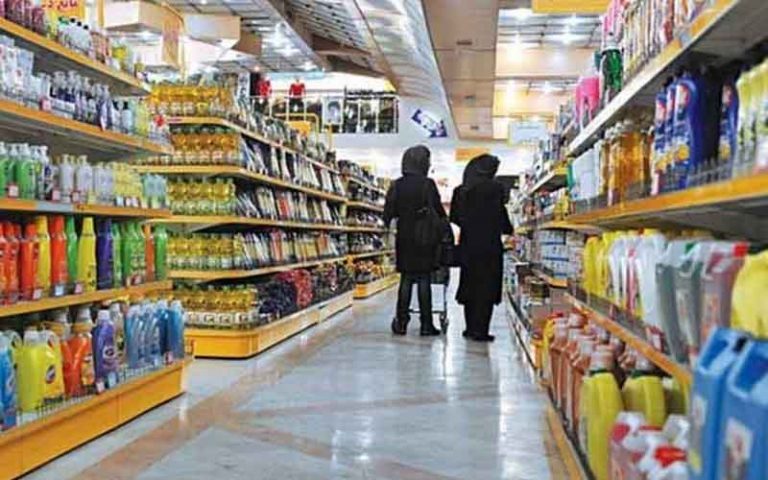
Most students have no choice but to use university cafeteria food—many cannot afford meals from outside, and many don’t have the time to cook.
Iranian Regime Atomic Energy Organization Protests IAEA Reports
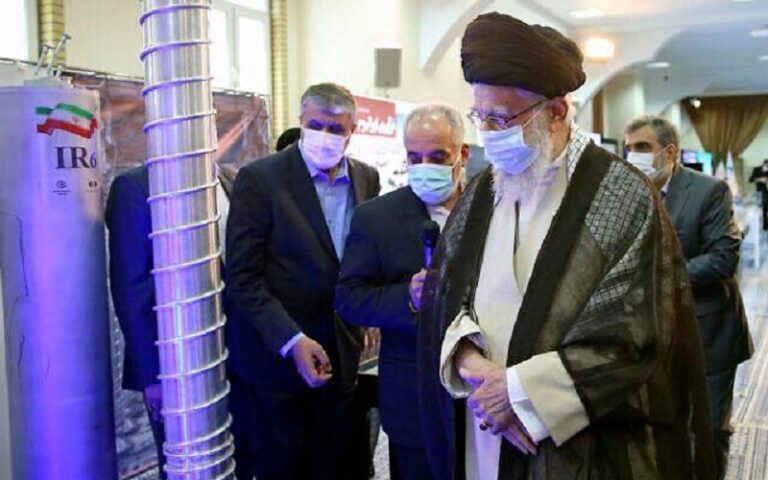
Behrouz Kamalvandi, the deputy head of the Atomic Energy Organization of Iran’s regime, said on Friday, April 18, in an interview with Iranian media, that during the recent visit of Rafael Grossi, Director General of the International Atomic Energy Agency (IAEA), to Tehran, “some of his interviews” were met with objections.
The regime-affiliated website Fararu quoted Kamalvandi as saying: “Specifically, there was an objection to Mr. Grossi’s recent remarks about Iran’s 60% enriched uranium stockpile, which he equated to seven atomic bombs.”
In its latest report on February 26, the IAEA announced that the Iranian regime had significantly increased its stockpile of highly enriched uranium over the past three months, and if this trend continues, the uranium reserves could theoretically be enough to build six nuclear bombs.
The Director General of the IAEA returned to Vienna on Thursday, April 17, after two days of talks with Abbas Araghchi, the Iranian regime’s foreign minister, and Mohammad Eslami, the head of Iran’s Atomic Energy Organization.
Rafael Grossi is expected to attend the second round of negotiations between Iran and the United States, which will be held on Saturday, April 19, in Rome, the capital of Italy.
Grossi has emphasized that an agreement between the Iranian regime and the United States will not be credible without the involvement of the IAEA.
In another part of his remarks to Iranian media, Kamalvandi stated that during Grossi’s recent visit to Tehran, “two Iranian officials, in separate meetings, stressed Iran’s firm stance against threats and warned that the Islamic Republic would deliver a strong response to any threat.”
The spokesperson of the regime’s Atomic Energy Organization announced that the IAEA Deputy Director General will travel to Tehran in two weeks for the “continuation of high-level technical negotiations.”
UN Special Rapporteur Warns About Transfer of Death Row Prisoners in Iran
Mai Sato, the UN Special Rapporteur on human rights in Iran, expressed deep concern over reports of the forced transfer of five political prisoners sentenced to death from Ward 4 of Evin Prison to Ghezel Hesar Prison.
On Thursday, April 17, Sato posted on X (formerly Twitter), recalling that in her latest report to the UN Human Rights Council she had also warned about conditions in Evin Prison. She reiterated concerns about reports of unrest and instability in the prison following the transfer of inmates, stating that this situation has created a dangerous environment. Meanwhile, political prisoner Golrokh Iraee, in a letter from Evin Prison, warned against society’s “numbness” to news of executions, following the transfer of Hamid Hosseinnezhad Heydaranlou for execution. Criticizing the general response to the issuance, confirmation, and enforcement of death sentences in Iran, she wrote: “We who oppose the death penalty, sitting freely in our homes or behind our desks, watching every move from our high-security phones lest we be identified.” The UN Special Rapporteur noted the broad impact of executions, emphasizing that the harm goes beyond the direct victims—it devastates families, causes psychological harm to other prisoners, and triggers waves of grief and anxiety throughout society. She described these impacts as “immeasurable.”۱) #ایران: گزارشهای نگران کنندهای دربارهی انتقال اجباری پنج مرد زندانی سیاسی محکوم به اعدام از بند چهار زندان اوین به زندان قزلحصار به دستم رسیدهاست.
— Mai Sato (@drmaisato.bsky.social) (@drmaisato) April 17, 2025
Iran: Behrouz Ehsani Said; I Have Never Bargained Over My Life with AnyoneSato concluded by highlighting the ongoing concerns over the Iranian regime’s use of the death penalty, stating that these cases once again underscore the need for oversight and accountability. She added, “I will closely follow this situation. The international community must not remain silent in the face of these events.”
Five Political Prisoners at Risk of Execution
Meanwhile, warnings have been issued that a group of political prisoners held in Evin Prison may be transferred to Ghezel Hesar. Among them are five political prisoners—Babak Alipour, Vahid Bani-Amerian, Pouya Ghobadi, Mohammad Taghavi, and Ali-Akbar Daneshvarkar—who have been sentenced to death on charges of “supporting the People’s Mojahedin Organization of Iran (PMOI/MEK).”History PMOI/MEK – 1979 Iran RevolutionSecurity forces had planned to transfer these five-death row political prisoners from Evin to Ghezel Hesar, but the transfer was halted due to protests from other prisoners. If these prisoners are transferred to Ghezel Hesar, the risk of their execution increases.
Executions Double in Recent Months
In the first three months of 2025, the Iranian regime hanged at least 230 prisoners across its prisons. This figure is more than double the 110 executions recorded during the same period last year. According to Amnesty International’s annual report, Iran accounted for over 64% of all documented executions worldwide in 2024, with at least 972 recorded cases, placing the Iranian regime at the top of the global execution ranking.Organ Trafficking Crisis in Iran
A group of people were caught selling vital organs such as kidneys, ears, or corneas from desperate individuals for exorbitant amounts—up to 700 billion rials (approximately $700,000)—to wealthy Iranian families.
According to the regime-run Hamshahri newspaper, the sellers included five Iraqi and four Iranian men. Exploiting legal loopholes and using false promises, they brought foreign nationals—including citizens of Iraq, Syria, Sudan, and Bangladesh—into Iran.
These individuals were from extremely impoverished backgrounds in their home countries and agreed to sell their vital organs in hopes of receiving dollar payments. However, the bulk of the profit went to middlemen and traffickers in the ring.
The amounts this trafficking ring received for organ sales ranged from 100 to 700 billion rials (approximately $100,000 to $700,000).
Iran: Sale of Body Organs Spikes as Poverty IncreasesIf the target had a highly compatible blood type and passed all medical tests, the price of their organs increased. On the other side, brokers usually identified families with financial means who were seeking kidneys for sick relatives. In such cases, the patients’ families were willing to spend billions of rials to purchase a kidney matching their relative’s blood type in an attempt to save their life. This case is particularly significant due to its organized structure and the extensive network involved. The group began by identifying individuals from Iraq, Sudan, and Syria who were willing to sell their organs and negotiated with them. They then arranged passports, handled embassy procedures, and finally obtained plane tickets for their entry into Iran. The suspects transported their victims to locations in the Dolatabad district of Shahr-e Rey and kept them in unsanitary conditions until it was time for their surgery. Notably, these surgeries were performed in officially licensed hospitals under the supervision of Iran’s Ministry of Health, which itself is a sign of regulatory failure and systemic corruption within Iran’s healthcare system. In recent months and years, numerous reports have been published in Iranian media about workers and citizens who, in protest of unpaid wages or due to worsening living conditions, resorted to selling their organs and later suffered death or severe physical complications. As poverty continues to spread rapidly across Iran, many people have turned to selling body parts such as kidneys and corneas to cover basic living needs. In some cases, individuals have even offered to sell their hearts—effectively agreeing to die—in a desperate attempt to lift their families out of poverty. In the past year, the growing market for the sale and purchase of sperm, eggs, embryos, and surrogate wombs has also come under increasing scrutiny. Social experts and medical professionals have repeatedly warned that this situation is a direct result of poverty, unemployment, and the drastic decline in people’s ability to afford basic living expenses. The response of official and governmental institutions in Iran to this crisis has been entirely ineffective and contradictory. While advertisements for kidney sales are easily found on platforms like Divar (a popular Iranian classifieds app) and on social media, the laws related to organ transplantation remain vague and incomplete. According to a report by the state-run Tejarat News website, several teenagers and young adults between the ages of 16 and 22 told the outlet that they have turned to selling their kidneys or bone marrow out of financial desperation. The report notes that younger age is considered an advantage for organ donors, making it easier for these youth to find buyers and receive the amount they seek. Currently, kidneys are priced between 3 to 6 billion rials (approximately $30,000 to $60,000) in Iran’s organ sales market. A 16-year-old named Hamid, who is one of the kidney sellers, told Tejarat News that he is even willing to sell his organ “a bit cheaper” due to his extreme financial need.
Hamid Hoseinnezhad Faces Imminent Execution in Iran
The political prisoner Hamid Hoseinnezhad Heydaranlu, who has been sentenced to death, has been transferred from the political ward of Urmia Central Prison to the prison’s quarantine section. Human rights sources reported that this transfer, along with the Supreme Court’s confirmation of his sentence, has intensified concerns about the imminent risk of his execution.
Human rights organizations reported on Wednesday, April 16, 2025, that Hamid Hoseinnezhad Heydaranlu has been transferred to the quarantine ward of Urmia Prison and stated that this move puts him on the verge of imminent execution.
Hoseinnezhad’s family has been informed to visit the prison for a final meeting, and his lawyer has written that the execution is scheduled to be carried out on Friday, April 18, 2025.
At the same time, the human rights website Hengaw also reported on his transfer to one of Urmia Prison’s solitary confinement cells, stating that his life is in danger.
Previously, on March 29, 2025, Branch 9 of Iran’s Supreme Court upheld the death sentence for Hoseinnezhad Heydaranlu without any changes. The ruling was formally delivered to him in Urmia Prison.
In July 2024, Hoseinnezhad was tried by Branch 1 of the Revolutionary Court of Urmia, presided over by Judge Najafzadeh. He was sentenced to death on the charge of “armed rebellion through membership in the Kurdistan Workers’ Party (PKK).”
The death sentence was issued despite the fact that he had denied all charges against him during the court session.
The Iranian regime’s Ministry of Intelligence, without providing any evidence, accused Hoseinnezhad of cooperating with the Kurdistan Workers’ Party (PKK). The judge, disregarding his defense, issued a death sentence in a court session lasting only a few minutes, solely based on what is referred to as the “judge’s knowledge” — a vague concept that allows rulings without hard evidence.
Hoseinnezhad, born in 1985 and a father of three, had been working as a “kolbar” — a porter who carries goods across Iran’s mountainous western borders — to make ends meet in recent years.
The Expansion of The “No to Executions Tuesdays” Campaign To 40 Prisons Across IranHe was arrested by border patrol forces on April 13, 2023, near the Chaldoran border crossing. After a few hours of interrogation, he was transferred to the Intelligence Department’s detention facility in Urmia. Hoseinnezhad was subjected to psychological and physical torture for 11 months and 10 days in order to extract forced confessions regarding his alleged participation in an armed clash between PKK members and Iranian regime border forces. Interrogators forced him to sign pre-written documents. In recent months, the rising number of executions as well as the issuance and confirmation of death sentences for political prisoners in Iran has triggered a wave of protests both inside the country and internationally. In the latest example, a group of families of political prisoners sentenced to death gathered in front of Evin Prison on April 15, 2025, during the 64th week of the “No to Execution Tuesdays” campaign. The campaign includes hunger strikes by prisoners in 40 prisons across the country. According to human rights sources, around 60 individuals in prisons across Iran are currently under death sentences on political or national security-related charges.
National Development Fund of Iran Drained by Regime Mismanagement and Military Control
Statistics from the Iranian regime’s Majlis (parliament) Research Center show that since the establishment of the National Development Fund in 2011 until March 2024, about 82% of its $161 billion revenue has been spent, and 88% of the loans disbursed were allocated to the government and public institutions such as the Islamic Revolutionary Guard Corps (IRGC).
Of the $132 billion in loans disbursed by the fund over 13 years, only $8 billion has been repaid. An additional $18 billion, despite reaching maturity, remains unpaid and has turned into overdue loans.
Iran’s 2025 Budget: Massive Oil Revenues for Military, State Assets Transferred to IRGCThe parliamentary research report shows that by March 2024, the fund’s foreign currency reserves stood at only $26.5 billion. After subtracting $6.5 billion in outstanding foreign exchange obligations, only $20 billion remains in manageable assets for Iran’s National Development Fund. The fund has yet to release its report for the previous fiscal year, which ended on March 20, 2025. However, reviews show that last year the government borrowed at least $10 billion from the fund — either directly (via approval from regime supreme leader Ali Khamenei) or by seizing part of the fund’s share of oil export revenues. According to the current year’s budget law, the government is also expected to borrow at least $9.4 billion from the projected $16 billion in oil revenue allocated to the fund. This financial institution was established 14 years ago to save a portion of the country’s oil revenues and provide loans to the private sector, replacing the former “Foreign Exchange Reserve Account.” In practice, however, the government and military forces have seized control of most of the fund’s financial resources. Only $14 billion — less than 10% of the total — has been allocated to the private sector, and given the widespread corruption and cronyism, it is unlikely that even this amount was distributed to genuine private enterprises. If no further unexpected withdrawals are made by the government by the end of the current year, total government debt to the fund will exceed $125 billion. The key issue is that the government lacks the financial resources to repay its debts. For the current year, the Iranian regime has projected daily oil exports of 1.8 million barrels, with one-third of that allocated directly to the military. If the National Development Fund is also turned into a direct oil exporter, the government would effectively be sidelined in Iran’s oil export sector. While Iran’s National Development Fund now holds less than $20 billion in manageable assets, data from the Global SWF (Sovereign Wealth Fund) Institute shows that the total reserves of oil-related sovereign wealth funds in the Persian Gulf countries and Azerbaijan have surpassed $3.6 trillion. In addition to the $3.6 trillion in oil-related funds, these neighboring countries also hold an equivalent amount in other sovereign wealth funds. For example, the United Arab Emirates operates eight sovereign wealth funds worth a combined $2.3 trillion. Only one of them, the Abu Dhabi Investment Authority (ADIA), is oil-related, and it alone manages over $1.1 trillion in assets. Beyond the $6.7 trillion in oil-related or independent sovereign wealth funds, public pension funds in Iran’s oil-rich neighboring countries also hold $650 billion in assets. In contrast, Iran’s public pension funds have effectively gone bankrupt for years and are reliant on government funding. Additionally, the central banks of Arab Persian Gulf countries hold over $850 billion in foreign currency reserves. By comparison, according to the Global SWF Institute, the Central Bank of Iran holds only $25 billion in reserves, most of which has been loaned to the government or domestic banks. The National Development Fund’s share of the region’s sovereign wealth fund value doesn’t even reach half a percent, even though Iran holds the largest gas reserves in the region and the second-largest oil reserves after Saudi Arabia. Iran’s oil production ranks third in the region after Saudi Arabia and Iraq, and it produces more natural gas than any other country in the region. Decades of misguided policymaking, widespread corruption, and plunder-based management have worked hand-in-hand with international sanctions to bankrupt Iran’s financial institutions one after another.
U.S. Imposes New Sanctions on Shipping Companies and Oil Tankers Linked to Iran’s Regime
Reuters, quoting the U.S. Department of the Treasury on Wednesday, reported that new sanctions have been imposed on shipping companies and oil tankers operating under the framework of U.S. sanctions programs related to Iran.
The sanctions target seven entities and five oil tankers. The companies named in this round of sanctions are registered in several countries, including Panama, Hong Kong, Malaysia, China, and the Marshall Islands.
The U.S. Treasury Department also sanctioned an independent Chinese refinery named Shandong Shengxing Chemical for purchasing over $1 billion worth of crude oil from the Iranian regime.
According to the department, any refinery or company involved in the purchase or trade of Iranian oil exposes itself to serious risk. The U.S. remains committed to disrupting the Iranian regime’s oil supply chain, which it says is used to fund proxy terrorist groups.
According to the statement, the new sanctions also cover six other companies, including Bestla Company Limited from the Marshall Islands, Civic Capital Shipping and Oceanic Orbit Incorporated and Starboard Shipping from Panama, Pro Mission SDN BHD from Malaysia, and Dexiang Shipping from Hong Kong and China.
These companies have been sanctioned for their role in the transport and sale of Iranian oil and for cooperating with entities affiliated with the Islamic Revolutionary Guard Corps (IRGC).
In addition, five oil tankers—Bestla, EGRET, NYANTARA, and RANI flying the Panamanian flag, and RESTON flying the Cameroonian flag—have also been sanctioned for their involvement in transporting Iranian oil and working with the blacklisted companies.
Forced Transfer of Five Political Prisoners Sentenced to Death in Iran
Following orders to transfer five political prisoners sentenced to death from Evin Prison to Ghezel Hesar Prison, tension and unrest broke out in Ward 4 of Evin. According to informed sources, prison guards entered the ward and cracked down on the protests by using force against the inmates.
The names of these political prisoners are Mohammad Taghavi, Pouya Ghobadi, Vahid Bani-Amrian, Ali Akbar (Shahrokh) Daneshvarkar, and Babak Alipour. These individuals were previously sentenced to death by Judge Iman Afshari on charges of affiliation with the People’s Mojahedin Organization of Iran (PMOI/MEK).
Iranian Regime’s Contradictory Justifications for Executing Political OpponentsAccording to witnesses, prison guards, under the orders of Heydatollah Farzadi, the warden of Evin Prison, locked the ward doors and created a security-heavy environment to prevent other inmates from protesting. Human rights sources have reported that the transfer was carried out in coordination with the Ministry of Intelligence. This move comes as the European Union, on April 14, placed Heydatollah Farzadi on its sanctions list for his role in the systematic repression of prisoners. Previously, in February 2025, two other political prisoners, Mehdi Hasani and Behrouz Ehsani, were also transferred to Ghezel Hesar without prior notice. In recent months, political prisoners Ali Moezzi, Khosro Rahnama, Asadollah Hadi, and Abolhassan Montazer have also been similarly moved to Ghezel Hesar. The six political prisoners sentenced to death who have recently been transferred to Ghezel Hesar or are awaiting execution have extensive records of political arrests and convictions. In response to these developments, families of several political prisoners sentenced to death gathered outside Evin Prison, demanding a halt to the executions and sudden transfers. Names and Status of the Six Political Prisoners Sentenced to Death
Seyed Mohammad Taghavi
Seyed Mohammad Taghavi, 57, is a political prisoner from the 2000s. He graduated in graphic design from the University of Tehran and had previously been imprisoned due to his political activities. In March 2024, he was rearrested and transferred to Ward 209 of Evin Prison. He had also been imprisoned in 2020 for approximately three years in Evin, charged with affiliation to the People’s Mojahedin Organization of Iran (PMOI/MEK).Pouya Ghobadi
Pouya Ghobadi, born in 1992 in Sonqor, is an electrical engineering graduate from Sanandaj University. He was arrested on February 23, 2024, while attempting to cross the border in Chaldoran and transferred to Maku Prison. On March 1, 2024, he was moved to Ward 209 of Evin Prison, where he remained for several months. Ghobadi had previously been arrested in 2018 on charges of “propaganda against the state” and “insulting the Supreme Leader,” and was sentenced to 18 years in prison and exile to Nikshahr.Babak Alipour
Babak Alipour, born in 1991 in Amol and a law graduate, was arrested in January 2024 and transferred to Ward 209 of Evin Prison. He had previously been arrested on November 4, 2018, along with his brother, Roozbeh Alipour, at the produce market in Rasht. He was sentenced to seven years in prison on charges of “membership in the PMOI” and “insulting the Supreme Leader,” and was released in 2023 after serving two years of his sentence.Shahrokh Daneshvarkar
Akbar (Shahrokh) Daneshvarkar, born in September 1966, is a dismissed civil engineer. He was arrested at his home on January 3, 2024. Daneshvarkar, who resides in Tehran, is married and has a 12-year-old son. Following his arrest, he was transferred to Evin Prison.Seyed Abolhassan Montazer
Seyed Abolhassan Montazer, born in 1959 and an architecture graduate, was arrested by security forces in Tehran on December 22, 2023, and later transferred to Ward 4 of Evin Prison. He is a political prisoner from the 2000s and had also been arrested in 2018. Montazer has been sentenced to five years in prison.Vahid Bani-Amrian
Vahid Bani-Amrian, born in 1992 and a native of Sonqor, holds a master’s degree in management from K. N. Toosi University of Technology in Tehran. He had previously been arrested in 2017 and 2018. In January 2019, he was sentenced to five years in prison on charges of “propaganda against the state” and “insulting the Supreme Leader.” These prisoners have been sentenced to death due to political charges and alleged affiliation with the PMOI, and their situation has attracted significant international attention. Human rights activists, warning of the imminent possibility of executions, have called for immediate intervention by international bodies to prevent widespread human rights violations in Iran’s prisons.Grossi: Iran’s Regime Is Not Very Far from Building a Nuclear Weapon
Rafael Grossi, Director General of the International Atomic Energy Agency (IAEA), arrived in Tehran on Wednesday evening.
Prior to his trip, Grossi said that the IAEA is not part of the bilateral discussions between Abbas Araghchi, the Iranian regime’s foreign minister, and Enrique Mora, the EU’s coordinator for nuclear talks, but it is not indifferent to them either.
Grossi added that they are well aware that the IAEA must provide its opinion on any potential agreement, as the agency will be responsible for its verification.
Before his trip to Iran, Rafael Grossi expressed his willingness for the IAEA to be involved in the nuclear negotiations between the United States and Iran’s regime in an interview with the French newspaper Le Monde.
Iran’s Nuclear Power Dream: From Fantasy to RealityGrossi said the IAEA has already initiated informal exchanges with the negotiating parties and added that once there is a text with concrete content, the agency will be asked to give its opinion regarding the procedures and the extent of inspections conducted. Grossi emphasized that without the presence of the IAEA, any agreement regarding Iran is merely a piece of paper… For such an agreement to be meaningful, there must be credible systems and strong monitoring mechanisms, which only the IAEA can provide. Regarding the nuclear capability of Iran’s regime, Grossi said that although the regime possesses enough material to produce not just one, but several nuclear bombs, it does not yet have a nuclear weapon. He likened it to a puzzle: they have the pieces, and they may one day be able to put them together. He emphasized that while the Iranian regime is still some distance away from acquiring a nuclear weapon, it must be acknowledged that it is not very far from it either. According to Grossi, over the past four years, the Iranian regime has significantly accelerated its uranium enrichment process, while at the same time, the scope of the IAEA’s intervention has diminished. He stated that for the international community, it is not enough for Tehran to simply say, “We do not have a nuclear weapon”; in order for the world to believe it, the IAEA must be able to verify that claim.
Massive Data Breach Exposes Personal Information of 30 Million Hamrah Aval Users in Iran
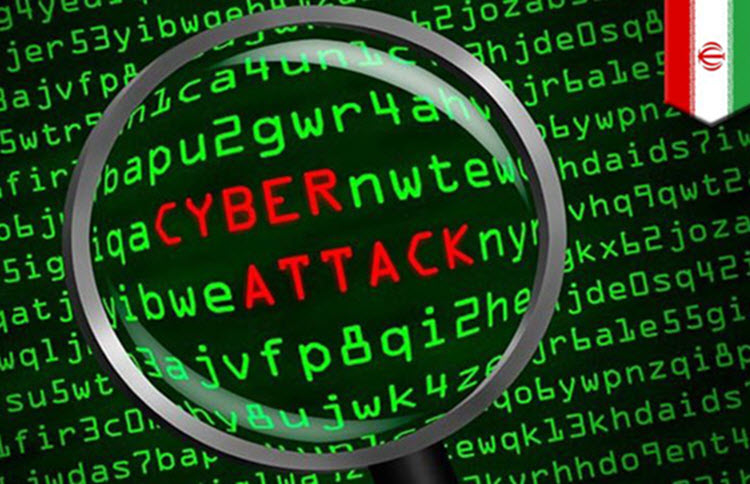
A hacker group has claimed to have infiltrated the customer database of Mobile Communications of Iran (commonly known as Hamrah Aval), the largest mobile phone operator in Iran, gaining access to the personal information of 30 million of its users.
According to reports, the hacked data includes customers’ personal information such as full names, dates and places of birth, national identification numbers, birth certificate numbers, and complete postal addresses.
The hacker group, named ShadowBits, also announced that it has obtained information about Hamrah Aval’s employees.
As of now, neither Hamrah Aval nor any state-affiliated media outlets in Iran have issued any statements or reports on the matter.
The Iranian technology news website Digiato initially reported the breach but later removed the article from its platform.
ShadowBits shared a screenshot of the deleted Digiato article on their Telegram channel, claiming that “pressure from intelligence agencies” led to the article’s removal.
Telecommunication companies in Iran, including Hamrah Aval, maintain close ties with intelligence and security agencies, and telecom data is often used for surveillance of citizens.
These companies have reportedly provided means for security services to intercept two-factor SMS authentication codes without the phone owner’s knowledge, allowing them to secretly access citizens’ online accounts.
Iranian Regime Presidency Servers Taken Over By Dissidents, Exposing Regime VulnerabilitiesThis is not the first time that Mobile Communications of Iran has been targeted in cyberattacks. In October 2022, during a wave of cyberattacks on websites affiliated with Iran’s regime, Hamrah Aval’s website was hacked and customer billing information was altered to show zero charges. In July 2016, Iranian media reported that “information pertaining to 20 million users” of a mobile operator had been hacked. In June 2020, MAHER (Iran’s Computer Emergency Response Team Coordination Center), which is affiliated with the Ministry of Information and Communications Technology, confirmed the leak of data for over five million users of Rightel, another Iranian mobile operator. In January 2024, anonymous hackers put up for sale a dataset of 160 million customer records from 23 Iranian insurance companies on the internet. Leakfa, an Iranian data breach tracking platform, confirmed the authenticity of the leaked data and stated that it was obtained through a cyber-infiltration of the infrastructure of “Fanavaran Etela’at Khebreh” (a technology service provider), which occurred shortly before. At the time, none of Iran’s official institutions—including the Security Office of the Central Insurance Organization and the regime’s cyber police—published any official report on how the hackers accessed the private data of citizens. This attack has raised serious concerns about privacy and data security for Iranian citizens. The structure of the leaked dataset indicates that the breach revealed both current and historical customer records, likely affecting both current and former subscribers of Hamrah Aval.