

Preferential Currency for Medicine Will Be Removed in Iran

Mohammad Reza Zafarghandi, the Iranian regime’s Minister of Health, Treatment, and Medical Education announced that the preferential currency for medicine will be removed starting next year.
Zafarghandi stated on Friday, November 29, that his ministry is preparing and planning to manage this change.
This comes after the Central Bank had claimed in September to have provided $1.5 billion in preferential currency for “medicine and medical equipment” by September 9. Zafarghandi had previously declared that the preferential currency for medicine had been removed.
Earlier, the previous health minister had announced the removal of the preferential currency for medicine imports under a plan called “Daruyar” starting in 2022. However, Iranian officials have made contradictory statements regarding the allocation of the “42,000 rial” currency for medicine.
Currently, the exchange rate for the dollar in the free market is approximately 700,000 rials.
At that time, it was announced that instead of providing currency for medicine, an equivalent budget would be allocated to insurance companies to expand insurance coverage and eliminate the need for people to buy unsubsidized medicines.
However, in practice, this plan led to significant increases in the prices of many medicines, a crisis for pharmaceutical companies in importing raw materials, shortages of many medicines, and crippling out-of-pocket expenses for the public.
In recent months, following growing criticism of the medicine crisis, Mohammad Jafar Ghaem-Panah, the executive vice president and acting chief of the Presidential Institution, announced that regime president Massoud Pezeshkian had ordered the Central Bank governor to address the liquidity issues in procuring raw materials for pharmaceutical factories and importing medicine.
The next day, Mohammad Reza Farzin, the Central Bank governor, stated during a coordination meeting with officials from the Food and Drug Organization of the Ministry of Health and representatives of the pharmaceutical sector that the Central Bank had allocated financial facilities to resolve liquidity and currency issues for importing medicine, with a report on the matter subsequently published.
Nevertheless, representatives of the Chamber of Commerce and pharmaceutical companies have harshly criticized the Central Bank and the government in recent months for failing to allocate currency for essential goods, particularly medicine.
The critical medicine shortage has long reached alarming levels, with Mohammad Ali Bandpei, a member of the Health and Treatment Commission’s board, announcing months ago that the number of scarce medicines had exceeded 200 items.
Now, the Minister of Health has also acknowledged the medicine shortage but stated that medical supplies are monitored daily, and if a pharmacy lacks certain medicines, “patients will be referred to another pharmacy where the medicine is available if possible.”
Mohammad Reza Zafarghandi also noted that if shortages occur nationwide, it is due to a lack of raw materials or reduced production in factories, which will be addressed and rectified on a case-by-case basis.
He did not elaborate on the methods or strategies to address the shortage of raw materials and medicine across the country.
Domestic medicine production in Iran is also facing a crisis due to the lack of liquidity for procuring raw materials for manufacturing plants. According to the head of the Iranian Pharmacists’ Association, more than 60% of domestic medicine production is “low-quality.”
750,000 Students Out of School in Iran
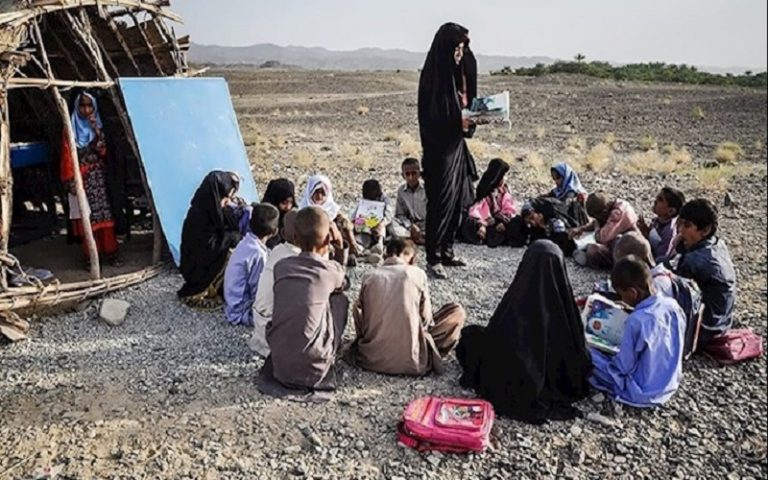
Alireza Kazemi, the Iranian regime’s Minister of Education reported that 750,000 students are out of school, noting that “approximately 150,000” of these are in primary education, while the rest are in middle school.
Kazemi stated that the issue of out-of-school students is unrelated to the Ministry of Education, claiming that those dropping out at the middle school are seeking work and vocational skills.
Several experts believe that school dropouts to enter the labor market have accelerated in recent years, coinciding with rising inflation and worsening poverty.
In this regard, the state-run Shargh newspaper reported on September 22: “Students consider dropping out and entering the labor market as a win, while attending school and spending hours in class feels like a loss to them.”
The state-run Khorasan newspaper also addressed this issue on August 1, writing: “Economic hardship and poverty are the most significant reasons for dropping out of school.”
Regarding the issue of girls being excluded from education in deprived areas and rural regions, social activists link it directly to poverty and child marriage.
In this context, the state-run Donya-e-Eqtesad newspaper published the results of a study on child marriage on August 13, stating: “In Iran, factors such as low per capita income, high inflation, and income inequality are among the primary causes of early child marriage.”
Meanwhile, the education system suffers from a shortage of teachers, insufficient classrooms, and deteriorating educational infrastructure. In this regard, the Deputy for Physical Education and Health of the Ministry of Education reported a shortage of approximately 8,000 physical education teachers nationwide.
As these shortages and educational crises have intensified in recent years, the regime’s officials have focused on changing the content of school textbooks.
Modifying textbook content and altering educational approaches in schools have been longstanding concerns of the Iranian regime’s Supreme Leader. Ali Khamenei has frequently expressed sensitivity to textbook content and called for their revision.
In May 2022, during a meeting with teachers and educators from across the country, he stated, “Useless content in textbooks must be removed.”
In November 2023, the Secretary of the Collaboration Headquarters between the Seminaries and the Ministry of Education told ISNA news agency about the hiring of 3,000 male and female seminary students as teachers. He stated, “Seminary students cooperating in the ‘Amin’ program with this ministry are entirely ‘voluntary,’ ‘devoted,’ and work in school counseling without receiving any financial assistance from the Ministry of Education.”
Global Academic Rankings of All Iranian Universities Are On The Decline

Yousef Hojjat, the acting head of Tarbiat Modares University in Iran stated that due to “low financial credibility,” the global academic rankings of all Iranian universities have declined.
On Saturday, November 30, Hojjat told the state-run ISNA news agency that Iranian universities have experienced a decline in the “Shanghai Academic Ranking.” He stated, “All university budgets are spent on daily operations such as salaries, dormitories, and food, and we cannot stop these activities.”
He emphasized “financial problems” as the reason for the academic decline of Iranian universities, stating that “due to the country’s economic situation, the funds allocated to universities are losing their purchasing power day by day.”
According to this university official, the allocation of funds to routine operations leaves little for research, which is less than in previous years.
The Shanghai Ranking is one of the most reputable and widely viewed university rankings, published by Shanghai Jiao Tong University based on four criteria: “quality of education,” “quality of faculty,” “research output,” and “per capita academic performance.”
In the 2024 update of this ranking, most Iranian universities experienced a decline. While the University of Tehran was ranked between 301 and 400 in 2022, it dropped to the 401-500 range in 2023 and 2024.
Sharif University of Technology dropped from the 601-700 range to 701-800, while Amirkabir University of Technology fell from 601-700 in 2022 to 901-1000.
A review of the rankings of universities in Islamic countries shows that Iran ranks third after Saudi Arabia and Turkey. In this ranking, Saudi Arabia, Turkey, and Iran have 12, 10, and 9 universities listed, respectively.
Since a significant portion of the university ranking criteria relates to “human resources and academic staff,” Iranian officials attribute the decline in university rankings to the increasing migration of faculty members.
Hossein Simaei Sarraf, the regime’s Minister of Science, had previously warned that the widespread emigration of university professors not only “lowers” the quality of universities and students but also means that “if this trend continues, they will be replaced by individuals who may have weaker qualifications.”
The Minister of Science described the 25% rate of professor emigration as “concerning,” noting that in recent years, “25% of university professors have emigrated, and some of them have no intention of returning.”
In addition to financial issues, political factors have also contributed to the emigration of academic staff in recent years. In September 2023, the Etemad newspaper published a list of 52 dismissed professors from Iranian universities, indicating that another wave of dismissals began with the start of Ebrahim Raisi’s administration in 2021 and intensified during the nationwide protests in Iran in 2022.
Reuters: Iranian Government to Install More Centrifuges at Natanz and Fordow
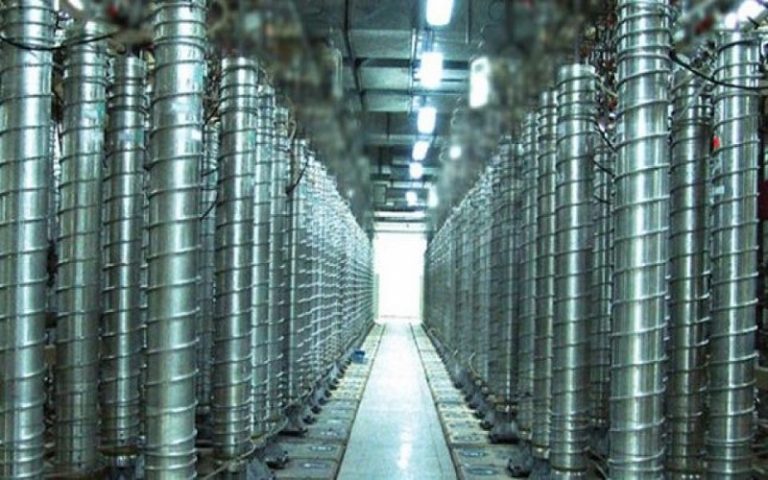
The Reuters news agency reported that the Iranian regime has informed the International Atomic Energy Agency (IAEA) of its intention to install more centrifuges at the Fordow and Natanz nuclear facilities.
According to the confidential report reviewed by Reuters, the Iranian regime also notified the IAEA of plans to bring recently installed devices at these facilities online.
The confidential IAEA report to member states did not mention uranium enrichment by the Iranian regime to 60% purity.
The Iranian government informed the IAEA that eight cascades of advanced IR-6 centrifuges will be installed at Fordow to enrich uranium up to 5%.
On Thursday, November 21, the IAEA’s Board of Governors passed a resolution condemning the Iranian regime for its lack of cooperation with the agency and its concealment of nuclear activities.
The resolution urged the Iranian regime to promptly provide credible explanations regarding uranium particles of human origin found at two undisclosed locations in Iran. It also called on Iran to inform the IAEA about the current location of any accumulated nuclear material or contaminated equipment, to provide the necessary documents and responses, and to grant inspectors access to the required sites and materials.
On Thursday, November 21, Laura Holgate, the U.S. representative to the IAEA praised the agency’s director-general for issuing a verification and monitoring report on Iran’s nuclear activities, which led to the adoption of the resolution against the Iranian government.
Holgate, highlighting the continued installation of additional advanced centrifuge cascades and the accumulation of larger amounts of highly enriched uranium by Iran, and referencing the director-general’s mention of these actions in the recent report, stated that this report makes clear, the leaders of the Iranian government are rapidly expanding their nuclear program, which is deeply concerning.
She emphasized that stocks of highly enriched uranium serve no peaceful purpose, adding that only countries with nuclear weapons enrich uranium to 60%. Holgate said that if the Iranian regime wants to build trust and claims its nuclear program is peaceful, it must not only halt further production of 60% enriched uranium but also completely eliminate its existing 60% stockpile.
The U.S. representative to the IAEA expressed deep regret over the Iranian regime’s obstructionism regarding safeguards concerns and failure to fulfill its legal obligations, stating that Tehran must fully implement its safeguard commitments without further delay and take seriously the implementation of the Additional Protocol and full transparency regarding the production of centrifuge components.
Following this condemnation, Iran’s Ministry of Foreign Affairs and the Atomic Energy Organization issued a joint statement announcing that orders have been given to launch a new set of advanced centrifuges in the country.
The New “Hijab and Chastity” Law in Iran: A Tool for Suppression and Control
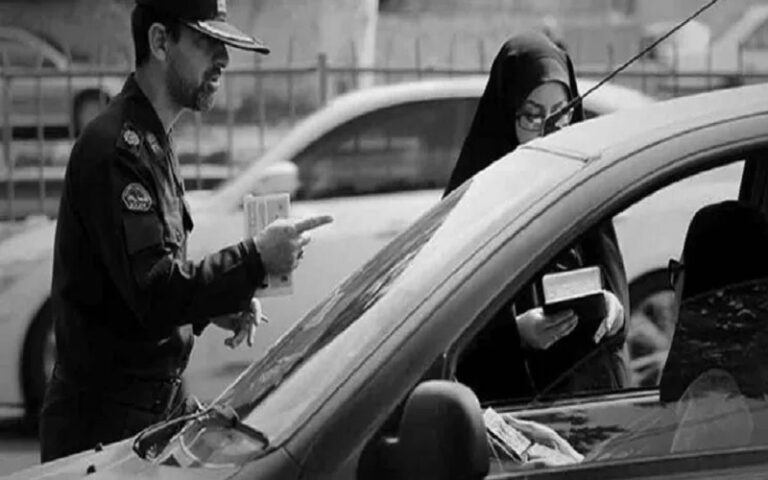
Mohammad Bagher Ghalibaf, the Speaker of the Iranian regime’s Majlis (parliament), announced the upcoming enactment of the new “Hijab and Chastity” bill. According to state-run media reports, he stated that this bill will be issued on December 13, with specific responsibilities outlined for each government agency regarding the enforcement of hijab regulations. Ghalibaf also claimed that the bill would eliminate the presence of the morality police.
To justify the repressive “Hijab and Chastity” initiative, Ghalibaf stated on Wednesday, November 27, that the bill categorizes violations such as “removal of hijab, improper hijab, and nudity.” According to him, an initial violation will result in a text message warning, followed by an official reprimand. At the first level, a fine will be imposed without further action. Repeated violations will incur a second fine, but imprisonment will no longer be an option in such cases.
The “Hijab and Chastity” law, passed by the Majlis in September 2023 and ratified by the Guardian Council in October 2024, has faced widespread opposition from human rights and civil society activists. These protests were largely expressed on social media platforms.
Majid Ansari, the Iranian regime president’s legal deputy, recently stated that despite its approval, the “Hijab and Chastity” law remains suspended. However, under governmental rules, if the president does not formally enact parliamentary legislation, the Speaker of the Majlis is authorized to do so.
Massoud Pezeshkian, the Iranian regime’s president, during his election campaign, introduced the “Light” policing approach to deal with opponents of mandatory hijab but cynically referred to it as “Darkness.” He advocated for dignified treatment of women. However, after ascending to power, he has abandoned these promises.
Ghalibaf further claimed that the bill aims to prevent direct confrontations and altercations. He added that under the new law, the morality police will no longer exist, and its enforcement mechanisms are explicitly outlined.
The “Hijab and Chastity” bill, introduced after the 2022 uprising, imposes heavy fines and penalties on opponents of mandatory hijab.
What remains concerning is the Iranian government’s persistent use of hijab as a tool to control women and society as a whole. This issue goes beyond hijab, representing an effort to suppress any public dissent or opposition. In essence, hijab has become a pretext for the regime to wield stringent laws and repressive measures to control the country’s social and political landscape.
These policies are essentially an attempt to stifle the growing social protests that have been gradually emerging. Iranian women, as one of the main social groups facing heavy governmental pressures, are consistently deprived of their basic rights and subjected to systematic repression.
Despite this repression, the voices of Iranian women remain strong. They continue their efforts through various means, including protests and online activism, to convey their demands to the global community. Although the regime employs repressive tools such as text warnings and car confiscations to silence these voices, Iranian women have demonstrated unwavering determination in their pursuit of rights. This resilience signifies a deep-rooted social movement born out of years of inequality and oppression.
Amnesty International Calls for Revocation of Varishe Moradi’s Death Sentence
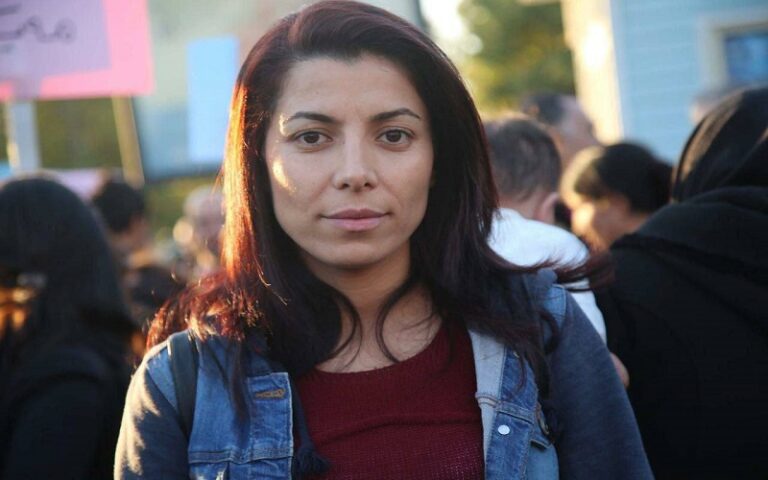
On Tuesday, November 26, Amnesty International issued a statement criticizing the death sentence handed down to Varishe Moradi, an Iranian political activist, and called for its immediate halt.
This international organization deemed the trial of Varishe Moradi “unfair” and, citing violations of her rights during detention, urged Iranian authorities to immediately halt the death sentence, annul her conviction, and release her without delay.
In its statement, Amnesty International also called on the Iranian regime to impartially investigate the allegations of torture and mistreatment of this political activist, prosecute those responsible in fair trials, and ensure her access to adequate medical care as well as visits with her family and lawyers.
Varishe Moradi, a 39-year-old political prisoner, was sentenced to death on November 10 by Branch 15 of Tehran’s Revolutionary Court on charges of “baghi” (armed rebellion against the government).
She was arrested on August 1, 2023, in the suburbs of Sanandaj and, on December 26, 2024, following the completion of her interrogation at the Ministry of Intelligence’s detention center known as Ward 209 of Evin Prison, was transferred to the women’s ward of the same prison.
In an open letter from prison, this political prisoner revealed that during her detention, she was subjected to physical and psychological torture, threats of execution, and gender-based violence.
Majlis Speaker: Iran Doesn’t Have Oil to Deny Enemies
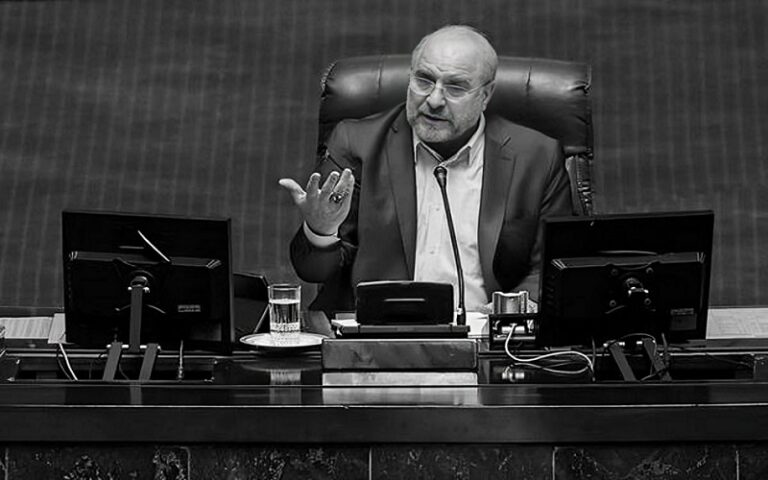
Mohammad Bagher Ghalibaf, the Speaker of the Iranian regime’s Majlis (Parliament) indirectly referred to past threats by Iranian officials to cut oil exports to the West. Highlighting the current energy imbalance crisis in the country, he stated that Iran now lacks the oil and market leverage to threaten the world.
On November 26, Ghalibaf said during a public parliamentary session: “There was a time when, in response to enemy threats, we used to say we’d shut off the oil supply to you—it was our leverage of threat. But today, with this situation, what oil can we shut off, and what market do we have?”
He further noted that, according to Iran’s oil minister, even if production exists, the country faces a “transportation problem” for transferring oil.
Ghalibaf added: “Our issues are more complex than simply discussing now whether mazut (a type of heavy fuel oil) should be burned in power plants or not.”
Officials from Mahmoud Ahmadinejad’s administration in 2012 had threatened the West that if Iran was sanctioned, it would “halt” oil exports to drive oil prices up to “$300” per barrel and create a “crisis” in the global economy.
In this context, Rostam Ghasemi, Iran’s oil minister at the time, stated in November 2012: “If you continue to increase sanctions, we will also cut off our oil exports to the world.”
He claimed: “We have prepared a contingency plan to run the country without any oil revenue.”
His threat has not been carried out in over a decade. Instead, Iran has resorted to relying on China to sell its oil, offering significant discounts in the process.
Additionally, Iran’s plan to run the country without oil revenues comes as, since November 2012, the government’s debt to the Central Bank—due to borrowing to cover budget deficits—has increased 38-fold to approximately 50 trillion rials (about $7.142 billion). Government debt to other banks is more than double this amount.
During this period, the government has also borrowed $100 billion from the National Development Fund. Overall, according to the International Monetary Fund (IMF), public debt has risen to one-third of Iran’s entire economy.
The Iranian regime’s past threats to disrupt the global economy by cutting off oil exports contrast sharply with its current situation. In the early 2010s, Iran exported 2.5 million barrels of oil per day, 18 billion cubic meters of gas, and 12 terawatt-hours of electricity annually. Now, it smuggles 1.6 million barrels of oil, faced a 64 billion cubic meter gas deficit last year, and has zero net electricity trade. This past summer, it also struggled with a massive electricity shortage.
Ghalibaf stated that this summer’s electricity deficit was 15,000 megawatts, and last winter’s gas shortage reached 250 million cubic meters, equivalent to 20% of the country’s total electricity and gas demand.
He added: “When consumption grows by 5.5% and production grows by only a fraction of a percent, the result is nothing but imbalance.”
The Iranian regime’s insistence on uranium enrichment to provide fuel for nuclear power plants comes while the Bushehr power plant—the country’s sole nuclear power plant—accounts for only 1% of the country’s electricity production. Over the past decade, it has produced a total of 70 terawatt-hours of electricity, worth less than $5 billion in regional markets.
Ignoring the hundreds of billions of dollars in direct costs from sanctions, the mentioned figure is even less than the construction cost of the Bushehr plant. In other words, over the past decade, the value of electricity produced by the Bushehr plant has not even equaled its construction cost.
The West accuses the Iranian regime of attempting to build a nuclear bomb—a claim the regime denies. However, it has refused to answer the International Atomic Energy Agency’s questions regarding clandestine activities and the origins of uranium particles found at undeclared sites.
People From Various Walks of Life Hold Protests Across Iran
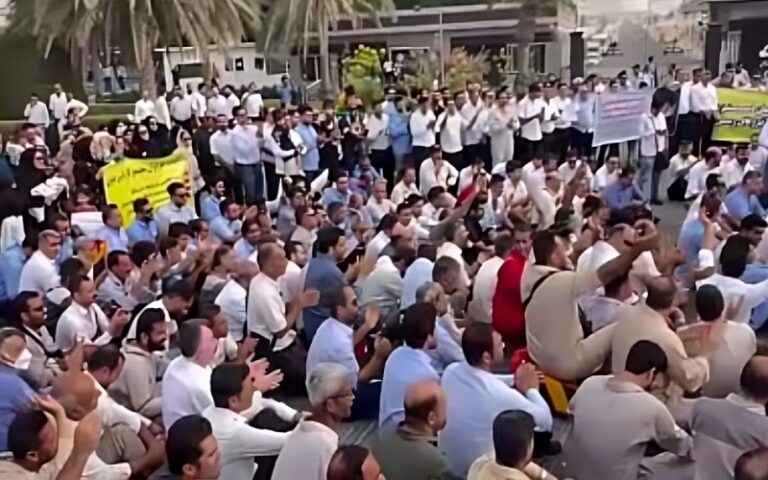
Protests involving various groups, including workers, retirees, and defrauded investors, were held on Tuesday, November 26, against the Iranian regime.
For a long time, Iranians have taken to the streets in demonstrations to demand their rights.
Protest by Contract Workers in the Oil and Gas Sector in Bushehr
Thousands of contract workers in the South Pars oil and gas sector, along with employees from twelve refineries, gathered in front of the South Pars Gas Complex headquarters to protest the neglect of their labor demands.
These workers, after 16 weeks of protests, demanded the implementation of a fair system for wage payments and chanted: “From slogans to action, empty promises—fair wages are our unalienable right.”
2023 Retired Educators Protest in Tehran
Educators who retired in 2023, after 15 months of non-payment of 60% of their retirement bonuses, gathered in front of the regime’s Presidential Office. They chanted slogans such as: “Stop postponing, give us our rights” and “Where is justice? Where is justice?” to demand their legal entitlements.
2023 Retired Educators Protest in Yazd
In Yazd, retired educators also protested in front of the provincial Program and Budget Organization. The protest was in response to the incomplete implementation of the salary equalization law. Their slogan was: “Half pay is what you get if you stay silent—we won’t rest until we get our rights.”
Protest by Retirees of Khorasan Petrochemical
A group of retirees from Khorasan Petrochemical, whose welfare benefits were cut 15 months ago due to collusion between the retirement fund and the employer, held a protest.
Protest by Employees of Tehran Metro Operating Company
Employees of Tehran Metro Operating Company protested against mismanagement and delayed wage payments. They also voiced opposition to the complete transfer of the metro company’s shares to Tehran Municipality. Some of their slogans included: “Zakani, have some shame, leave the municipality” and “The transfer of the company is forbidden, forbidden.”
Protest by Defrauded Investors of Rigan Vehicle and Shahr Khodro Companies in Tehran
Defrauded investors of Rigan Vehicle Company and Shahr Khodro held a protest in front of the Judiciary Headquarters. They criticized corruption in the judicial system and alleged collusion between some judges and fraudsters, demanding faster enforcement of court rulings.
The widespread protests by various groups—from workers and retirees to employees and defrauded investors—reflect deep dissatisfaction with the economic situation.
These protests, held across different parts of the country, signify a deep divide between the people and the Iranian regime.
Iran’s “No to Executions Tuesdays” Campaign: The Authoritarian Regime Seeks to Spread Fear
In its 44th consecutive week of protests, on Tuesday, November 26, the “No to Executions Tuesdays” campaign, held in 25 different prisons across Iran, described the issuance of “mass execution sentences” as “the strategy of Iran’s authoritarian regime to instill fear and terror.”
The statement reads: “While Iranian society is grappling with severe and complex livelihood problems, and the regime has reached a deadlock in resolving them, it considers increasing executions as the only solution to prevent the recurrence of widespread popular protests.”
In this regard, the “No to Executions Tuesdays” campaign highlighted the “daily executions” in various Iranian prisons, adding that “at least 25 individuals have been executed in just the past week.”
According to the statement, last month alone, “the regime executed over 140 people, leaving hundreds of families in mourning. These sentences serve no deterrent purpose and are not aimed at punishing individuals but are political in nature, intended solely to spread fear and repression in society.”
In this context, the human rights news agency HRANA reported on Thursday, November 21, that between October 22 and November 21 alone, at least 133 executions were carried out, including one public execution, 24 sentencing decisions, and seven death penalty confirmations.
The “No to Executions Tuesdays” campaign, referencing the issuance of “mass death sentences,” including for six defendants in the Ekbatan case, wrote that these actions should be seen as part of “the regime’s strategy to assess and prevent the start or spread of protests by the fed-up Iranian people.”
The campaign added: “In a repressive move, the authoritarian regime ruling the country has recently issued inhumane death sentences for two Kurdish political prisoners in Urmia Central Prison: Mehran Hassan-Zadeh, who was arrested during the 2022 protests, and Hamid Abdollahzadeh.”
The campaign’s statement emphasizes that the issuance of these sentences coincides with the 71st condemnation of the Iranian regime by the United Nations General Assembly’s Third Committee for gross human rights violations.
The statement also noted the transfer of four Arab political prisoners sentenced to death from Sheiban Prison in Ahvaz to solitary confinement, adding that it has been nearly 40 days with no information about the status of Adnan Ghobeishavi, Ali Mojadam, Moein Khanfari, and Mohammadreza Moghaddam, warning that their lives are “in serious danger.”
The “No to Executions Tuesdays” campaign, while condemning all executions, the unjust judicial processes, and the blatant human rights violations in Iran, issued a serious warning about the escalation of executions. It called on all organizations and individuals worldwide, including political, human rights, civil, and labor activists, to make greater efforts to save the lives of prisoners on death row in Iran.
The statement emphasized: “We continue to stress collective solidarity and united action to stop the machinery of killing.”
The statement also noted that members of the “No to Executions Tuesdays” campaign have been holding hunger strikes on Tuesdays for 44 consecutive weeks in protest against execution sentences in Iran.
Report: A Call for Action Against Executions in Iran
In a remarkable show of solidarity, 580 mayors in France have issued a collective call to end executions in Iran. Their statement supports the initiative led by Maryam Rajavi, the president-elect of the National Council of Resistance of Iran (NCRI), who has consistently championed the abolition of capital punishment, as outlined in her “10-point plan for the future of Iran.” This movement underscores the growing international concern over the alarming increase in executions under the current Iranian administration.
The French mayors expressed profound concern about the sharp rise in executions, which far exceeds the rates of previous years. Among those executed are political dissidents, including Reza Rassaei, who was arrested during the November 2022 uprisings in Shahriar, Tehran Province. Observers note that such executions serve as a tool for the Iranian regime to pursue political objectives, primarily by instilling fear and suppressing potential uprisings. As the mayors aptly stated, “Every execution carried out under this regime is inherently political.”
The international community’s lack of decisive response to Iran’s suppression and mass executions has emboldened the regime. Silence from global actors has inadvertently encouraged the continuation of these repressive practices. The regime has systematically weaponized executions to silence dissent and maintain its grip on power. Many analysts argue that the absence of meaningful international condemnation has contributed to this troubling trend.
A UN Fact-Finding Mission, in a recent report, labeled acts such as killings, imprisonment, torture, and sexual violence by the Iranian regime as crimes against humanity. These findings have further highlighted the urgent need for global action. In an alarming revelation, the report cited cases of torture and inhumane treatment directed toward political prisoners and opposition members.
As of early 2024, political prisoners in 20 prisons across Iran have launched a weekly hunger strike campaign titled “No to Executions Tuesdays.” This movement, held every Tuesday, reflects the prisoners’ determination to challenge the regime’s draconian policies and amplify calls for justice. Their courage has drawn attention to the plight of those who are often forgotten or silenced behind prison walls.
The July 2024 report by UN Special Rapporteur Professor Javaid Rehman further cemented these concerns. According to his findings, the Iranian regime’s actions, including mass executions, torture, and other inhumane acts, have been systematically aimed at members of the People’s Mojahedin Organization of Iran (PMOI/MEK). These acts, carried out with genocidal intent, represent a grim chapter in Iran’s modern history.
The French mayors’ call aligns with Maryam Rajavi’s steadfast advocacy for justice and human rights in Iran. Her 10-point plan envisions a future where the death penalty is abolished, and fundamental freedoms are guaranteed. The mayors emphasized their support for Rajavi’s vision, stating, “We endorse Maryam Rajavi’s call to end executions in Iran and her firm commitment to abolishing the death penalty as enshrined in her 10-point plan.”
The regime’s strategic use of executions has become a hallmark of its oppressive rule. By fostering fear and eliminating dissent, the authorities aim to stifle any momentum toward popular uprisings. However, the growing chorus of international voices, including the French mayors, reflects a shifting tide. It signifies a rejection of the status quo and a demand for accountability.
In conclusion, the call by 580 French mayors to end executions in Iran represents a significant step in rallying international support against the Iranian regime’s human rights abuses. The courage of political prisoners, coupled with the steadfast advocacy of Maryam Rajavi and the findings of UN reports, underscores the urgent need for decisive global action. This collective effort could pave the way toward justice, accountability, and a future where the dignity and rights of all Iranians are respected.
