


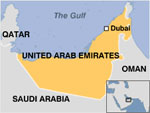
 AFP: Iran should respect the unity of its Arab neighbours in the Gulf, the United Arab Emirates foreign minister said on Wednesday at a time of heightened regional tension.
by Lynne Nahhas
ABU DHABI, April 20, 2011 (AFP) – Iran should respect the unity of its Arab neighbours in the Gulf, the United Arab Emirates foreign minister said on Wednesday at a time of heightened regional tension.
“Iran should reconsider its policies in the region,” Sheikh Abdullah bin Zayed Al-Nahayan, whose country holds the rotating presidency of the Gulf Cooperation Council, told a news conference in the UAE capital of Abu Dhabi.
And it “should respect the unity and sovereignty of Gulf countries,” he said at the end of an annual GCC-European Union ministerial meeting.
“I’m trying to choose my words carefully. I don’t want to act like some Iranian officials who throw their words in an abrasive and indecent way,” Sheikh Abdullah said.
“All I wish for is that Iran view its neighbours with responsibility and respect.”
Tension has been running high between Iran and its Arab neighbours across the Gulf, with the two sides locked in a war of words since Shiite-led protests against Bahrain’s ruling Sunni dynasty broke out in mid-February.
A Saudi-led Gulf force including UAE police rolled into Bahrain on March 14, freeing up Bahraini security forces to crush the protest movement in the only Shiite-majority Arab state of the Gulf, in a move condemned by Iran.
A joint GCC-EU statement issued after Wednesday’s meeting backed the deployment.
It said the two blocs played up “the importance of respect for the sovereignty of GCC member states and recognised the GCC is entitled to take all necessary measures to protect” their citizens.
The statement followed a meeting in Abu Dhabi between EU foreign policy chief Catherine Ashton and Bahrain’s King Hamad.
“I’ve just had a meeting with his majesty the king of Bahrain. We discussed the importance of meaningful dialogue, meeting the aspirations of the people of Bahrain and… the respect of human rights” there, Ashton told reporters.
Twenty-four people were killed in the one-month long uprising in the tiny Gulf kingdom, according to its interior ministry. Four others have died since in detention, drawing condemnation from the EU, Washington and rights groups.
On Monday, Bahraini Foreign Minister Khaled bin Ahmad Al-Khalifa said the Gulf troops had entered his country “to deter an external threat,” a reference to Iran.
“We have never seen such a sustained campaign from Iran on Bahrain and the Gulf as we’ve seen in the past two months. Usually it’s short-lived and then they back off; this time is something different,” he said.
“We wrote a letter to the secretary general of the United Nations, and in that letter we have a full attachment on the threats and all the evidence we have against Iran and Hezbollah,” the Lebanese Shiite group backed by Tehran.
And on Wednesday, Kuwaiti Foreign Minister Mohammed Sabah al-Salem Al-Sabah confirmed that Iranian diplomats accused of spying have been expelled, in another spat between Iran and its Gulf neighbours.
Iranian state television had previously said three of Tehran’s diplomats and an embassy employee were expelled from Kuwait, but Sheikh Mohammed’s remark on Wednesday was the first official confirmation from the Kuwaiti side.
Sheikh Mohammed had said on March 31 that Iranian diplomats were to be expelled for alleged links to a spy ring working for Tehran, reportedly ever since the 2003 US-led invasion of Iraq.
The foreign minister charged the diplomats had proven links to a spy ring, three alleged members of which a Kuwaiti court condemned to death on March 29.
Strains in relations across the Gulf date back to the 1980s when the Arab states, notably Saudi Arabia, backed Saddam Hussein’s Iraq in an eight-year war against Iran.
The GCC has more recently voiced concern over Tehran’s alleged ambitions for regional dominance and its nuclear programme.
In other disputes, Iran has in the past claimed Bahrain as part of its territory and it controls three islands in the southern Gulf that are also claimed by the UAE.


