


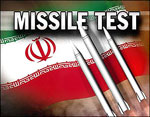
 AFP: Iran said Sunday it tested a new medium-range missile during war games near a vital Gulf oil transit channel, hours after US President Barack Obama signed a law tightening sanctions against Tehran over its nuclear programme.
By Marc Burleigh
TEHRAN (AFP) — Iran said Sunday it tested a new medium-range missile during war games near a vital Gulf oil transit channel, hours after US President Barack Obama signed a law tightening sanctions against Tehran over its nuclear programme.
A military spokesman also announced that Iranian ships and submarines will on Monday carry out manoeuvres designed to allow them to shut the strategic channel, the Strait of Hormuz, if Tehran so wishes.
The show of military muscle underlined a threat by Iran to shut the narrow strait — a throughpoint for 20 percent of the world’s oil — if more Western sanctions were applied over its nuclear programme.
The potential for that scenario, and possible confrontation with US warships that patrol the Gulf, was given impetus when Obama on Saturday signed tough new sanctions targeting Iran’s central bank and financial sector.
Under the measures, foreign firms will have to choose between doing business with the Islamic republic or the economically mighty United States.
The aim is to put the squeeze on Iran’s crucial oil revenues, most of which are processed by the central bank.
The new US sanctions were “unjustifiable,” Mohammad Nahavandian, the head of Iran’s chamber of commerce, told the ISNA news agency. He said previous sanctions had “failed to halt Iran’s trade.”
Iran has said new sanctions, including a possible oil embargo being mulled by the European Union, could push it to close the Strait of Hormuz. Its war games underlined the threat.
“From tomorrow morning (Monday), a vast majority of our naval units — surface and underwater, and aerial — will implement a new tactical formation, designed to make the passage of any vessel through the Strait of Hormuz impossible if the Islamic Republic of Iran’s navy so chooses,” navy spokesman Commodore Mahmoud Mousavi was quoted as saying by the ISNA news agency.
On Sunday, “for the first time, an anti-radar medium-range missile was successfully fired during the massive naval drills,” Mousavi said, according to state media.
“This medium-range surface-to-air missile is equipped with the latest technology to combat radar-evading targets and intelligent systems which try to disrupt missile navigation,” he was quoted as saying.
The missile was fired from a warship, the Fars news agency said.
Other details about the weapon were not immediately known, notably what distance it is able to fly.
Oil market analysts have been watching developments near the Strait of Hormuz closely.
Oil prices climbed briefly after Iran’s vice president, Mohammad Reza Rahimi, vowed Tuesday that “not a drop of oil will pass through the Strait of Hormuz” if more sanctions were imposed.
But they fell back again as analysts said such a closure would devastate Iran’s own economy, and could be viewed as an act of war provoking military action by the United States and its Gulf allies.
The United States has said it “will not tolerate” a closure of the strait.
Iran, though, has kept the threat on the table.
The deputy commander of Iran’s elite Revolutionary Guards, Brigadier General Hossein Salami, told ISNA on Sunday that “we will carry out whatever it takes to implement our defensive strategies in line with Iran’s defensive doctrine,” regarding the strait.
“If the vital interests of our country are endangered by the enemy, we will respond to any threat with a many-pronged threat of our own,” he was quoted as saying.
The United States and many Western countries believe Iran is trying to make atomic weapons under the cover of its civilian nuclear programme. Tehran denies this is so.
Tensions between Washington and Tehran — foes since Islamist students stormed the US embassy in Iran in 1979, taking 52 Americans hostage — entered a dangerous new phase in October, when US officials said the Revolutionary Guards had a hand in a thwarted plot to kill the Saudi ambassador to Washington. Iran has denied any involvement.


