


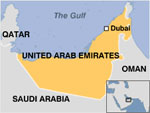
 USA Today: This small, oil-rich country across the Persian Gulf from Iran will soon be bristling with more high-tech weapons to counter its neighbor.
USA Today
Tom Vanden Brook
ABU DHABI, United Arab Emirates — This small, oil-rich country across the Persian Gulf from Iran will soon be bristling with more high-tech weapons to counter its neighbor.
Defense Secretary Chuck Hagel met Thursday with Crown Prince Mohammed bin Zayed as part of his swing through the Middle East to tout the proposed $10 billion in arms sales to Israel and friendly Arab states.
Hagel’s announcement Thursday that Syria likely used chemical weapons in its civil war pulled the spotlight away from the arms deal. It also showed the difficulty the Obama administration faces in trying to shift its attention from the Middle East to the Pacific region.
The continued crises in the Middle East will continue to be central to American security interests, Hagel said.
“Our attention has to be focused on this part of the world,” he told reporters traveling with him.
Defense officials for the past week have been highlighting the proposed sale of 25 F-16 fighter jets to the United Arab Emirates. Yet in recent years the Pentagon has also bolstered the arsenal of the U.A.E., population 5 million, with some of its most advanced weaponry.
“U.S. arms deals in the Middle East are always a balancing act between the security needs of friendly Arab states and the competing concerns of Israel,” said Loren Thompson, a military analyst at the Lexington Institute and consultant to defense contractors. “In this case, the weapons being provided to the U.A.E. are clearly intended to counter the air and missile threat posed by Iran.”
For example, in November the Pentagon notified Congress that it wants to sell the U.A.E. 48 missile interceptors for more than $1 billion. The Terminal High Altitude Area Defense, or THAAD, is designed to destroy ballistic missiles in flight. The Pentagon announced plans to send one of its only two of such systems to Guam earlier this month to counter the missile threat from North Korea.
John Pike, executive director GlobalSecurity.org, said the desire of states on Arab states on Persian Gulf to buy missile defenses, fighter jets and powerful bombs indicates their concerns about Iran’s pursuit of a nuclear weapon.
“There’s an arms race,” Pike said. “They are spending money like drunken sailors. You name it. Two of each, five of each. Nothing’s too good for them.”
While the interceptors will provide better protection from missiles than exists and the fighter jets are far superior to Iran’s, the Gulf states would be better served by low-tech systems to counter provocations Iran is already taking, said Peter Singer, director of the Center for 21st Century Security and Intelligence at the Brookings Institution.
For instance, the Gulf states need more ships to clear mines, which Iran has placed in the past to choke shipping lanes in the Persian Gulf that can be as narrow as a few miles wide.
“For all the buying of shiny objects, there are still some major gaps in capabilities,” Singer said. “It’s great they are buying sexy expensive systems from major American contractors, but for strategic purposes as allies, what we really need them to buy are boring old minesweepers.”
The Gulf states spend almost eight times as much on defense as the Iranians, Singer said. Minesweepers, not fighters or missile interceptors, would be a better investment, he said.
That would help defuse Iran’s threat from conventional weapons, Singer said, “which would aid us in unraveling the nuclear side of the problem.”


