


Iran Focus
London, 3 October – A Romanian human rights organization has insisted that the United Nations must investigate the 1988 Iranian massacre of political prisoners in.
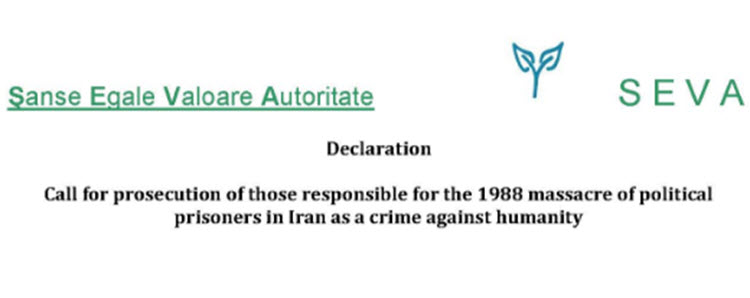
Şanse Egale Valoare Autoritate (SEVA) issued a statement on September 28, condemning the massacre of some 30,000 political prisoners, mainly members of the opposition group, the People’s Mojahedin (PMOI or MEK).
The statement in full can be read on the National Council of Resistance of Iran’s website.
SEVA called for those responsible for the massacre to be prosecuted for “crimes against humanity”.
SEVA President Angela Zarojanu wrote that following the leak of audio footage of a death commission meeting- which proved that the massacre had taken place and was pre-mediated– and the growing number of executions, there could be no other path: the culprits must be brought to account.
Of the four people heard on the tape, other than Ayatollah Montazeri who was protesting the killings, three still hold important positions within Iran.
Justice Minister Mostafa Pour-Mohammadi was recently asked to account for his role in the massacre and claimed that he was “proud” and had “done God’s work”.
Many of those murdered by the regime in 1988 were already serving -or had completed- prison terms for political activism. Others were relatives of those arrested who refused to disavow their loved ones.
According to reports by Amnesty International, an average of 10 people per day were executed between August and December. They, along with Human Rights Watch, and the International Federation of Human Rights Leagues, called this a crime against humanity.
The UN must investigate this massacre, the biggest slaughter of political prisoners since WW2, and the international community must stop relations with Iran until their executions are stopped.


