


One of the dilemmas before ordinary Iranians is the shortage and skyrocketing price of medicines. All the while, the regime’s pharmaceutical companies are busy producing sports supplements to increase their profits.
It is predicted that the price of medicine will increase by 30 to 40 percent due to inflation. However the price of medicine on the ground has already ballooned far beyond that. Skyrocketing prices are not the only issue. Nowadays, some medicines are not even available in reputable pharmacies, even the Red Crescent. Patients being denied insurance coverage for medicines is another problem they are facing these days.
A young lady, who requested to remain anonymous, says that she has been searching for Zoliver (an anti-anxiety medication) in central pharmacies. However no pharmacy has this medication. A middle-aged man went to a pharmacy to get Alendronic (a medication for increasing bone density) and the pharmacy staff told him they don’t have the prescribed medication and offered an alternative.
Currently, the shortage of medicine in Iran includes both routine medications and over the counter (OTC) drugs. A woman describes how she has been searching the city’s pharmacies for a week to find a package of Omeprazole (an OTC drug for stomach issues). She has been suffering from stomach pain for a week.
According to an interview with the regime’s Khabaronline website, Mohammad Taheri, a pharmacist, says, “Even domestically produced medications, simple and routine ones, are hard to find in pharmacies. Instead, domestic manufacturers are producing sports supplements. Nowadays, sports supplements, colorful and powerful, occupy the shelves of pharmacies, while medications for common colds and routine ailments are difficult to find.”
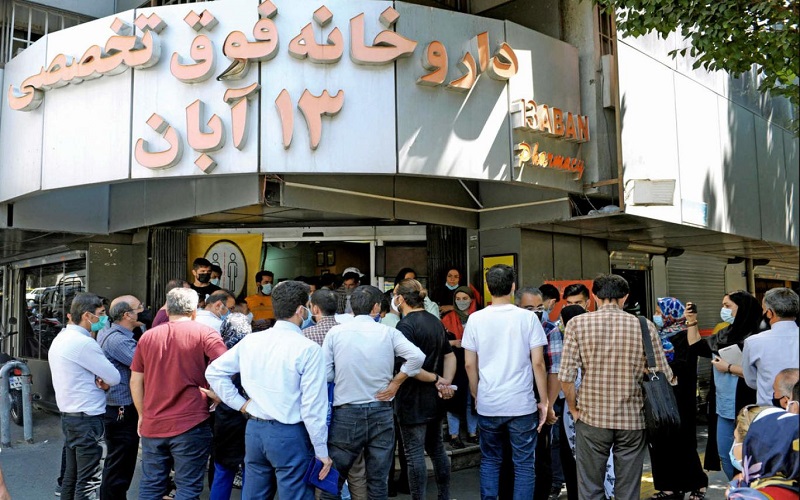
“The situation is even worse for people with specific diseases. It is challenging for patients to find medications like Melphalan, Thiotepa (chemotherapy medication) in reference pharmacies. For individuals with hemophilia, finding Factor 8 is impossible, and those with multiple sclerosis cannot find specific brands of Interferon Beta and Diphosel (MS medications) and are forced to use alternative brands. The problem is that a woman with MS tells us that she is sensitive to some brands and cannot use them,” Taheri continued.
According to Taheri, “The situation is even more critical for patients in need of organ transplants. Vital medications for this group have not been purchased for months to be imported into the country.”
Medicine is both expensive and not covered by insurance
Experts in the pharmaceutical field predict a 30 to 40 percent increase in the price of medicine this year. Although Taheri says, “It is possible that medicine will become even more expensive.” His prediction is that “the inflation rate for medicine may even rise to more than 50 percent.”
On-the-ground evidence confirms this claim. For example, an elderly man sitting in a Red Crescent pharmacy is baffled at his latest receipt. Until last week, his medication, Protral Opas (a prostate medication), was covered by insurance. He no longer has such coverageand now has to pay three times as much as last week. He says, “I need to use other medication, too, including for blood pressure, heart illness, and diabetes. Every week all these medications become more expensive. In this situation, does my pension increase every week?”
A middle-aged woman seeking to purchase heart medication , Elpidue, is facing similar issues as the price is increasing every week. She used to buy this medication for around 8,000,000 rials (approximately $15.50). Now she has to pay around 10,600,000 rials. Taheri says, “Raw materials are needed to produce domestic medication. In 80 percent of the cases, they are imported from abroad. All other costs, including production, distribution, etc., need to be added, making the production of medication economically unfeasible for the manufacturer and expensive.”
A mother talks about her son’s chemotherapy medication and mentions that Busulfan, (a medication used to control the side effects of chemotherapy for blood cancer), used to cost around 5,500,000 rials (approximately $10.70). However, it is now priced at around 1,800,000 rials (approximately $35). However, if this mother wants to purchase specific brands of this medication she will have to spend around 50,300,000 rials (approximately $103) or even 70,700,000 rials (approximately $150). The price of medications for individuals with multiple sclerosis (MS) is increasing every day. A few months ago a young girl who has MS used to buy Glatiramer acetate injections for approximately 10,800,000 rials (approximately $35). However, this medication now costs around 40,400,000 rials (approximately $85.60).
It is worth noting that the minimum monthly salary of wage earners in Iran is approximately 80 million rials, meaning a mere $155.


