


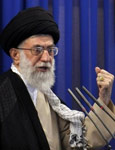
 AFP: Iran’s supreme leader Ayatollah Ali Khamenei said on Tuesday that flexibility was sometimes necessary in diplomacy as his negotiators prepared for new talks on his government’s controversial nuclear drive.
By Mohammad Davari
TEHRAN (AFP) — Iran’s supreme leader Ayatollah Ali Khamenei said on Tuesday that flexibility was sometimes necessary in diplomacy as his negotiators prepared for new talks on his government’s controversial nuclear drive.
Khamenei’s comments, reported by state television, came after Iran’s moderate new President Hassan Rowhani, who took office last month, said he would show flexibility in renewed talks with the major powers.
“Heroic flexibility is very useful and necessary sometimes but with adherence to one main condition,” Khamenei told members of the elite Revolutionary Guards.
“A wrestler sometimes shows flexibility for technical reasons. But he does not forget about his opponent nor about his main objective,” Khamenei said.
On September 11, Rowhani said he had the tacit support of Khamenei for “flexibility” in talks with six major powers that are expected to resume in the coming weeks.
Rowhani has said he wants to allay Western concerns but that he will not renounce Iran’s goal of an independent civil nuclear programme.
Foreign Minister Mohammad Javad Zarif was to fly to New York later on Tuesday to attend the United Nations General Assembly.
On the sidelines, he is scheduled to meet the European Union’s top diplomat, Catherine Ashton, who represents the powers in the decade-long talks.
Rowhani has vowed to take a more constructive approach to the talks than his hardline predecessor Mahmoud Ahmadinejad in a bid to win a relaxation of crippling Western sanctions imposed on Iran’s oil and banking sectors.
His approach has drawn a cautious welcome from Western governments which have long suspected that Iran’s nuclear programme is cover for a drive for a weapons capability, an ambition Tehran has always denied.
US President Barack Obama has refused to rule out a resort to military action to prevent Iran developing a weapons capability, a position echoed by its regional ally Israel.
Iran’s foreign ministry spokeswoman Marzieh Afkham on Tuesday strongly criticised Obama’s position.
“It is a source of regret that he still uses the language of threat after we told them to replace it with one of respect,” Afkham told reporters.
In an earlier statement, she said it was “unjustifiable” that the White House should “violate international rules and the UN charter to cater to the interests of lobbies by resorting to the military option.”
“The Obama government must understand that the use of the language of threats against the Islamic republic of Iran will not have the slightest effect on the determination of the government and the nation to defend their absolute nuclear rights, particularly on enriching uranium,” she said.
In an interview with ABC News on Sunday, Obama said that a deal between Washington and Moscow to dismantle the chemical arsenal of Iran ally Syria and avert Western military action offered a “lesson” in the benefits of diplomacy.
But the US president again warned Tehran over its nuclear programme.
“My suspicion is that the Iranians recognise they shouldn’t draw a lesson — that we haven’t struck (Syria) — to think we won’t strike Iran,” he said.
In the ABC interview, Obama also revealed that he and his Iranian counterpart had exchanged letters.
Afkham confirmed that an exchange of letters had taken place “through diplomatic channels,” without going into details.
Tehran and Washington have had no diplomatic relations since the aftermath of Iran’s 1979 Islamic revolution when US embassy staff were held hostage.


