


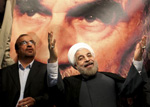
 Reuters: President Hassan Rouhani said on Sunday he wanted Iran to do a better job of explaining its nuclear program to prevent “evil-minded” people misleading world opinion, two days before Tehran resumes talks with world powers on its disputed atomic activity.
By Michelle Moghtader and Mehrdad Balali
DUBAI (Reuters) – President Hassan Rouhani said on Sunday he wanted Iran to do a better job of explaining its nuclear program to prevent “evil-minded” people misleading world opinion, two days before Tehran resumes talks with world powers on its disputed atomic activity.
Iran and the United States, France, Germany, Britain, China and Russia will reconvene in Vienna to try to iron out differences over how to end a long standoff over suspicions that Tehran has sought the means to develop nuclear weapons.
Western powers have long demanded greater openness from Iran to address those concerns and head off the risk of a downward spiral towards a new Middle East war, with Israel threatening to attack its arch-foe if diplomacy does not rein it in.
“What we can offer the world is greater transparency,” Rouhani, a relative moderate who replaced a conservative hardliner who antagonized the West – said in a speech at a ceremony celebrating Iran’s scientific achievements.
In his remarks, Rouhani reiterated that Iran was not seeking nuclear weapons and would never halt its atomic program, which was for peaceful purposes. He also repeated a denial of Western charges that Iran has carried out any secret nuclear bomb work.
But along with achieving scientific progress, Rouhani added, Iran ought to develop its abilities in the legal, political and information realms to prevent “the enemy” making problems for its nuclear developments.
“If one engages in a technological endeavor but is not doing good legal and political work, then the enemy might come up with a fictional excuse to cause trouble for you,” he said.
The Islamic Republic’s leaders normally use the term “the enemy” to refer to the United States and Israel.
“If you don’t have good public relations and are not able to communicate well, then you might find other evil-minded people misleading world public opinion,” Rouhani said.
“So our effort today is to even out our efforts on multiple levels … We don’t want to retreat one step from our pursuit of technology, but we want to take a step forward on the political front.”
His comments appeared to be a criticism of hostile statements from within the hardline conservative establishment, including his predecessor Mahmoud Ahmadinejad, who called U.N. resolutions against Iran on the nuclear dispute a “worthless piece of paper”.
“RIGHT DIRECTION”
Ahmadinejad’s strident rhetoric during his eight years in office on issues like the Holocaust and Israel served to shore up international resolve to curb Iran’s nuclear program.
Iran in January halted its most sensitive nuclear operations under a preliminary deal with world powers, winning some relief from painful economic sanctions that have damaged its oil-dependent economy by forcing a sharp reduction in crude exports.
Rouhani said Iran if it so chose could resume enrichment of uranium gas to a fissile purity of 20 percent – its most sensitive nuclear activity because it is a relatively short technical step away from the level required for nuclear weapons.
“We wanted to tell the world that our activities are moving in the right direction: If we say we can enrich to 3.5 percent, we can do it. If necessary we will do (it to) 20 percent,” he said.
Iran agreed under its November 24 deal to shelve enrichment to 20 percent. It has since diluted some of its 20 percent-enriched stockpile to a lower concentration and converted some into an oxide less suited to processing into bomb-grade material.
Iran has justified its 20 percent enrichment drive by saying it was meant to replenish the fuel supply of a Tehran medical research reactor. But Western officials are skeptical, saying Iran had refined far more than it required for such a purpose.
While Iran stopped 20 percent enrichment in January, it is allowed under the November pact to keep producing uranium refined to up to 5 percent, the level required for fuelling civilian nuclear power stations.
(Editing by William Maclean and Mark Heinrich)


