


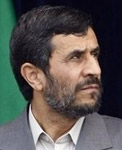
 Washington Post: President Ahmadinejad has a penchant for the somewhat loony, as when last weekend he denounced Paul the Octopus, omniscient predictor of eight consecutive World Cup matches, as a symbol of decadence and purveyor of “Western propaganda and superstition.”
The Washington Post
Op-Ed Columnist
By Charles Krauthammer
Friday, July 30, 2010; A21
“They [the United States and Israel] have decided to attack at least two countries in the region in the next three months.”
— Iranian President Mahmoud Ahmadinejad, July 26
President Ahmadinejad has a penchant for the somewhat loony, as when last weekend he denounced Paul the Octopus, omniscient predictor of eight consecutive World Cup matches, as a symbol of decadence and purveyor of “Western propaganda and superstition.”
But for all his clownishness, Ahmadinejad is nonetheless calculating and dangerous. What “two countries” was he talking about? They seem logically to be Lebanon and Syria. Hezbollah in Lebanon has armed itself with 50,000 rockets and made clear that it is in a position to start a war at any time. Fighting on this scale would immediately bring in Syria, which would in turn invite Iranian intervention in defense of its major Arab clients — and of the first Persian beachhead on the Mediterranean in 1,400 years.
The idea that Israel, let alone the United States, has the slightest interest in starting a war on Israel’s north is crazy. But claims about imminent attacks are serious business in that region. In May 1967, the Soviet Union falsely told its client, Egypt, that Israel was preparing to attack Syria. These rumors set off a train of events — the mobilization of Arab armies, the southern blockade of Israel, the hasty signing of an inter-Arab military pact — that led to the Six-Day War.
Ahmadinejad’s claim is not supported by a shred of evidence. So what is he up to?
It is a sign that he is under serious pressure. Passage of weak U.N. sanctions was followed by unilateral sanctions by the United States, Canada, Australia and the European Union. Already, reports Reuters, Iran is experiencing a sharp drop in gasoline imports as Lloyd’s of London and other players refuse to insure the ships delivering them.
Second, the Arab states are no longer just whispering their desire for the United States to militarily take out Iranian nuclear facilities. The United Arab Emirates’ ambassador to Washington said so openly at a conference three weeks ago.
Shortly before the 1991 Persian Gulf War, Pat Buchanan famously said that the “only two groups” that wanted the United States to forcibly liberate Kuwait were “the Israeli Defense Ministry and its amen corner in the United States.” That was a stupid charge, contradicted by the fact that George H.W. Bush went to war leading more than 30 nations, including the largest U.S.-led coalition of Arab states ever assembled.
Twenty years later, the libel returns in the form of the scurrilous suggestion that the only ones who want the United States to attack Iran’s nuclear facilities are Israel and its American supporters. The UAE ambassador is, as far as ascertainable, neither Israeli nor American nor Jewish. His publicly expressed desire for an attack on Iran’s nuclear facilities speaks for the intense Arab fear, approaching panic, of Iran’s nuclear program and the urgent hope that the United States will take it out.
Third, and perhaps even more troubling from Tehran’s point of view, are developments in the United States. Former NSA and CIA director Michael Hayden suggested on Sunday that over time, in his view, a military strike is looking increasingly favorable compared to the alternatives. Hayden is no Obama insider, but Time reports (“An Attack on Iran: Back on the Table,” July 15) that high administration officials are once again considering the military option. This may reflect a new sense of urgency or merely be a bluff to make Tehran more pliable. But in either case, it suggests that after 18 months of failed engagement, the administration is hardening its line.
The hardening is already having its effect. The Iranian regime is beginning to realize that even President Obama’s patience is limited — and that Iran may actually face a reckoning for its nuclear defiance.
All this pressure would be enough to rattle a regime already unsteady and shorn of domestic legitimacy. Hence Ahmadinejad’s otherwise inscrutable warning about an Israeli attack on two countries. (Said Defense Minister Ehud Barak to Fox News: “Who is the second one?”) It is a pointed reminder to the world of Iran’s capacity to trigger, through Hezbollah and Syria, a regional conflagration.
This is the kind of brinkmanship you get when leaders of a rogue regime are under growing pressure. The only hope to get them to reverse course is to relentlessly increase their feeling that, if they don’t, the Arab states, Israel, the Europeans and America will, one way or another, ensure that ruin is visited upon them.


