Home Blog Page 242

Iran Regime’s Clerics Fear Their Inevitable Overthrow

The danger of demise is greatly scaring the Iran regime’s top clerics, forcing them to confess about it in public, while putting the blame on years of corruption and looting that have brought the regime’s economy to the verge of collapse.

As such, they are desperate to forestall their inevitable overthrow. Ebrahim Raisi’s recent trips to China and Russia and agreements he has made with both countries, seem to be a last-ditch effort to save themselves. What the regime will be gaining from those agreements remains a mystery, however.

Regarding the nuclear talks in Vienna, the outcome remains unclear. Even a positive result will not solve the regime’s problems. The state-run daily Mardom Salari admitted as much in a recent commentary.

“Of course, to say that all the problems will be solved with the JCPOA will not be the case. The problems are so great that the JCPOA, at best, can only provide normal conditions for economic exchanges. Of course, in the current context, due to some issues, the lifting of sanctions alone may not be the solution. In a situation where Iran has not yet adopted the FATF regulations, even if the JCPOA is revived, these issues remain and need further action,” it wrote.

It added, “But the fact is that the shadow of the pressures and problems of the past years will continue to weigh on the people in the coming year. The overall revival of the JCPOA will reduce the pressures, but it is not a realistic idea that cost of living will be lowered and that the purchasing power of the people will increase as inflation rate declines.”

A senior cleric Abdollah Javadi Amoli pointed to the source of the pressures and problems faced by the Iranian people in a discussion with the head of the regime’s Central Bank.

He said, “Sometimes economic problems cause even a big government to fall. The Central Bank has a very serious task, including shielding the Central Bank reserves from legislators who circumvent the law. The embezzlement of billions is not created by ordinary people. They are done by the pen of individuals, not by force of arms. Therefore, embezzlements that have taken place should be examined to find out how they took place in the first place.”

He later expressed his fear about the army of starving people: “Wealth is the cause of a nation’s uprising. If a nation wants to stand, its pocket must be full, poor does not mean weak! Rather, he is the one whose spine is broken, the one whose spine is broken does not listen to the government.”

Hossein Nouri Hamedani, another senior cleric, pointed out the value of the national currency, comparing it with other countries. “The value of our national currency is low compared to many countries, we have to fix the problems in this area. Once you could buy a house for 300,000 rials, but now they do not give a kilo of fruit for that amount,” he said.

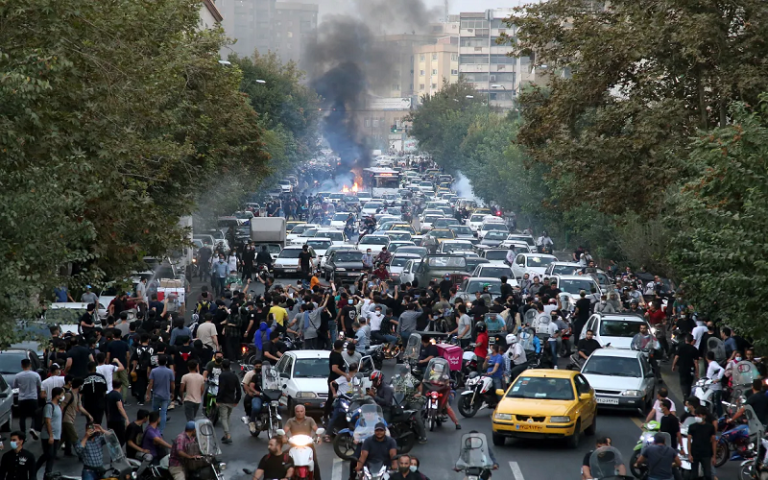
What Javadi Amoli and Nouri Hamedani have warned about is a handful of many examples of the country’s economic situation and the living conditions of Iranian people, who are falling below the poverty line every day due to the destructive policies of the Iranian regime. This has subsequently led the regime to become the target of protests, as the Iranian people fight back to claim their most basic rights.

In response, regime officials are struggling to contain the brewing social explosion. With no solutions to offer to remedy the problems within Iranian society, all they can do is show their fear of the prospect of being overthrown and warn others about it.

Iran’s Regime Playing With Fire

Trapped in the nuclear talks, which are teetering on the verge of collapse, the Iranian regime has launched a drone attack on its Middle Eastern neighbors, similar to the drone attack it launched on Saudi Arabia’s oil facilities in September 2019.

This time, the regime launched an attack on Abu Dhabi’s airport in the UAE, with assistance from their Yemeni proxy group, the Houthis. This is just the latest attack among many that have been destabilizing the region for many years.

The regime plunders the wealth of the Iranian people in a bid to continue spreading terrorism across the globe, in a bid to fuel the flames of wars in the Middle East. Aimed at engaging the international community and the region, these crises serve as an insurance policy for the regime. This is despite the regime’s claims about new and expanding relations with the ‘East’ which in and of itself is proof of its international isolation and weakness even if it succeeds to secure a favorable outcome during the nuclear talks in Vienna.

As for the latest attack, the state-run Vatan-e Emrooz daily wrote on January 20, “What the Emiratis did not imagine finally happened. The nightmare of instability and insecurity has finally cast a shadow over the center of Wall Street in the Arab world. Henceforth, the Yemeni war has acquired different characteristics and must be approached from new angles.”

The same day, the Donya-e Eghtesad daily highlighted, “The Yemeni crisis is the main and key element in Iran-Saudi relations in the Middle East regional equation, especially in the current situation. Any opening or impasse in it will play a very important role in reconciliation or tension between the two countries. As the crisis hotspots in relations between the two countries, especially Syria and Bahrain, have largely waned, Yemen still has the potential to keep the Iran-Saudi relationship tensions active.”

The regime’s officials, and supreme leader Ali Khamenei, believe that by carrying out such actions, they will be able to garner more concessions from Saudi Arabia and keep them away from joining the nuclear negotiations actively and adding their own demands, such as the regime’s commitment to stop its destructive behavior in the Arab World. However, given the regime’s already weak position, it is likely that these latest acts of aggression will have an opposite effect.

On January 19, the Noandish daily warned Khamenei’s mouthpiece, Kayhan daily regarding the consequences of the regime’s terrorist attack on Abu Dhabi. “The happiness of friends in Kayhan about such attacks is quite understandable because they are generally not interested in improving Iran’s relations with other countries from Saudi Arabia and the UAE to Europe and the United States. Nevertheless, escalating tension now is the last thing that the country needs.”

This warning is a stark message to the regime that it is high time it stops blackmailing other countries with terrorism, missile, and drone attacks.

The Noandish daily further stated, “At a time when Vienna’s talks to revive the JCPOA, and talks with the Saudis to resume diplomatic relations, have reached a critical juncture, the recent Houthi attack on Abu Dhabi could complicate the equation and act as a double-edged sword. While this attack may strengthen Iran’s position, it might very well disrupt the talks.”

Iran and Hezbollah Face Blame for Dual Financial Crises

The United States Treasury Department announced on Friday, January 21, that it would be enforcing sanctions on three Lebanese individuals and ten companies, based on accusations that they had contributed to terrorist financing on behalf of the Iranian regime. The new sanctions reflect longstanding recognition of the outsized role that Lebanon’s Shiite militant organization, Hezbollah, plays in the Iranian terror network. The intricacy and longevity of that relationship have led to numerous reports of Tehran using Hezbollah as a model for the development of proxy groups elsewhere in the region.

However, that relationship is now being challenged by the simultaneous financial pressures affecting Lebanon and Iran. The announcement of new sanctions on Hezbollah assets specifically addresses Lebanon’s severe financial crisis and accuses the Iran-backed militant group of ignoring the domestic population’s suffering to continue “misuse of the international financial system to raise and launder funds for its destabilizing activities.”

The crisis in question is reportedly the worst Lebanon has faced since its civil war concluded in 1990 after 15 years of fighting. While the country’s national currency lost 90 percent of its value, the poverty rate skyrocketed from 42 percent to 82 percent between 2019 and 2021. Meanwhile, Lebanon saw a decline in the charitable services that Hezbollah has traditionally offered to buy the domestic population’s acquiescence to its more militant activities.

Traditionally, that public relations effort has been financed in large part by the Iranian regime, so one might assume that the reduction in Hezbollah services is at least partly attributable to Iran’s financial crisis, which has been more gradual but has resulted in similar spikes in poverty and unemployment, accompanied by similar declines in the value of the national currency. However, experts such as Hisham Jaber, head of the Middle East Center for Studies and Public Relations, note that the Islamic Republic continues to pay approximately 500 million dollars to Hezbollah per year.

Many of those same experts conclude that this sum’s failure to alleviate the crisis is explainable in terms of its misappropriation. In this sense, they have levied the same accusations as the US Treasury Department has levied against the Iranian regime and Hezbollah. Furthermore, growing numbers of Lebanese people appear to be joining in the effort to assign blame to Tehran for their own economic and social difficulties.

Popular unrest is on the rise in Lebanon, with many activists taking explicit aim at the Islamic Republic and accusing it of a hostile “occupation” that has turned their country into a staging ground for the Iran regime’s pursuit of its interests. More than 200 Lebanese political figures came together last week to form the National Council to Lift the Iranian Occupation of Lebanon.

In its first public statements, the council emphasized that Hezbollah was an agent of that occupation. Foreign Minister and council leader Ahmad Fatfat told reports that the situation being faced by Lebanese people was “occupation by proxy.” He went on to explain: “Even if Iran does not have boots on the ground, Hezbollah exists with 150,000 missiles and 100,000 fighters threatening the country from inside.”

The further problem with that situation is that the missiles and fighters in question are not committed to Lebanon’s self-defense, much less to the welfare of ordinary people living in that country, but instead act as a paramilitary proxy for Tehran in conflicts with Israel, Syrian rebels, and others. Hezbollah played a major role in the fight against ISIL and against moderate opposition groups during Syria’s nearly decade-long civil war, and the Lebanese group’s resources were naturally drained by the severity of that conflict.

Ongoing protests in Lebanon reflect continued awareness of these effects, as evidenced by one 60-year-old female activist’s recent remarks to international media. “Why are we engaging in wars in Syria and Yemen while we are dying of hunger?” she asked, referencing not only Iranian support of the Syrian dictator Bashar al-Assad but also Iranian backing of the Shiite militant group that has been fighting for dominance of Yemen since driving out the country’s internationally-recognized government in 2014.

Such questions are starkly reminiscent of slogans that have become increasingly commonplace inside Iran itself during recent years. That country was rocked by a nationwide uprising in January 2018 and by another, even larger uprising in November 2019. In both and also in numerous other protests, Iranian citizens were heard to chant “forget about Syria; think of us,” to highlight the regime’s misplaced priorities and neglect of a worsening economic crisis at home.

Now, with the formation of the National Council to Lift the Iranian Occupation, it appears that Lebanese citizens are increasingly aware of those same misplaced priorities. Thus, the opportunity exists for activists in both countries to work together toward mitigating the impact of Tehran’s regional ambitions on both of their populations.

Iran – Conflicting State Policies Deepen Social Crises

The Iranian regime has decided to spend about $800 million to encourage more childbirths in 2022 in an attempt to grow the population. This is while the regime refuses to provide funding to resolve more fundamental crises, like access to water, and while most Iranians are now living below the poverty line.

Over the past few years, the regime’s supreme leader Ali Khamenei has repeatedly expressed the theocracy’s desire to increase the number of marriages as well as the fertility rate.

Regime officials are now trying to boost funding for the implementation of those objectives. Demographics in Iran are shifting toward a more aging population and as many of the regime’s officials have admitted, if the current trend continues unabated, in the coming decades the country will face a critical situation in terms of population growth.

Despite this trend, the regime’s proposed solutions are disastrous and counterproductive, particularly if fundamental economic problems, which are the root cause of many social ills, remain unaddressed. What is worse, regime officials attribute lower marriage and fertility rates to youth being influenced by “Western culture,” reinforcing the view that Tehran’s mullahs are deflecting blame and politicizing the problem rather than relying on technical expertise to solve it.

The State-run daily Salam-e No, wrote on January 11, 2022, “More than half of Iran’s working-age population is not economically active. Data from the Statistics Center of Iran show that the rate of economic participation of the female population aged 15 and above in the fall of 2021 decreased by one percent compared to last year’s comparable time. That is, 241,931 women have left the labor market.”

What remains unsaid is that following the disastrous eight-year war against Iraq, which the regime needlessly continued for years, the mullahs’ supreme leader actively discouraged population growth. Years later, however, Khamenei has made a dramatic volte-face, deciding to boost population growth while more than 70 percent of people’s daily expenses are dependent on state subsidies.

Over the last four decades, Iran’s population has more than doubled. The 1980s can be considered as the decade of a population boom in Iran. In the last decade, however, primarily due to rampant inflation (Iran’s inflation rate ranks sixth in the world), an increasing number of young couples have decided not to have kids and many families simply cannot afford to have more than one child.

Iran sits atop some of the world’s richest natural resources and has an educated and talented labor force that has been woefully denied economic opportunities. Now, a worsening economy that has been ruined by the regime’s mismanagement and rampant corruption has led to major demographic shifts. Many adults are simply financially unable to raise kids, considering themselves to be lucky enough to feed themselves.

One state-run newspaper wrote recently: “Unemployment statistics in the country show an increase in the population of ‘hopeless youth’ who, according to sociologists, have been at the center of protests in recent years. Young people are inevitably gripped by the pressures of the Iranian economy.” Indeed, the frequency and scope of social protests in Iran have increased exponentially, with the country experiencing eight rounds of unprecedented nationwide uprisings in the past four years alone.

The paper continued: “Even though the number of young people working as street vendors in subway stations or on the streets is increasing every day, the latest Statistics Center of Iran report pegged the unemployment rate at 8.9 percent, which is much lower than in previous years. According to recent data from the Statistics Center of Iran; ‘The unemployment rate for the age group between 19 to 24 indicates that 23.6 percent of people in this age group were unemployed in the fall of 2021.’” (State-run daily Eghtesad-24, January 9, 2022)

The Iranian society is still very much a society that functions on the premise of the nuclear family. But an increasing number of young Iranians are denied access to sources of national income, and thereby robbed of a decent future. Instead of establishing the economic preconditions for young families to grow and prosper, the regime diverts national wealth into shoring up destructive activities that are meant to preserve its weakening hold on power.

While state authorities continue to embezzle billions of dollars, next year the regime is expected to increase taxes by 60 percent while most salaries will not even keep pace with inflation. Yet at the same time, Khamenei is pushing young Iranians struggling to make ends meet to have more children.

The regime’s proposed solutions to crises breed even more crises. Young Iranians are increasingly alive to the fact that this disastrous situation will not change unless and until the entire theocracy is replaced by a secular democratically-elected republic that has the ability and the will to resolve festering economic, political, and social calamities in a responsible and sustainable manner.

NCRI Hosts Conference in France To Address the Need To Hold the Iranian Regime Accountable for Its Crimes

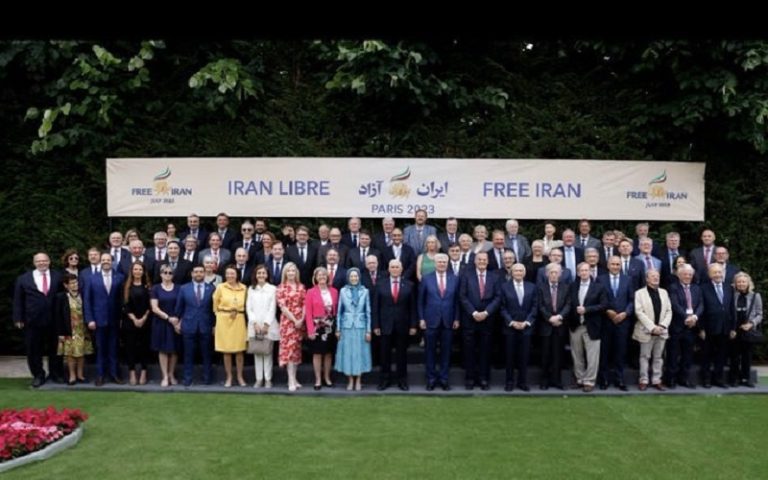
On January 17, the National Council of Resistance of Iran (NCRI) hosted a conference in Auvers-sur-Oise, north of Paris, entitled “Holding the Mullahs’ Regime Accountable for Genocide, Terrorism, and Nuclear Defiance.

The NCRI’s President-elect, Maryam Rajavi, and several senior former European officials attended and addressed the conference.

Mrs. Rajavi began her address touching on the crises that Iranian citizens are currently facing, as regards their livelihoods, welfare, health, education, employment, and housing. She explained how the Iranian regime is refusing to improve conditions for the Iranian people, further stirring up the discontent within society, while the regime’s Supreme Leader, Ali Khamenei, is more focused on reinforcing his security forces to deal with the unrest, and cling onto his draining power in a regime that is on the verge of being overthrown.

She said, “There is an openly hostile relation between the ruling regime and our people. The existence of an organized and widespread resistance against the regime attests to this truth,” adding, “Western governments have long paid the price of appeasing the religious fascism from the pockets of the Iranian people. But now, beyond the interests of the people of Iran and the Middle East, the security and vital interests of Western countries and societies are at stake.”

The future of Iran is ultimately to be determined by the Iranian people and their Resistance unit network across the country. Resistance groups carry out daily activities against the regime’s repressive forces, standing shoulder to shoulder with the people fighting for their rights.

“As a result, the existence of an alternative is of crucial importance. But such an alternative is not just a theoretical solution. Rather, it must rely on a movement that has risen up against the fountainhead of fundamentalism, paid the price of its struggle, and enjoys the capacity to bring about change in society,” Mrs. Rajavi emphasized.

The NCRI President-elect stressed that the international community must reinstate the six UN Security Council resolutions on the regime’s nuclear projects because that would bring the regime’s uranium enrichment program to a close, and finally shut down their nuclear sites.” She also underlined that the brutal violation of human rights in Iran be placed high on the UN Security Council’s agenda, reiterating that “The regime’s leaders must be brought to justice for four decades of crimes against humanity and genocide, especially the massacre of 30,000 political prisoners in 1988, and the killing of at least 1,500 protesters in 2019. I urge all governments and parliaments, especially in Europe, to recognize the 1988 massacre as a crime against humanity and genocide.”

In Monday’s conference, Mr. Guy Verhofstadt, MEP, and Former Prime Minister of Belgium referred to the systematic impunity in this regime and remembered the obligation of the Western countries to confront the regime and said:

“We must discuss the systematic impunity of the regime of Iran. It’s our common duty to denounce violations of democracy and human rights. It is our duty to stand up for democracy and fundamental freedoms.

“The regime’s answer to the people’s demands is to strike them instead of solving their problems. The impunity crisis in Iran reached a peak in June when Raisi was appointed as the regime’s president. He is one of the main perpetrators of the 1988 mass murder of more than 30,000 political prisoners. Instead of being tried for crimes against humanity, he is occupying the post of presidency. This shows that impunity is rampant in Iran.”

As for the regime’s illegitimacy Mr. Fredrik Reinfeldt, former Prime Minister of Sweden, said: “It’s very popular nowadays for rulers to say they were elected. Democracy means freedom of speech, media, the right to assemble and campaign, to stand as a candidate. If you don’t follow these rules, you are not a democracy. Raisi is not in support of the Iranian people. He was chosen among a few men to keep control.

“The situation in Iran is especially worrying. There is a very dangerous combination. It brings together authoritarianism and religious dictatorship.”

John Bercow, the former Speaker of the British House of Commons referred to the Iran nuclear talks currently underway in Vienna and said:

“The nuclear issue is being focused on to a certain degree. Democracies must recognize that there is a key difference between dealing with other democracies and dealing with other countries whose regimes are non-democracies. The regime is spending vast sums of money on weapons of mass destruction that they do not need and should not be allowed to obtain.”

And Franco Frattini the former Foreign Minister of Italy, pointed to the regime’s and its lobbies’ insistence on, and in the Western countries to lift the sanction while making the excuse that these are hurting the people.

“Another argument is that we must lift sanctions because the sanctions are affecting innocent people. This is absolutely not true. As a matter of fact, the more money they have the more money the regime will spend on its nuclear program and not on improving the quality of life in Iran. I support the idea of a stricter policy toward the regime regarding sanctions. No complacency. We have to know every dollar spent for improving and strengthening the nuclear and military apparatus against the people, increasing the nuclear capacity to intimidate and dominate not only the people of Iran but also the region against the countries of the Middle East, and contributing greatly to destabilizing the Middle East,” he said.

Iran’s Regime Tries To Whitewash Its Crimes

Iran’s State Prisons and Security and Corrective Measures Organization, which is under the supervision of the Judiciary, has distributed a new guideline to all sectors under its control. This new order claims that according to new laws all the prisons are obligated to observe and consider the rights of the prisoners.

This directive has prohibited “all kinds of psychological and physical persecution of the prisoners and detained defendants.”

This directive, which was publicized by the media center of the Judiciary, emphasized that actions like taking fingerprints from the prisoners or naked inspections must be restricted to special cases, while seriously sick and injured prisoners should not be accepted at the prisons.

It added that the defendants should have access to a phone and have the right to call their families and lawyers within 48 hours of their detention.

Youths must also be separated from adult prisoners, and insulting prisoners or the use of handcuffs inside the prison is prohibited unless some special cases warrant them.

There is no doubt that the decision to issue the directive was a response to the massive pressure on the Iranian regime because of its human rights violations. This assessment is particularly reinforced as news of the death of some of the prisoners due to torture and mistreatment by prison officials, or the lack of treatment for sick prisoners continues to leak.

Iran’s prisons are scenes of systematic abuse, torture, executions, insults, humiliation, and rape on a daily basis.

A review of the events leading to the deaths of some prisoners in less than a year illustrates the appalling reality of Iranian prisons:

February 16, 2021: Behnam Mahjoubi; a Darvish prisoner arrested after the Golestan protests, died in prison. He could not cope with imprisonment due to his illness but was arrested and imprisoned regardless. On February 13, 2021, he was taken to hospital for the second time after falling into a coma due to drug poisoning in prison, and the news of his death was confirmed on February 21, 2021.

Behnam Mahjoubi had been sentenced to two years by Branch 26 of the Revolutionary Court of Tehran. Mahjoubi had said in an audio file from prison in November 2020, ‘I am convinced that the security agents intend to kill me.’

June 7, 2021: Sasan Nik Nafs; A political prisoner in the Greater Tehran Prison in Fashafoyeh, Nik Nafs died after he was transferred to the Greater Tehran Prison Medical Center due to his deteriorating health condition and negligence by the authorities.

September 2, 2021: Hadi Atazadeh; This prisoner died in the city of Ahar after being flogged. Regime’s officials denied the reports.

September 20, 2021, Shahin Naseri; He exposed the torture of wrestling champion Navid Afkari and was killed in his cell. His death was first made public by his imprisoned friends. Regime’s officials were later forced to admit it.

September 23, 2021, Amir Hossein Hatami; This prisoner from Ilam was killed in the Greater Tehran Prison as a result of beatings and torture by the regime’s prison officers. This 22-year-old prisoner was a resident of Sirvan in Ilam province. Following his death, his family and friends staged a large protest.

January 1, 2022, Adel Kianpour; The political prisoner died in Sheiban Prison in Ahvaz after a week of hunger strike without receiving medical treatment, in protest of being deprived of the right to a fair trial.

January 8, 2022, Baktash Abtin; An Iranian poet and filmmaker and a member of the Writers’ Association of Iran, died in Evin Prison due to lack of timely treatment and hospitalization.

January 10, 2022, Omid Mousavi; A detainee who was shot during the November 2019 protests and was later arrested and tortured for a long time. He was imprisoned for 15 months in the Greater Tehran Prison. Omid died of a heart attack at the age of 27.

We also should not forget that in recent months, a video was released from Evin Prison showing the mistreatment and beating of prisoners.

Following the release of the disturbing video footage, 28 political prisoners in Greater Tehran Prison issued a joint statement saying that “what is shown in these films in the form of torture, humiliation, and naked and physical harassment is only part of the visible reality of torture against prisoners and their families in Iran. But other forms of torture are not recorded by any cameras.”

This directive also emphasized that “Defendants of political and press crimes, defendants of financial (legal) crimes and persons under the age of eighteen, are not required to wear uniforms in prison.” It also set the maximum days of solitary confinement to between 10 and 15 days.

But the reality in Iran’s prisons is something else. According to a report published on October 23, 2021, by Kurdistan Human Rights Network, Kurdish political activists in IRGC-affiliated prisons have routinely faced torture such as attaching weights to their testicles, hanging from the ceiling for long hours, artificial executions, and threats of rape against their spouses and other family members.

This directive is like regime founder Khomeini’s 8-article decree in 1982, which was carried out after the execution of thousands of political prisoners and brutal killings on the streets.

In that order, Khomeini apparently restrained some of the brutal behavior of his Revolutionary Guards. But the 8-article decree exempted political prisoners and the Mujahedin-e Khalq (MEK). This means that taking the lives and properties of the MEK were deemed entirely permissible by the regime.

Iran: Raisi’s Six-Month Economic Record Contrasts Sharply With His 7,000-Page Program

In the summer of 2021, the Iran regime’s supreme leader Ali Khamenei installed the infamous Judiciary Chief Ebrahim Raisi as the president. During his election campaign, Raisi claimed that he and his incoming economic team have prepared a 7,000-page economic program and that if carried out, the people and the country would witness a boom.

Now more than 180 days later, the question remains: What happened to the 7,000-page economic program, and, for that matter, the economic boom Raisi had boasted about?

Now that Raisi has been in office for six months, the economy is still plagued with many a plethora of economic problems and astronomical corruption.

Practically speaking, what has become obvious is that Khamenei and his handpicked president do not care about the country’s economy. Instead, they are only interested in filling the coffers of their cronies and agents by stealing from the country’s wealth.

After much wrangling over the 42,000 rials preferential currency used by the regime’s officials and brokers for the import of the country’s basic and important goods at a convenient price, the Parliament finally approved its elimination. This will only lead to a spike in the price of food stuff.

The import of basic goods so far was $11 billion with the 42,000 rial currency, but revenue of less than $1.8 billion has entered the country’s treasury.

If goods were to be imported at the open market rate, some $10 billion would go to the treasury, a significant difference in revenue that will end up in the pockets of the regime’s officials.

Is the government’s business performance clean and transparent? Is it governed by any regulations at all? Does the government have any control over all the entry and exit points of commodities? Or on the customs and the country’s ports which are under the control of the regime’s Revolutionary Guards (IRGC)?

In this regard, a report published by the regime’s Parliamentary Research Center said:

“Since 2013, statistics related to the reports of the Central Headquarters for Combating Smuggling show that in the lowest case, the total amount of incoming and outgoing smuggling (including reverse smuggling) was more than $12 billion, which is a significant figure compared to the country’s official trade figures. Goods include clothing, footwear, cigarettes, home appliances, cosmetics.” (State-run daily Arman, January 1, 2022)

News about the country’s economic crisis is leaking from all corners of the government’s institutions and their statistics. One of them is the so-called “lofty” index which is an indicator of the consumption power of the managers and owners of manufacturing enterprises.

The scale of this index is between 0 and 100. And any number above 50 shows the prosperity of the manufacturing enterprises and vice versa.

Now, this index has reached its lowest rate in the past four months.

“This lower ‘lofty’ index for the past four months reflects growing concerns of the private sector entrepreneurs and business owners.

“Surveys of economic actors show that the continued recession and volatility of foreign exchange market prices and declining purchasing power have negatively affected the positive expectations of economic actors and that companies have faced a lack of liquidity and reduced orders due to declining customer purchasing power.

“Also, the main reason for the decline in the overall index in December was due to the recession in the construction, services, and agriculture sectors,” the State-run daily Tejarat, wrote on January 5, 2022.

The report emphasizes that procurement managers are facing severe disruptions in currency price stability and other production costs and are unable to forecast and plan for the coming months and cannot make any planning to continue operations in the coming months.

State economists also warn that the economy has returned to a period of recession, seeing the “lofty” index and performance of foreign trade and the situation of smuggling and rent-seeking of billions of dollars.

Iran’s Export in the Casino of the State Mafia

0

The Chairman of the Tehran Chamber of Commerce, Mohammad Khansari, has stated that the total volume of exports of technical and engineering products has dropped from $6 billion to $200 million over the past few years alone.

In a healthy economy, such exports replenish the currency reserves and create a currency balance for the country. That is why states try hard to balance their foreign trade by strengthening exports over imports.

As an example, China in a very rare policy is trying to keep the value of its national currency low, to be able to increase its exports.

The Iranian economy, however, is mired in state corruption and rampant mismanagement. When the clerical regime obtained a windfall of cash because of the 2015 nuclear deal, it spent the bulk of it for its malign and destructive activities while a substantial portion was embezzled by corrupt officials.

In the end, none of the money was allocated to improve a lot of average citizens. Now, the treasury is empty, and the results of sanctions have been compounded by such abhorrent mismanagement and embezzlement, with the gap between rich and poor widening to unprecedented levels.

Even before the sanctions, the regime did not have much to offer to the people, and the main export of the country was oil, along with some other basic commodities primarily to neighboring countries.

Criticizing the foreign exchange rate policies of regime President Ebrahim Raisi’s administration, Khansari stated that the Turkish government had previously faced a 20 percent inflation but had managed to increase its exports to $220 billion, while on the other hand, the Iranian regime is restricting exports.

This is happening at a time where the regime is amid wrestling with crises like a rapidly growing budget deficit, rampant inflation, severe devaluation of the national currency, and extensive poverty.

Another significant problem in the country’s economy is the unfair distribution of wealth. This has effectively denied the chance for many people, and independent businesses, to contribute to the country’s exports.

What little export opportunities in Iran have remained are controlled by the Islamic Revolutionary Guard Corps (IRGC) and companies affiliated with the regime supreme leader’s office.

These are institutions that have caused significant capital exodus by investing their acquired capital in enterprises abroad. As a result, a ballooning budget deficit is seriously threatening the regime’s already depleted treasury.

Khansari added, “In the last 40 years, we have always had a budget deficit, which is one of the most important factors in the country’s economy, meaning that income has been less than expenses. If this happens to a company or a household, the company will go bankrupt and the household will become homeless, but governments are using the resources and people will become poorer day by day.”

He further stated, “The budget deficit means that we want to cover the deficit by printing money, which means raising the general level of prices and plundering people’s pockets. When the government has no currency, they print money, which increases inflation. When it has currency, it starts to ‘spread money’ (unlimited currency supply), which leads to hyperinflation.”

Will Iraq Get Ever Free of Iran’s Sway?

0

After many years and massive popular protests, there are indications that Iraq’s body politic has decided to separate its ways from the mullahs’ regime of Iran.

In the fifth election after the invasion of Iraq by the international coalition, the Iran regime’s proxy forces and its affiliated political groupings lost the power game. Cleric Muqtada al-Sadr’s faction secured the most seats in the parliament and is expected to form the next government in coalition with others, not under Tehran’s complete influence.

Pro-Iran political factions suffered a crushing defeat despite the full weight of the mullahs’ political and financial backing.

Furious over their rejection by the people of Iraq, the pro-Tehran factions resorted to terrorism and violence, even targeting the home of the country’s Prime Minister Mustafa Al-Kadhimi with suicide drones, but to no avail.

The Fatah Alliance and other Iran proxy factions managed to win only 17 seats in the parliament. The same group, part of the Popular Mobilization Forces (PMF), held 47 seats in the previous Iraqi parliament.

Al-Halbousi, a member of the Sunni coalition, was elected as the speaker of the Iraqi parliament, albeit with considerable delay, to prepare the groundwork for the appointment of a Kurdish president and a prime minister acceptable to the Sadr group.

The Sadr faction, which claims to oppose foreign intervention in Iraq, is reported to be considering reaching out to the United States and its NATO allies, de-escalating tensions with the Arab League, and the Gulf Cooperation Council, and perhaps preparing the ground for the signing of the Abraham Accords.

The fact is that after the fall of the former government in Iraq and for nearly two decades, Iraq became the roaming grounds for the clerical regime and its proxy forces and militias, which had disastrous consequences for the people of that country. The Iranian regime’s meddling reached its climax with the election of Nouri Al-Maliki as the Prime Minister, who, as a puppet of Tehran, carried out the mullahs’ policies in that country.

Fed up with continuing Iranian meddling in their country, the people of Iraq rejected the pro-Tehran factions to rid their country of the grip of the mullahs.

Iran: The Truth Behind Regime’s Call for a Return

While brain drain and migration from Iran under the mullahs’ rule has one of the highest rates in the world, Ebrahim Raisi’s government is insisting on the return of the expatriate Iranians, deceptively claiming that they should not have any concerns about being persecuted.

The regime is trying to lure the exiled Iranians back to Iran by asserting that they will have “fully ensured security”, “facilities needed to return”, and a “return without any problem.”

However, dissidents say the notorious Intelligence Ministry (MOIS) and the Revolutionary Guards (IRGC) are poised to snatch them at the airports when they approach the security checkpoints, according to dissidents.

The parliament’s official website ICANA, stated on March 20, 2020, that the latest report of the Parliamentary Research Center and another report by a former Deputy Minister of Education Baqer Larijani, say Iran ranked second in brain drain and some 150,000 to 180,000 educated specialists leave the country annually.

The regime’s Foreign Minister Hossein Amirabdollahian promised, “Their return will be no problem and has been coordinated with the security authorities.”

The state-run website Rouydad 24 admitted in a report on January 5, 2022, that the interrogation of passengers at airports is carried out in coordination with the MOIS and the Foreign Ministry.

“It has obtained information from some Iranian passengers that show that several passengers were taken to rooms by security officers with wireless (Walkie-Talkie) to fill out a form about their personal information,” Rouydad 24 wrote.

Recounting the plight of two Iranians in the Netherlands and Germany, Rouydad 24added that “since a few months ago” interrogations are carried out at Tehran Airport.

The report added: “According to an Iranian traveler living in the Netherlands, right after checking his passport and seal of arrival, a person with a wireless device led him and his wife to a room near the passport control office and asked them to fill out a form.

“This form asks for information such as name, address, place of residence, education, job, income, and date of arrival and departure.

This traveler added: “In addition to him, about 10 other passengers were in the room-filling out their declaration [interrogation] forms.”

Rouydad 24 reported that its investigation had concluded that “not only dual nationals or refugees were the target of these self-reported forms [interrogation], and but also foreign nationals are questioned.”

The Foreign Ministry’s consular section launched a ‘traffic inquiry system’ on the ‘Integrated Consular Services Management’ website on Wednesday, December 29, 2021, and according to Amirabdollahian, “Iranians abroad can find out whether or not they can leave the country after arrival by providing minimal information about themselves.”

The question is what objectives are the regime is pursuing by calling for the return of the Iranians?

Call to return in the service of looting

The budget deficit of more than $11 billion in 2022, according to Tasnim news agency, on January 10, 2020(higher according to some regime officials), lays bare the economic bankruptcy of the regime, forcing it to make up for part of its budget deficit with the capital of Iranians abroad.

Iran’s parliament speaker Mohammad Bahger Ghalibaf stated: “The inability to use the assets of Iranian diaspora would be a sign of our ineptitude.”

A spokesperson for the Judiciary added: “Iran is the best place for Iranians to invest.”

The state-run Mostaghel daily on December 28, 2021, confessed to the regime’s deception.  “Experience has shown that the main purpose of returning Iranians is essentially the return of their funds. In these years, due to sanctions, very low foreign investment and increased capital evasion, the capital of Iranians abroad has always been a seductive issue to provide a portion of the country’s economic costs,” it wrote, adding, “Of course, if their (government) intention to return Iranians is serious, the most obvious measure is to try to keep them in the country and motivate them not to migrate.”

Beware the “Mikhak System” an MOIS App

The Mikhak System like any other website or application created in Iran, first and foremost, serves MOIS. Therefore, using or subscribing to such Apps entails great risks.

In remarks to the State-run daily Iran Press, December 27, 2021, regime Foreign Minister Abollahian admitted as much: “Some Iranians who have not traveled to the country for many years are concerned. Since 8:00 a.m. (Wednesday) we have placed an environment in the State Department’s the ‘Mikhak System’ as a ‘traffic inquiry ‘ where Iranians abroad can ask us without divulging any information, whether or not they can leave the country easily after entering Iran.”

He added, “And we’ll respond to them within 10 days, and the foreign ministry ensures that Iranians can easily travel to their homeland.”

Adel Kianpour a latest bitter example  

Political prisoner Adel Kianpour, imprisoned since July 2020, died suspiciously on January 1, 2022, after being infected with the Coronavirus following a week of hunger strike in the Sheiban prison in Ahvaz.

Kianpour was sentenced to three years by a court in Ahvaz on charges of propaganda against the regime and benefitting opposition groups and disturbing public opinion.

In a voice message, addressing the regime’s Judiciary Chief Gholam-Hossein Mohseni-Ejei, he said, “Mr. Ejei, you said that everyone who has a security problem and is abroad can come back, and we help them get back to a normal life. By life, you mean life in prison?”

After returning to Iran, Kianpour was immediately arrested, tortured for two months forced, to make incriminating confessions, and was deprived of his right to an attorney and visitation for five months.

The last word

In a report on December 28, 2021, the state-run daily Mostaghel unmasked the regime’s latest ploy, “When nepotism is the main factor for promotion in the executive branch, is there any need for domestic elites and the return of the people aboard? Finally, Mr. Foreign Minister when you say that people can return and they will be harassed, this in and of itself is inaccurate. Are you and all your actions correct, and are all the other offenders? This sounds like you are being gracious by looking the other way as regards any mistakes they may have committed (while in exile).” now you decided to close your eyes on all their mistakes with generosity?”