


By Jubin Katiraie
Workers at Qeshm Heavy Oil Refineries, Abadan Refinery, Parsian Refinery, Lamerd Petrochemical, among others, went on strike.
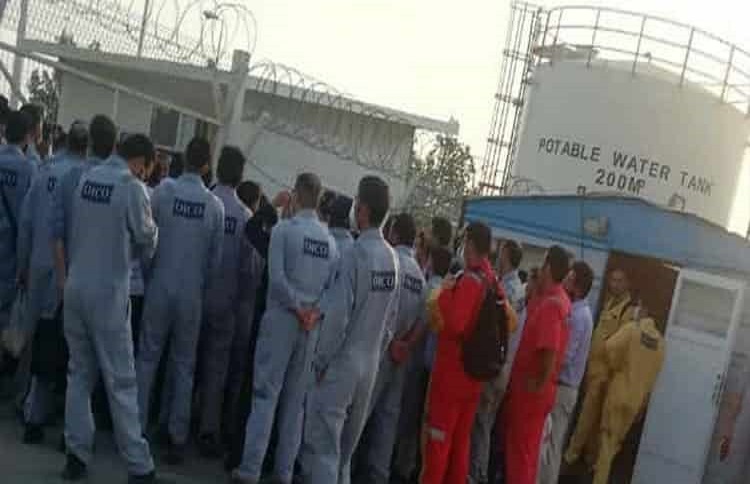
On 1 August 2020, workers at several major refineries, including the Qeshm Heavy Oil Refinery, the Abadan Refinery, the Parsian Refinery, and Lamerd Petrochemical, went on strike in protest to non-payment of their salaries and benefits.
Due to the failure of the government to make financial settlements with contracting companies, these companies are facing a liquidity crisis and are unable to pay workers’ salaries.
The workers’ protest and strike are against the non-payment of months of salaries and job benefits. Workers at the Exir and Scaf contracting companies at the Abadan refinery are in a dire situation due to back pays.
In the past, the workers have repeatedly staged protests in recent months over layoffs, arrears of wages and job benefits, but the government’s disregard for the workers’ demands led them to go on strike on Saturday.
“Our serious challenge to the Minister of Oil is the dismissal of local workers and employees,” said Karim Hosseini, a member of parliament from Ahvaz, criticizing the government’s anti-labor policies.
“More than 80 percent of the country’s oil is extracted in Khuzestan, but there is still the problem of lack of job opportunities,” he added.
In Fars province, workers at Lamerd Petrochemical and Parsian Natural Gas Refinery also went on strike. An hour after the strike began at Lamerd Petrochemical, more workers joined the strike.
Workers at the Parsian natural gas refinery near the city of Mehr in Fars province also went on strike on 1 August.
On the Qeshm Island, the workers of the heavy oil refinery went on strike at the same time as the workers of other refineries.
The widespread strike by refineries and petrochemicals in the south of the country expanded to the phases 22 and 24 of South Pars Kangan.
Many workers working in refineries, petrochemicals, and industrial projects face months of back pay and benefits. Most of the protesting and striking workers are workers in contracting companies.
The general strike began on 29 July, when personnel at the North Azadegan oil field went on strike to protest the lower wages suggested by the Iran Ofogh company.
This oil field is one of the largest oil fields in the Middle East, most of which is located in Hur al-Azim and the villages around the city of Hoveyzeh.
Despite the extraction of oil reserves in the region, the authorities also refuse to employ local workers in companies operating in the North Azadegan oil field.
The limited number of indigenous people employed for temporary and unprofessional work also face the risk of discrimination in wages, benefits, and dismissal, and so far, many of these workers have been fired under various pretexts.
The strike by all the personnel of the North Azadegan oil field was carried out following the threat of dismissal of the personnel by Ismail Gholampour, the executor of the North Azadegan oil field project.
According to reports, a deal between senior executives of PEDEC Oil Development Engineering Company and the announcement of Iran Ofogh as the winner and the dismissal of the OICO company sparked protests at the refinery, and Iran Ofogh’s offer of low salaries in a formal tender led to a strike at this refinery.
As a result, a threatening letter from the management of the Petroleum Engineering and Development Company was given to the personnel, who will be fired if they do not comply.
The nationwide strike by oil workers and employees has started in the south of the country, while in this region, the protest and strike by the workers of Haft Tapeh Sugarcane Company entered its 48th day on 1 August.
The lack of attention by the authorities to workers’ rights has led to an increase in protests and strikes. It is predicted that due to the inability of the government to solve these problems, it will lead to the spread of protests and strikes among workers from different strata.
Read More:


