


This is the third in a three – part series about Iranian Resistance group, the People’s Mojahedin Organization of Iran (PMOI/MEK) in Iraq.
At the end of our last piece, the MEK had endured horrific violence from the Iraqi forces who were supposed to protect them from harm after the US withdrew in 2009. The MEK was then forcibly moved to Camp Liberty, an abandoned military base near Baghdad airport, where the international community promised they would be safe until they could be moved out of Iraq.
Sadly, the MEK was not free from violence during their time at Camp Liberty and the violence against them continued until they could leave for safety in Albania in 2016.
Let’s look at the MEK’s time in Camp Liberty.
Arriving at Camp Liberty
Special Representative for Iraq and the Head of United Nations Assistance Mission for Iraq (UNAMI), Martin Kobler, organised this 2013 relocation without the approval of the MEK and refused to let the MEK assess the infrastructure at Camp Liberty before moving them.
They were moving from a fully functional city at Camp Ashraf to a place that could not possibly meet their needs. It had no electricity, no running or potable water, no sewage system, no public lighting, and no room for recreation at all. Instead, the MEK members had to live in paper-thin trailers and dine in a looted and vandalised kitchen.
An expert from the Office of the United Nations High Commissioner for Refugees (UNHCR) visited the location and concluded that it was unfit to accommodate the MEK but Kobler saw differently and released a contradictory report. He also had the UNAMI release a statement claiming the “infrastructure and facilities at Camp Liberty are in accordance with international humanitarian standards”.
His report contained numerous falsehoods, used selective pictures, and overall gave a false impression of the camp.
In response to this, Tahar Boumedra, former Chief of the Human Rights Office of UNAMI resigned stating that Kobler had “misled the [MEK], the international community, and most dangerously he lied to the Security Council”.
Boumedra said that Kobler’s agreement with the Iraqi government “[violated] each and every article of the Universal Declaration of Human Rights and the corresponding provisions of the ICCRP [the International Covenant on Civil and Political Rights]”.
In the following months, all but 100 MEK members were relocated to Camp Liberty, where they were subjected to violations of their most basic human rights, in a manner that reminded Boumedra of the concentration camps that he lived in as a child during Algeria’s war of liberation.
Harassment of MEK
The MEK was once again harassed by Iraqi intelligence officers stationed at Camp Liberty, who refused to allow deliveries of food shipments and medical supplies or the removal of sewage trucks. Then, the Iraqi government removed 17,500 protective T-walls that the US had installed there against the wishes of the MEK.
The UNAMI refused to act and Kobler lied and said that the MEK had wanted this, so now the MEK were even more vulnerable to attack.
The Iraqi government even denied the MEK’s request for protective helmets and vests, concrete bunkers, T-walls, and materials to construct dual-layer roofs for their trailers- even though the MEK would pay for it.
Attacks
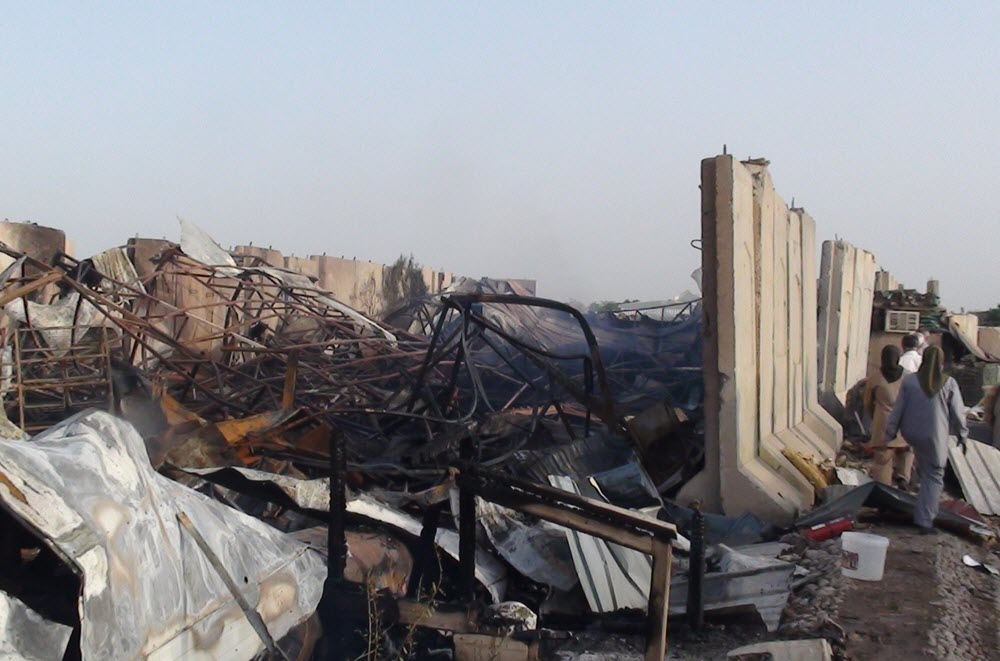
The MEK has been subjected to a number of attacks at Camp Liberty, at the behest of the Iranian Regime. In 2013, there were three separate rocket attacks (in February, June, and December) which caused 15 deaths and left nearly 200 injured. Then in October 2015, another heavy rocket killed another 20 MEK members.
This is in addition to the everyday violence at the hands of the Iraqi government.
Relocation
Eventually, in 2016, the MEK members were relocated to safety in Albania, but it is important to note that the MEK members were still under protected person status granted by the US in 2004 while all of these attacks happened.
Therefore the US is still responsible for the MEK and should have stepped in to protect them against the Iraqi government. It is also unconscionable that there have been no independent investigations into the attacks on the MEK.
Although, the MEK are now safe in Europe, they deserve for their attackers to be brought to justice.


