


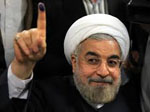
 AP: Iran’s President Hassan Rouhani said Sunday that last month’s nuclear deal with world powers has already boosted the country’s economy, as he continues a push to convince skeptics of the benefits brought by the pact’s partial sanctions relief.
The Associated Press
TEHRAN, Iran (AP) — Iran’s President Hassan Rouhani said Sunday that last month’s nuclear deal with world powers has already boosted the country’s economy, as he continues a push to convince skeptics of the benefits brought by the pact’s partial sanctions relief.
Rouhani told an open session of parliament that, after the “success” of the talks, investors were gravitating to businesses and the stock exchange.
“Economic activities have been shifted to the stock exchange from gold, hard currency and real estate,” said Rouhani in his televised speech. He gave no specific figures.
Iran’s economy has been hit hard by sanctions imposed over its nuclear program. Rouhani has recently stressed the deal’s offer of sanctions relief in return for a halt to parts of Iran’s uranium enrichment program to challenge criticism from hard-liners who say Iran is giving up too much for too little.
The Obama administration estimates relief from some sanctions in exchange for a temporary pause in Iran’s nuclear enrichment program will amount to just $7 billion, a meager amount for a nation of nearly 80 million people – it’s less than one month’s worth of Iran’s oil production and just 7 percent of Iran’s overseas cash that remains frozen under the sanctions.
Nonetheless, analysts say that the deal is a first step toward economic normalcy, and thus is likely to have a psychological effect that could boost markets.
The $68 billion budget predicts a U.S. dollar set to 26,000 Iranian rials. The rial is currently 29,000 to the dollar. Parliament will decide on the budget within months. Iran also separately budgets some $200 billion for hundreds of government banks and companies.
Rouhani also said the country’s budget aims for more foreign investment, privatization and decentralization of the economy.
He said the budget will decrease the inflation rate, a major priority of the government. Inflation currently stands at about 40 percent but Rouhani said last week he hopes to reduce it to 25 percent by March 2015.
Rouhani said the proposed budget is 50 percent more than current year’s budget. It covers Iran’s fiscal year that starts March 21, 2014.
This is Rouhani’s first budget. He took office in August, succeeding an outgoing president, Mahmoud Ahmadinejad, widely blamed for economic mismanagement. In addition to inflation, Iran also suffers from a high unemployment rate that runs to 12.2 percent, according to official numbers, and may be twice that among young, educated people.
Iran’s economy largely depends on oil revenue, which represents up to 80 percent of its foreign income and about 50 percent of its total income.
The West suspects Iran’s nuclear program is aimed at weapons development. Iran says it is for peaceful purposes like power generation, medicine and research.
Rouhani spoke as inspectors from the U.N. nuclear watchdog began their visit to a heavy water production plant that Iran agreed to open to inspection last month, according to state TV.
In an example of the challenges facing Rouhani, hard-line lawmakers accused U.S.-educated Foreign Minister Mohammad Javad Zarif, who played a major role in the nuclear deal, of being intimidated by the United States.
The semi-official Fars news agency said some 50 lawmakers sent a letter to Zarif, saying he feared U.S. military power because he was not in the country to witness Iran’s military performance in its 1980-88 war with Iraq.
Zarif last week told students in Tehran University that the U.S. is not frightened by the Iranian military. “Do you think that America, who can paralyze our entire defensive system with a single bomb, fears our defense system or our people?” he said.
Parliament approved Zarif in August with 232 votes out of 281. But hard-liners have since made him a lightning rod for criticism of Rouhani’s policies.
Later Sunday, according to the official IRNA news agency, some of those lawmakers sent a separate letter to Rouhani asked him to “reconsider” whether Zarif should continue as minister.


