

Iran’s Air Pollution Crisis Is not the People’s FaultAsgarian, speaking at the fourth webinar of the Higher Institute for Social Security Research, referred to the “centralized social security system for individuals” and said that there were currently a population of about 20 million people in need of social security coverage. Regarding the current economic situation and the devaluation of the national currency and the rising unemployment of workers and the high cost of goods, he points to horrific statistics and he said: “There are currently a population of about 20 million people in need of social security coverage. The monthly observation center samples at 1,800 points and defines the food poverty line. Now the ‘food poverty line’ is 670,000 tomans per person, and if you consider a family of three with the minimum wage, many working families are below the poverty line or on the border of the ‘food poverty line’”. Statistics of the Statistics Center of Iran and the depth of the disaster These government confessions show only a small part of the reality of society and the enormous pressure that has been put on the people. The horrifying reality is that, according to the Statistics Center of Iran, a population of over three million of the country’s working population are unemployed. But the indicator that the statistics center has for having a job is that: “If a person has done an hour-long job during the week, he is considered employed.” A closer look at the statistical studies of the Statistics Center of Iran reveals the depth of the tragedy. A document published by the Statistics Center of Iran in the fall of 2019, states: “A review of the unemployment rate of the population aged 10 and over shows that 6.10 percent of the active population was unemployed. Based on these results, the unemployment rate was higher among women than men and in urban areas compared to rural areas.” As can be seen, government agents have also included 10-year-old working children, who should be in the classroom, in the labor force. The reason is that they want to balance their statistics by increasing the number of working children and avoid giving real statistics. Warning signs of a silent massacre Various statistics on the number of educated unemployed in Iran have been published in government publications. In the mentioned statistics, the number of unemployed university graduates of the country is mentioned from 2 million to 4 million. This population is the main labor force of the country that should take the helm of the country’s economy after 16 years of education or more. But due to the destruction of the country’s economy in the fields of industry, agriculture and services, such a huge force has remained unemployed. According to government officials, with a poverty line of 10 million Tomans, about 70 million of the country’s population fall below the poverty line. If we consider the new government criterion based on the “food poverty line” which is 670,000 tomans, even if one million of this population of 70 million who are below the poverty line are below the “food poverty line”, that would be a warning about a nationwide silent massacre. Because this population cannot afford the daily strength to survive.
“Food Poverty Line” a Warning Sign of Iran’s Silent Massacre
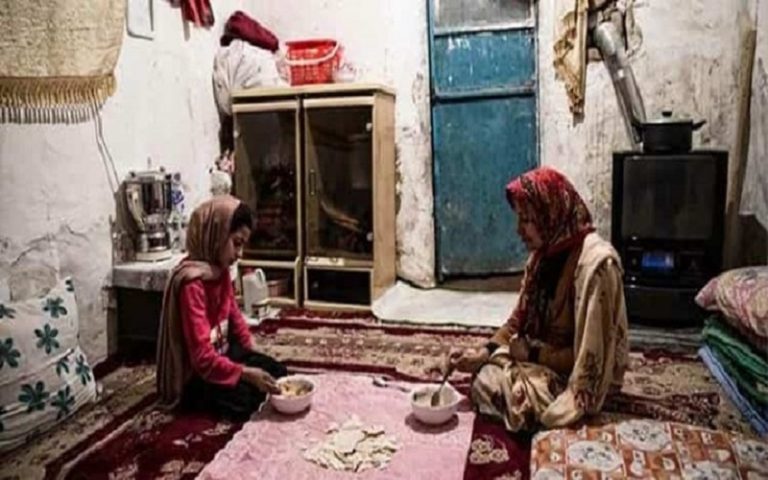
The “food poverty line”, the warning of a silent massacre, and with the continuation of Iran’s clerical rule, the severity of the economic devastation have reached a point where even the usual words in the economy do not reflect the current situation.
This is why even government economists have become aristocratic. They use new self-made vocabulary to describe the current situation.
Government agents, instead of the “poverty line” whose amount is set at 10 million tomans, name another line called “food poverty line” or “livelihood line” which set be set at 670,000 tomans per person.
The “livelihood line” is the “death line.” If a family cannot earn this amount of income, it will be unable to provide food.
The “food poverty line” is 670,000 tomans
“Many working-class families are below the poverty line or on the border of the ‘food poverty line.’ The food poverty line is 670,000 tomans per person,” said Alireza Asgarian, the relief committee’s deputy for public participation, whose remarks were published in government newspapers on January 26, 2021.
Iranian Ministry of Foreign Affairs, a Cover for State Terrorism

The Iranian Ministry of Foreign Affairs acts as a cover for state terrorism. The Antwerp court in Belgium announced its verdict on Thursday, February 4, on the charges of a “terrorist group.”
Assadollah Assadi and three accomplices were convicted of planning to attack an Iranian opposition rally involving senior U.S. and European statesmen in the outskirts of Paris in June 2018.
This is the first time a European court has tried an Iranian diplomat on terrorism charges. The trial comes as the direct role of Iranian government diplomats in the assassinations was clear in similar cases, including the assassinations of Dr. Kazem Rajavi, Abdolrahman Ghassemlou, Sadegh Sharafkandi, and others. But because of the European appeasement policy, they were all released.
EU Policy on Tehran Leads to TerrorismIn this way, this is the sign of serious change in the relationship between the EU and the Iranian government. First, it shows the weakness of Iran’s leaders, who can no longer blackmail and threaten the West with terror acts. Secondly, it was a big blow to the diplomatic apparatus of this clerical dictatorship. This blow means that diplomatic facilities can no longer provide security for Iran’s terrorists in power. Thus, the hand of the government in terrorist operations is completely closed.
The Role of the Ministry of Foreign Affairs in the Sovereignty of Iran
So, the question here is, what is the role of the regime’s Ministry of Foreign Affairs in the structure of this regime if it cannot lead the state’s terror acts outside the country and provide the regime’s intelligence service a ‘diplomatic cover’ to conducts its acts of terror. The role of the foreign ministry shows the clear purpose of this ministry. “I was in charge of representing Iran in New York at the time of the US invasion of Iraq. I was talking to American officials on the orders of the country’s top officials,” said Iranian Foreign Minister Mohammad Javad Zarif. “I had the most coordination with General Soleimani—Qassem Soleimani, the Islamic Revolutionary Guard Corps – Quds Force (IRGC-QF) commander who was killed by a U.S. drone in 2020 in Iraq. Soleimani and I decided to review the latest developments at least once a week and make the necessary arrangements,” he added. The weekly coordination with Soleimani confirms precisely the fact that the main task of the Ministry of Foreign Affairs in the Islamic Republic is to facilitate the transfer of ammunition, weapons, money laundering, travel documents, and documents for spies and terrorist cells, as well as organized terrorist guidance. Between 2015 and 2019, “seven diplomats,” including an ambassador, were expelled from Europe for involvement in terrorist plots.Iran’s FM Zarif Should Be Held to Account for TerrorismTherefore, it can be said with certainty that without the cooperation of the Ministry of Foreign Affairs, the Ministry of Intelligence and the IRGC-QF would never have been able to carry out terrorist plots outside Iran. This was not the first overseas terror operation of the regime in European countries. Examining the dark record of the clerical dictatorship presents us with a list of terrorist acts. A review of this record of all crimes shows us that in the past, the government carried out terrorist acts with a free hand and evaded accountability. For example:
- In the assassination of Shapur Bakhtiar, Abdolrahman Ghaselmo, Sadegh Sharafkandi, Prof. Kazem Rajavi, Zahra Rajabi and Ali Moradi, Abdolrahman Boroumand, and Mohammad Hossein Naqdi, Iran’s diplomats were never tried. Even in the case of the assassination of Zahra Rajabi and Ali Moradi, the then Turkish government only expelled four regime diplomats.
- Tehran even has planned to assassinate Maryam Rajavi, the President-elect of the Iranian opposition coalition (NCRI), in Dortmund, Germany. This terrorist act was exposed before it was carried out. Meanwhile, two diplomats, Ali Osuli and Jalal Abbasi were expelled from Germany for their involvement in the plot.
- In another plot against Mrs. Rajavi, a hand-made cannon of Iran’s defense industry called a 320 mm folding missile was to be launched. The weapons and ammunition, which were placed in three boxes with the label of pickles in one of the containers of the ship named Kolahdooz, were discovered during an inspection by customs officials in the Belgian port of Antwerp.
Historical Trial of Iranian Diplomat in EuropeDue to the dirty policy of appeasement and extortion, the regime was not only able to get rid of this terrorist incident but also brazenly made demands from the relevant country. In response to the newspaper article, the Iranian ambassador to Germany Hossein Mousavian sent a letter to the Frankfurter Allgemeine. “It is said that a weapon was found in the port of Antwerp. The security services of these countries want to disrupt the relations between Germany and Iran in all fields in unison with the Mojahedin Organization, and now they are trying to achieve this by exchanging information,” Mousavian wrote. We are facing a new situation in the case of the Villepinte bombing. For the first time, a diplomat was taken to court and then to prison. The trial of this diplomat is not the trial of one person, but the trial of the integrity of the regime and, in a higher-order, the trial of the appeasement policy with a religious dictatorship. Now it’s time for the EU countries to make decisions and change their relationships with the Iranian government in all fields.
Struan Stevenson on the arrest of Iranian agent Afrasiabi
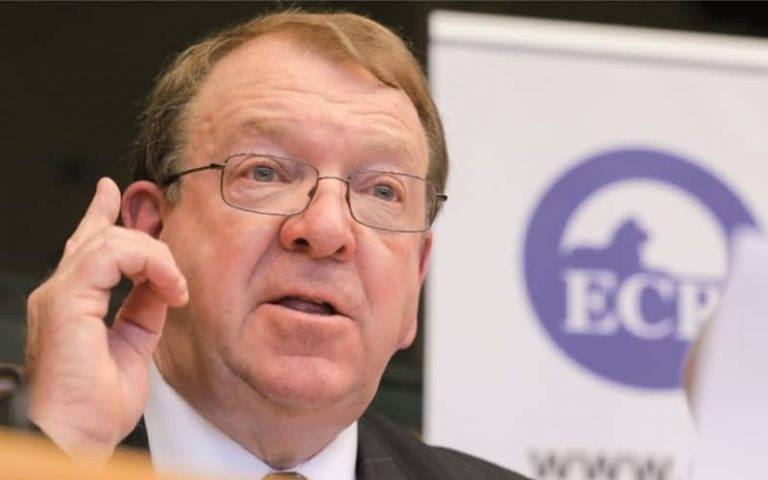
The arrest of political scientist and Iran expert Kaveh Lotfolah Afrasiabi by the FBI should have been top news in Western media, according to Struan Stevenson, the coordinator of the Campaign for Iran Change.
He wrote that Afrasiabi has been openly praising Iran for 13 years without registering as a foreign agent, despite being paid over $265,000 through Iran’s Permanent Mission to the United Nations in New York.
The U.S. Justice Department is charging Afrasiabi for “conspiring to act as an unregistered agent of the government of the Islamic Republic of Iran”, with John C. Demers, assistant attorney general for national security, explaining that Afrasiabi presented himself as neutral when talking about the regime to Congress, the media, and the public, swaying opinion and perhaps policy in an illegal way.
“The revelation that an Iranian spy was embedded in the heart of the U.S. democratic process certainly came as no surprise to representatives of the National Council of Resistance of Iran and the Mojahedin e-Khalq (MEK/PMOI), the main opposition movement to the theocratic fascist regime in Iran,” wrote Stevenson a former member of the European Parliament. “The NCRI and MEK have long been the target of a campaign of misinformation and demonization by Tehran.”
This campaign took place in papers, on the internet, on TV, and on the radio, parroting the narrative of the Iranian government, with so-called experts quoted. Sometimes, Stevenson said, Western reporters and media outlets are even on Iran’s payroll.
It has been going on since the 1979 revolution, with the most common victims being the Iranian opposition because they seek a democracy with full respect for human rights.
This is not just a war of words but has been used strategically to justify Tehran’s abuses of the MEK, from the 1988 massacre of 30,000 supporters to the assassination of its leading members abroad.
Don’t Ignore Iran Terror Plot“Needless to say, following their long history of lies and deception, all of these murders and assassinations are routinely denied. There is now a high-level investigation into the 1988 massacre underway by the United Nations,” Stevenson wrote. Stevenson believes the trial of Iranian diplomat Assadollah Assadi, who is charged with attempting to blow up the 2018 Free Iran rally, has the power to fundamentally change relations between the West and Iran. In this regard, many politicians like former U.S. Secretary of Homeland Security Gov. Tom Ridge, former U.S. National Security Advisor and United States European Command Gen. James Jones, former Vice-President of the European Parliament Alejo Vidal-Quadras, and many prominent dignitaries agreed with him. Notably, Assadollah Assadi and his accomplices were convicted of long-term prison by a Belgian court in Antwerp on Thursday, February 4. However, the Iranian “diplomat” is facing further charges in Germany over information that was found in a notepad in his car upon his arrest that reportedly links him to a Europe-wide terror network. “Sadly, years of appeasement of the tyrannical Iranian regime have emboldened its efforts to deceive the West while indulging in grave violations of human rights at home and aggressive military expansionism and the export of terrorism abroad. The arrest of Afrasiabi and the trial of Assadi should surely be a wake-up call for the West,” Stevenson addressed.
Iranian Diplomat Convicted for Terror Plot Against Dissidents
Iranian Diplomat Convicted for Terror Plot Against Dissidents
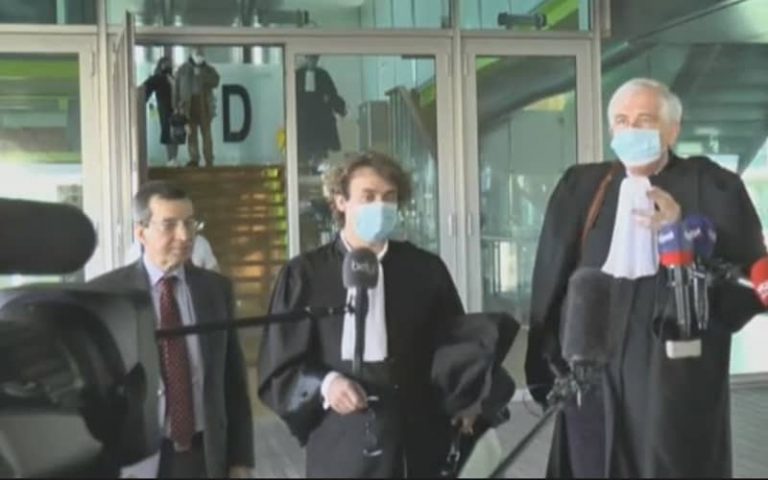
The Belgian Court of Antwerp declared its ruling in the case of Iranian diplomat Assadollah Assadi and his three accomplices on Thursday, February 4, 2021. Following more than two years of investigations into Tehran’s foiled bomb plot against the Free Iran 2018 rally in Paris, the court annulled Assadi’s diplomatic immunity and sentenced all four “terrorists” to long-term imprisonment.
Back in November 2020, Belgian prosecutors had urged life imprisonment for Assadi, as the plot’s mastermind, and 15-18 years prison for his accomplices. Eventually, judges sentenced Assadi to 20 years, Nasimeh Naami to 18 years, Mehrdad Arefani to 17 years, and Amir Sadouni to 15 years in prison.
Simultaneously, supporters of the Mojahedin-e Khalq (MEK/PMOI) gathered outside the court. Furthermore, the Iranian opposition National Council of Resistance of Iran (NCRI) held an international webinar connecting Iranian dissidents from at least 40 countries together. Many politicians and members of the parliaments in Europe and the United States attended the virtual conference.
As the conference’s keynote speaker and the main target of Assadi’s attack, NCRI President-elect Maryam Rajavi highlighted the role of the Iranian government in sponsoring terrorism. “The conviction of the clerical regime’s terrorist diplomat by a European country’s judiciary confirms the regime’s state-sponsored terrorism,” she said.
EU Must Adopt Punitive Measures Against Tehran in Assadollah Assadi’s CaseAssadi’s attorney also affirmed this reality, saying, “My client feels that it is not himself but his government that is on trial.” The conviction of an Iranian diplomat underscored significant facts, including that the theocracy ruling Iran has organized an extensive network for terrorizing and blackmailing other countries, as well as targeting dissidents. In parallel, Tehran leads a misinformation campaign against the Iranian Resistance, particularly the MEK. However, Iranian leaders’ main purpose is to suppress domestic objections. The Islamic Republic has institutionalized human rights violations in its constitution, which is the autocrats’ leading instrument to ensuring their establishment. In this context, they employ terrorism to silence governments. They also target dissidents abroad to dishearten angry people about any protest. The ayatollahs apparently remove their opponents but, in fact, they create and spread an atmosphere of fear among citizens. Moreover, the Iranian government explicitly addressed its alternative. Iranian officials exploited diplomatic privileges to transfer and deliver explosive materials to terrorist operatives. Under the cover of third counselor of Iran’s embassy in Vienna, Assadollah Assadi was directing Tehran’s intelligence station in Europe.
Don’t Ignore Iran Terror PlotDuring this period, he established an extended network of terrorists called sleeper cells. In his travels to 11 European countries, he personally paid secret agents’ salaries. German law enforcement discovered and seized two booklets when they arrested Assadi in July 2018. One of them contained the bomb instructions for the terror plot. Another one contained 289 notes, including appointments and receipts. This information gave a clue to European security services to shed light on the Iranian government’s covert operations on European soil. Finally, Assadi had been tasked by Iranian Foreign Minister Mohammad Javad Zarif. In the West, many know Zarif as a ‘moderate.’ They ironically try to embolden moderates versus hardliners while Zarif and his President Hassan Rouhani are wolves in sheep clothing, opposition activists say. In other words, the conviction of Zarif’s subordinate proved that there is no distinction between Iran’s moderates and hardliners when it comes to savagery. In this context, before shaking Zarif’s hand and taking selfies, international negotiators must consider what if Assadi’s plot had succeeded and the bomb had exploded. Iranian dissidents have frequently insisted that the international community should condition any negotiations with Iranian officials to an end to human rights violations inside the country and terrorism abroad. Unconditional negotiations with autocrats in Iran merely incite them to carry out more abuses of human rights and more terror plots, they say.
Zarif Personally Involved in Iranian Terrorism and Hostage-Taking
Don’t Ignore Iran Terror Plot
Four Iranian terrorists were arrested in Europe in June 2018 on the charge of attempting to bomb the Free Iran rally in Villepinte, a suburb of Paris.
Two of them – Nasimeh Na’ami and Amir Saadouni – were arrested in Belgium carrying 500 grams of the high-explosive TATP, shortly after their handler Assadollah Assadi, a diplomat at the embassy in Austria, had handed it off to them.
The two would-be bombers were instructed to place it as close as possible to opposition leader Maryam Rajavi, who was sat amongst many dignitaries from around the world. If successful, the loss of life would have been horrific because there were a total of 100,000 in attendance.
Proof Iran Is Responsible for 2018 Bomb PlotAssadollah Assadi was arrested in Germany with two notebooks, one containing details of the plot and one that is possibly linked to a Europe-wide terror network. After two years of investigations, Assadollah Assadi and his three co-conspirators went to trial in November and a verdict is due Thursday, with the expectation that Assadollah Assadi will be found guilty and given 20 years in jail. The prosecutors said that he was not working on his own volition though, rather he was taking orders from Iran’s Supreme Leader Ali Khamenei and President Hassan Rouhani. Therefore, why would the Iranian government do this? Well, to put it simply, the threat posed by the Iranian Resistance was large enough that the government was willing to risk whatever might come their way. In December 2017, the Resistance organized a major protest with people calling for regime change and it shook the ayatollahs’ establishment to its core. Of course, the protest was soon quashed by oppressive forces, including the State Security Forces (SSF), the Islamic Revolutionary Guard Corps (IRGC), and the Ministry of Intelligence and Security (MOIS) with dozens killed in the streets and thousands arrested.
Iran Diplomat on Trial for TerrorismHowever, Maryam Rajavi called for a “year full of uprisings,” and Iran’s theocracy saw her as so much of a threat to their continued rule that they wanted to kill her and hundreds more to strike a blow at the heart of the Resistance. “In light of the high political price the regime had to pay for this terrorist act, it stands to reason that the regime was willing to pay this price to destroy or exert a blow to the Iranian resistance and the MEK. This, in itself, is indicative of the significance of Iranian resistance, and the MEK and its existential threat to the regime,” the Iranian Resistance wrote. They cautioned the EU against ignoring the Iranian government’s role in this as that will only embolden the ayatollahs and called for the ayatollahs’ ruling system to face the consequences.
Iran Media Warns of Protests Over Crises
Iran Executes Eight Prisoners in One Week
Authorities in Iran executed a 31-year-old Iranian Baluch political prisoner on Saturday in Zahedan central prison.
The execution of Javid Dehghan Khold was the eighth in just one week, suggesting that Iran’s human rights situation is deteriorating fast.
Dehghan Khold was arrested in 2015 and tortured into confessing to the charges lodged against him, including the pulling out of fingernails and being flogged with a cable.
Many human rights activists and groups urged the Iranian regime to spare his life.
“[Iran should] immediately halt the execution of Javid Dehghan, a member of Iran’s disadvantaged Baluchi ethnic minority… Amnesty International opposes the death penalty in all cases without exception. The death penalty is a violation of the right to life and the ultimate cruel, inhuman and degrading punishment,” Amnesty International wrote on Thursday, January 28.
Prior to Dehghan Khald’s execution, the Iranian government executed seven more people, including:
- Iranian-Arab prisoner Ali Motayeri was executed in Sheiban Prison, Ahvaz, on Thursday, for the internationally vague crimes of waging war against God and corruption on earth. He was also tortured into confessing.
- Iranian wrestler Mehdi Ali Hosseini was executed on Monday, despite an international campaign to save his life, who was the second wrestler to be killed since September. The first being national hero Navid Afkari sentenced for taking part in the 2018 Iran protests.
Iran Executes Another AthleteIran is continuing to execute more people, having killed almost 40 in the last few months, mainly in an attempt to intimidate the public with the goal of preventing further protests against the Iranian establishment. “We strongly condemn the series of executions—at least 28—since mid-December, including of people from minority groups. We urge the authorities to halt the imminent execution of Javid Dehghan, to review his and other death penalty cases in line with human rights law,” the United Nations Human Rights Office stated. The fact that the international community has not responded to these executions, including that of French resident Ruhollah Zam, in any real way—in fact, just postponing a business forum with Iran—means that Tehran feels emboldened to continue.
Iran’s Human Rights Abuses in 2020The international community must do whatever is in their power to end human rights abuses in Iran, perhaps even through the use of the European Union’s new global sanctions regime. “This regime cannot last even for a day without torture and execution… This regime is a disgrace to contemporary humanity and must be isolated by the international community,” said Maryam Rajavi, the President-elect of the National Council of Resistance of Iran (NCRI).
Iran Ranked 95 Among 98 Countries in Coronavirus Response
The Lowy Institute released a Covid performance index on January 27. In its index, the institute sorted countries by regions, political systems, population size, and economic development to provide a real view of states’ performance to counter the novel coronavirus.
Based on the availability of data across the six indicators used to construct the index, the Lowy Institute ranked 98 countries compared to the average performance over the time in managing the Covid-19 pandemic in the 36 weeks following their hundredth confirmed case of the virus.
In this context, New Zealand showed the best performance with a 94.4 score while Brazil stood at the end of the table with only 4.3 points. Iran was ranked as the 95th country in managing the pandemic before Colombia and Mexico.
The Lowy Institute, of course, used official figures for ranking countries. This is while not only have the people and opposition rejected the statistics provided by the Iranian Health Ministry but also health officials have strongly challenged official figures.
For instance, in late April 2020, as the government officially declared that 5,877 people had lost their lives to the coronavirus, Mohammad Reza Mahboub-Far, member of the National Covid-19 Task Force, admitted that the health ministry’s stats were fabricated.
“The current stats of the coronavirus illness are 20 times higher than what is being announced by the Health Ministry. This has resulted in the people not taking this lethal illness seriously,” Vatan-e Emrouz daily quoted Mahboub-Far as saying on April 28, 2020.
At the time, the Iranian opposition Mojahedin-e Khalq (MEK/PMOI) had announced that more than 36,600 people—nearly seven times the health ministry’s stats—have died of the Covid-19 as of Tuesday, April 28, 2020. The MEK said the number provided via reports tallied from 301 cities across all of Iran’s 31 provinces.
According to the MEK, the death toll surpassed 209,700 cases in 480 cities as of February 1, while the officials claim the death toll has stood at 58,038—around a third of the actual figure—until the same date.
Due to the government’s mismanagement and particularly Supreme Leader Ali Khamenei’s recent Fatwa, which banned the government from purchasing U.S., UK, and French Covid-19 vaccines, coronavirus victims would increase even more.
Khamenei Bans Importing COVID Vaccines, Leading Iran to More DeathsNotably, based on the official death toll, Iran has the second-highest rate of Covid-19 death per capita. “We had the second-highest rate of death today after Mexico. Well, this is very scary. Yes, we now have the average coronavirus death in our country, which is about what happened today, something about 17 times, 17 percent of the world average. While we have 1.1 percent of the world population,” said Hamid Souri, member of the National Covid-19 Task Force, in an interview with TV Channel Five on August 19, 2020. Also, Iran is the worst coronavirus-hit country in the Middle East by a large margin. On the other hand, the air pollution in Tehran and major cities, as well as power outages, have exacerbated the conditions in recent weeks. Nonetheless, the government’s disastrous performance in containing the virus is the main element for the rare death rate in this zone of the world. Dissidents reckoned that Iran’s autocrats intentionally drive the country to more fatalities to quell any objection and disappoint citizens about their legal grievances. They remember the government’s ‘human waves’ tactics during the eight-year war with Iraq to remove minefields. Furthermore, Khamenei described the coronavirus disease as a ‘blessing’ on March 3, 2020. That description, his recent decision for depriving citizens of credible Covid-19 vaccines, and non-transparent statistics about the real scope of this health crisis are in line with the opposition’s assertion.
Iran: Covid-19 Vaccine and Ayatollahs’ Dirty Business
Iran’s Provocative Actions Must Stop and Until They Do, Pure Diplomacy Must Wait
French Foreign Minister Jean Yves Le Drian recently spoke to the media about longstanding conflicts over the 2015 Iran nuclear deal and said, “This has to stop because Iran and – I say this clearly – is in the process of acquiring nuclear [weapons] capacity.”
To Le Drian’s credit, the quotation reflects his frequent willingness to be more up-front than many of his colleagues about the nature and extent of Iran’s malign activities. But that quality is undermined by the larger context of his remarks and what he was referring to when he said, “This has to stop.”
One might assume that the pronoun in that sentence refers simply to Iran’s violations of the Joint Comprehensive Plan of Action, which include the resumption of 20 percent uranium enrichment and the start of work on production of uranium metal, which is a key component in the core of a nuclear weapon. Iran has even lately teased the possibility of kicking international inspectors out of the country, though some officials have insisted they will be allowed to stay but will have their access to suspicious sites scaled down even further from a level that was already deemed inadequate by many of the JCPOA’s critics.
Of course, Le Drian does want Iran to cease these provocative gestures and to reverse the ones it has already undertaken. But that wasn’t what he was referring to when he said “this has to stop.” Instead, he offered that phrase as a follow up to his latest condemnation of the Trump administration’s “maximum pressure strategy,” which he characterized as having “only increased the risk and the threat.”
In other words, the French foreign minister recognizes the seriousness of Iran’s provocative gestures and the likelihood of more JCPOA violations in the near future, yet he places the blame for those violations on an entity other than the Iranian regime. For all his willingness to speak more plainly about Iran’s pursuit of nuclear weapons, its ballistic missile development, and its regional interventionism, Le Drian’s comments on the future of the nuclear deal make him almost indistinguishable from the many colleagues who seem happy to give into the pressure those activities are intended to exert.
On the whole, European policymakers continue to promote the idea that it is better to provide Iran with additional concessions in order to preserve the JCPOA than it is to counter Iran’s pressure tactics with more of the same. But this is a foolish position to take, because it ignore the obvious fact that by giving into that pressure when Iran has comparatively little leverage, Western powers would only be emboldening the Iranian regime to capitalize on a stronger position sometime later, and continue exerting more pressure in pursuit of more concessions.
With that in mind, the common wisdom must not be allowed to stand. But unfortunately, the transition from one US president to another has raised serious questions about who might be in a position to challenge the predominant European policy. With Trump’s maximum pressure strategy now relegated to history, it still remains to be seen what President Joe Biden with replace it with. In advance of his inauguration, he had signaled willingness to return to the existing nuclear deal, which his predecessor pulled out of in 2018. But he also said Iran would have to resume compliance first, and his foreign policy team has only cast further doubt on the notion of a speedy return to the status quo.
Europe Condemns Iran’s Nuclear Moves but Further Action Is NeededStill, there is ample grounds for concern that Biden might largely reverse the preexisting policies and demonstrate to Iran that he is prepared to reopen something resembling normal diplomatic relations. This is not to say that the US under Biden might allow Iran to reopen an embassy in Washington; but by simply treating the Islamic Republic as a good-faith negotiating partner, the Biden administration could help to legitimize the conciliatory policies that hold so much appeal for European allies despite Iran’s ongoing efforts to exploit them. Making matters worse, the administration risks delivering a message of support for the status quo precisely at the time when a small handful of European entities are actually beginning to challenge it. Next week, a Belgian federal court is expected to return a verdict in the terrorism case against Assadollah Assadi, the first Iranian diplomat to ever face such charges. It is a watershed moment in the history of European relations with the Islamic Republic, and it promises to help expose the underlying danger of Iran’s overlapping diplomatic and terrorist networks. However, that promise could easily be undermined if the US contradicts Belgium’s progress by disavowing maximum pressure and insisting upon pure diplomacy despite Iran’s well-recognized preference for threats and ultimatums. On the other hand, by continuing to publicly acknowledge the progress that maximum pressure has made, the US could give a much-needed push to those, like Le Drian – who remain on the fence between calling out Iran for its misbehavior and appeasing that behavior in hopes of securing small, temporary concessions. Make no mistake: there has been progress from maximum pressure. It has brought the Iranian economy to the brink of collapse. The escalating violations of the nuclear deal only confirm that the regime is desperate for relief. The Assadi case, being related to a 2018 terror plot against pro-democracy activists in Iranian expatriate communities, signifies that that desperation was already setting in more than two years ago. Of course those two years have been fraught, but this is no time to return to the way things were, and to declare that all that strife was for nothing. Under Trump, the US made Iran’s theocratic dictatorship historically vulnerable all on its own. Under Biden, the US could amplify that vulnerability greatly by convincing wary European government to sign onto a policy that recognizes genuine diplomacy as a goal rather than a means to an end in dealing with Iran. That diplomacy will only be mutually beneficial when Iran has first been compelled to stop escalating its nuclear activities and levying other threats against Arab and Western lives and interests. Those activities are a problem, and it has to stop. US-led sanctions, diplomatic isolation, and other pressures are a response to that problem, not the other way around. This is the way it should stay. Iran’s impulse toward malign behaviors must be the focus of Western policy, and until that impulse is truly gone, there must be no illusion that Western policies caused it.
Car Import and Assembly Mafia in Iran

The automotive industry in Iran is the second largest industry in the country after the oil industry; but the position of the Iranian car industry among its peers in the world is not very admirable and so far, it has not even been able to win the title of a second-class car manufacturer.
Inside the country, several names came up and went and carried the name of ‘national car,’ but it did not work. Peykan, Renault, Pride, Samand, Dena, Rana, Tiba and Saina are different names of an assembly industry, some of which have reached the end of their lifespan.
‘Most of the automotive industry in Iran has been assembling products of larger global companies during its years of activity. Even now, most assembled cars are made in China. It can be said that the history of cars in Iran has never been able to be as fruitful as it should be and has always failed to compete with other countries for internal or external reasons.” (State-run website Divar, August 19, 2020).
The Iranian government in the administration of the assembled automobile industry has always faced the fluctuation of life and death of factories that make a living from the pockets of the people or the treasury of the country with the intention of making exclusive profits for its owners and managers.
The cooperation of the Iranian regime with the two French companies Peugeot and Renault has been done in the form of these assemblies.
But all sorts of unplanned programs, a lack of foreign exchange resources, breaches of contracts due to political issues, international sanctions and, most importantly, a lack of independent and internal car design, have forced the regime to build parts that has become an unsolvable in this industry. This cycle of part import and forced internalization has been repeated several times in the last four decades.
IRGC Tries to Steal From Iran’s Car Industry‘According to car industry experts, after 40 years, the car industry is still an assembler, because it cannot have a car design, and even sanctioning the production of a car like the Pride with the least technology and the cheapest car faced many challenges. This shortage of parts is not only related to ‘high-tech’ parts, and some simple parts are also imported from abroad as domestic production.’ (State-run daily SMTnewspaper, January 30, 2021). ‘We do not have much to say about the achievements of this industry,’ said Fazlullah Jamalo, an expert in the automotive industry of this government. The reason was the constant preference for importing ready-made parts (CKD). Of course, there is no technology transfer in this regard. In addition to assessing the managers of automotive companies as mundane and careless in the field of work, he considers wasting millions of dollars for assembly work as an irreparable damage to the industry: ‘It is very important how much currency has been taken out of the country to import parts and cars. Millions of dollars were spent in collaboration with Peugeot, Renault, Mazda and other foreign brands; But without having a coherent and clear strategy.’ (State-run website Asr-Khodro, January 30, 2021) This car expert considers one of the problems of this industry as the mafia and preventing their internalization and says: “The car mafia, with its power and leverage, did not allow the deepening of domestic production to take place in previous years, because imports were in their favor. There were so many behind the scenes that imports were more profitable for them than to strengthen the parts industry.” (SMTnewspaper) The story does not end with the confrontation of the mafia importers of cars and ready-made parts with domestic parts manufacturers. But in the parts manufacturing industry, flawed and monopolistic structures have been formed so that there is no way to save the automotive industry. The automotive industry expert said: “Unfortunately, many component makers also played on foreign soil. Recent trends in the piece industry have been indicative of this. The component importers import the products from China and selling them in the market as domestically manufactured parts. In this industry, a clone is formed that usually does not allow small companies to enter the supply chain. There are people in the parts industry association who have been sitting on the chair of this center for many years. (SMTnewspaper) Reza Hashemi, another activist in the parts manufacturing industry, compares the Iranian auto industry in the last 40 years with countries such as Turkey and South Korea and said: “The fact is that we are far behind global progress. We lagged behind the neighboring countries in terms of industry, because inefficient people took over the management of it, who did not come from the heart of the industry. If we move forward in the same way, with the state of progress that science has, in less than five years, other countries will make many times more progress than Iran, and Iran will have to assemble, even few decades later.” (SMTnewspaper) Siamak Hojjat, CEO of the automotive industry, also said: “Our country does not have an automobile industry, and it is better to say that we have an assembly industry, especially in the last two or three decades, we have been 100% an assembler, and unfortunately we have seen a decline in car quality and high cost in this industry.” (ISNA, December 14, 2020)
Drug Smuggling Funds Iran’s Ayatollahs
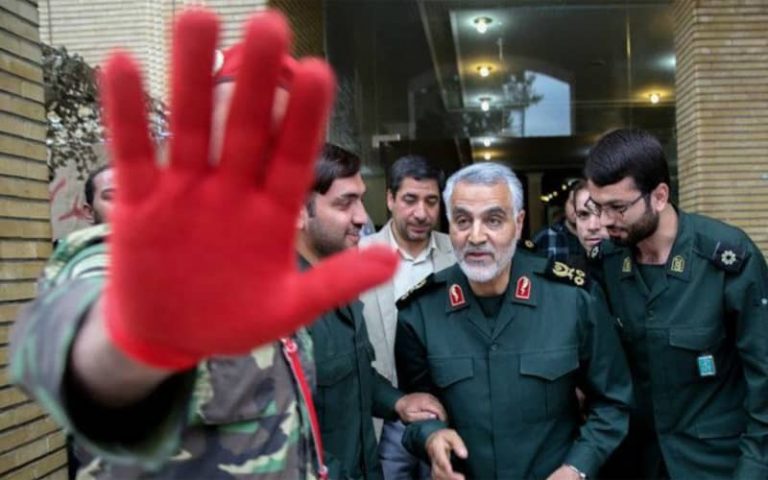
Last month, Mohammad Baghar Zolghadr, a commander at the Islamic Revolutionary Guard Corps (IRGC) – Quds Force’s Ramazan military base and deputy of the judiciary, told the state-run Tasnim News agency that former IRGC-QF commander Qassem Soleimani was always able to find the money for the group’s malign actions, even when the government has trouble finding the cash, but Zolghadr refused to go into detail.
But why? If he wanted to talk about Soleimani’s ingenuity, why not show how he did it? Well, the answer may lie in some news articles over the past year concerning drugs trafficked into Europe and the Middle East.
Smuggling Gang Received $36Bn & 80 Tons of Gold by Presidential Order: Iranian MPOn August 5, 2020, the National World Website wrote that “85 million narcotic pills” were confiscated in Italy, having been smuggled into Europe by the Syrian dictatorship and the Hezbollah group, both of which are backed by Iran. The drugs, which would have made 1 billion euros in profit if they’d been sold, constituted the largest narcotics shipment ever seized. Shortly after, Orient TV affiliated with the Syrian Opposition reported on September 3, 2020, that Rumania confiscated a shipment of over 2250 kilograms in narcotics, worth an estimated $71 million, that had been shipped from Syria’s Lazeghiyah port, which is controlled by the Syrian and Iran. While in December, Al Arabia TV reported that six Iranian sailors were arrested in Al Muhreh province, eastern Yemen, for smuggling a massive shipment of narcotics, including Heroin, Crystal Meth, and Marijuana, worth 5 billion Yamani Rails [$20.243 million]. Not that this is the first year that this happened. In 2019, German Newspaper Spiegel reported that Hezbollah secretly operates in Germany, raising money through various illicit actions, including drug smuggling, car thefts, and money laundering. “The truth is that the institutions set up by Qassem Soleimani and Quds Terrorist force, have made huge profits by smuggling narcotics and only a small portion of it has been revealed to the press,” iranprobe.com wrote on January 26. “Of course, the main brunt of financing expensive terrorist activities of the regime and the Quds force in the region is felt by the Iranian people, in a way that poverty and paucity, has hit all levels of the society. For instance, paying for the daily bread in parts has become part of the culture in the country,” the website added. For Iran, preservation is done at any cost, including domestic suppression, terrorism export, and warmongering. The ayatollahs steal from Iranians and use criminal activity to fund other illicit actions, all to save the government. But they want to keep this secret.
60 Million Iranians Below the Poverty Line
