


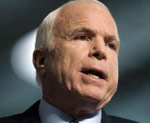
 Reuters: U.S. Senator John McCain said on Thursday the fall of Muammar Gaddafi was inspiring people all over world, including citizens of Syria, Iran, China and Russia, but he twinned his praise with caution about Libya’s many revolutionary armed groups, saying they had to be brought under control.
By William Maclean
TRIPOLI (Reuters) – U.S. Senator John McCain said on Thursday the fall of Muammar Gaddafi was inspiring people all over world, including citizens of Syria, Iran, China and Russia, but he twinned his praise with caution about Libya’s many revolutionary armed groups, saying they had to be brought under control.
Leading the first visit to Tripoli by members of the U.S. Congress since Gaddafi’s fall last month, McCain added at a media conference that U.S. investors were eager to do business in the oil-exporting country but this would be difficult as long as fighting continued.
Many residents of the capital say they want the return of the police and the departure of trigger-happy provincial gunmen who have based themselves there since they helped topple Gaddafi last month, saying they fear the militias’ jockeying for post-revolutionary power may turn violent.
“We believe very strongly that the people of Libya today are inspiring the people in Tehran, in Damascus, and even in Beijing and Moscow,” said the Republican Senator from Arizona, a former presidential contender.
“They continue to inspire the world — and let people know that even the worst dictators can be overthrown and be replaced by freedom and democracy.”
“How they succeed will also be watched very carefully by the rest of the world,” said McCain, who was accompanied by fellow Republicans Lindsey Graham of South Carolina, Marco Rubio of Florida, and Mark Kirk of Illinois.
They earlier held talks with the country’s de facto head of state, Mustafa Abdel Jalil, the chairman of the interim National Transitional Council (NTC), and the interim Prime Minister, Ahmed Jibril.
Rubio said the United States should always side with democracy even if it might be tempted not to, in cases where “those in charge of a government are friendly to our interests.”
“Ultimately I believe we should always be on the side of a transition to democracy that includes Iran, Syria and eventually I hope Bahrain and Saudi Arabia,” he said.
Asked if the United States would cooperate with Libya in the event that it had an “Islamic government,” McCain replied: “I think the U.S. will be prepared to cooperate with any government that the Libyan people decide. But obviously our relations will be affected by what kind of government that is.”
“I do not claim to be an expert on Libya but I do know enough to know that the people of Libya are not in significant numbers interested in a radical Islamic extremist government such as we have in Iran or a couple of other countries. That’s not the nature of the Libyan people.”
McCain also said the interim NTC had to continue trying to bring under control Libya’s many armed groups, whose habit of shooting in the air unsettles many in the capital.
“It’s important for the NTC to continue bringing the many armed groups in this city and beyond under the responsible control of its legitimate governing authority,” McCain said. “It’s essential to continue working together to secure the many weapons and dangerous materials that the Gaddafi regime proliferated around this country.”
On Lockerbie, McCain said Americans wanted to know if anyone else was responsible for the 1988 airliner bombing which killed 270 people other than the one Libyan so far convicted for the attack, Abdel Basset al-Megrahi.
In March, NTC chairman Jalil, Libya’s former justice minister, said he had evidence of Gaddafi’s involvement in the bombing of Pan Am Flight 103.
“I see no reason why we will not see cooperation on the part of the Libyan government after all 90 some Americans are dead as a result of his (Megrahi’s actions) actions and we’d like to know who else was connected with it,” McCain said.
Megrahi was convicted of the bombing in 2001 and sent to a Scottish prison to serve a life sentence. The Scottish government released him and sent him back to Libya on compassionate grounds in 2009 because he had cancer and was thought to have only months to live.
Megrahi’s release and return to a hero’s welcome in Libya angered many in Britain and the United States, home to most of the Lockerbie victims.
(Editing by Louise Ireland)


