


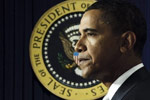
 Reuters: The United States believes increasingly warm ties between Venezuela, Iran and Cuba do not benefit the Venezuelan people, U.S. President Barack Obama said in an interview with a Venezuelan newspaper published on Monday.
By Daniel Wallis
CARACAS (Reuters) – The United States believes increasingly warm ties between Venezuela, Iran and Cuba do not benefit the Venezuelan people, U.S. President Barack Obama said in an interview with a Venezuelan newspaper published on Monday.
Venezuelan leader Hugo Chavez and his Iranian counterpart, Mahmoud Ahmadinejad, have expanded the two OPEC nation’s close business and political relations in recent years, exacerbating tensions between Caracas and Washington.
In May, the United States imposed sanctions on Venezuela’s state oil company PDVSA for defying U.S. law by sending at least two tankers carrying $50 million in oil products to Iran.
“Venezuela is a proud, sovereign nation … The U.S. has no intention of intervening in Venezuela’s foreign relations,” Obama said in the email interview with El Universal newspaper. “However, I think the government’s ties with Iran and Cuba have not benefited the interests of Venezuela and its people.
“Sooner or later, Venezuela’s people will have to decide what possible advantage there is in having relations with a country that violates fundamental human rights and is isolated from most of the world. The Iranian government has consistently supported international terrorism.”
Chavez denounced the PDVSA sanctions as “gringo aggression.”
His alliance with Ahmadinejad, as well as other anti-U.S. leaders, is a source of pride for the socialist and a central part of his efforts to build alternative axes of power.
Since coming to power in 1999, Chavez has sought to project himself as the head of a global “anti-imperialist” movement inspired by his ideological mentor former Cuban president Fidel Castro.
Chavez lauds Castro’s communist-led revolution and underwent cancer surgery in Cuba in June. After recuperating from that and several subsequent sessions of chemotherapy in Havana, Chavez is now focused on winning a new six-year presidential term in an election next October.
‘IDEOLOGICAL BATTLES’
In the interview, Obama said the U.S. administration was closely watching the run-up to the Venezuelan vote.
“We felt great concern to see that measures have been taken to restrict press freedom and to erode the separation of powers that are so necessary for a democracy to flourish,” he said.
A year ago, the U.S. government revoked the Venezuelan ambassador’s visa in retaliation after Chavez rejected Obama’s choice of envoy to Caracas. That appeared to bury any lingering hopes of a rapprochement between both men.
But most analysts say neither will risk jeopardizing trade ties, principally Venezuelan oil exports that amount to about 1 million barrels per day and are crucial to both economies.
There was a window to improve ties after Obama took office in January 2009 and promised more engagement with foes. Chavez toned down his tirades against the “Yankee empire” and shook hands with the new U.S. leader at a summit.
But within months, Chavez said Obama was disillusioning the world by following his predecessor George W. Bush’s foreign policies, and the rhetoric from Caracas cranked up again.
In his interview, Obama said most people in the region were worn out by the war of words.
“I think most people in Latin America are tired of refighting old ideological battles that contribute absolutely nothing towards improving their daily life. Our people want to know what we promote, not just what we oppose,” he said.
“I look forward to the day when the governments of the United States and Venezuela can work together more closely.”
(Reporting by Daniel Wallis; editing by Anthony Boadle)


