


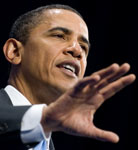
 Wall Street Journal: President Barack Obama is ramping up efforts to sell his diplomatic drive with Iran to skeptical Middle East allies and to Congress, starting with a crucial meeting at the White House on Monday with Israeli Prime Minister Benjamin Netanyahu.
The Wall Street Journal
By Jay Solomon and Carol E. Lee
WASHINGTON—President Barack Obama is ramping up efforts to sell his diplomatic drive with Iran to skeptical Middle East allies and to Congress, starting with a crucial meeting at the White House on Monday with Israeli Prime Minister Benjamin Netanyahu.
Israel and a number of allied Persian Gulf states are voicing concern about the pace of rapprochement, arguing that Iran will use the diplomatic cover to advance its nuclear work.
Israel, the U.S. and Western allies maintain Tehran is seeking to develop nuclear weapons, a charge that Iran’s new president, Hasan Rouhani, repeatedly has denied.
The diplomatic push also faces trouble on Capitol Hill, where Israel’s allies are signaling the likelihood of resistance if Mr. Obama moves to ease sanctions on Tehran as part of negotiations. A new round of talks is scheduled for mid-October in Geneva.
Mr. Netanyahu said over the weekend that he would use his U.S. visit, which includes the White House meeting and a speech Tuesday before the United Nations General Assembly, to highlight “the truth in the face of the sweet talk and the onslaught of smiles” about Iran’s nuclear program.
Underscoring Israel’s skepticism, the country’s domestic security service, Shin Bet, said on Sunday that it arrested a Belgian citizen of Iranian origin on charges he was sent by Iran to spy on Israel.
Mr. Rouhani told world leaders last week that Tehran has no desire for atomic bombs, a position his foreign minister repeated on U.S. television talk shows on Sunday.
“We believe nuclear weapons are detrimental to our security,” Foreign Minister Mohammad Javad Zarif told ABC News.
Senior U.S. officials said the White House talked over the weekend with Israel and key Arab allies about Mr. Obama’s Friday phone conversation with Mr. Rouhani. The 15-minute call was the first between U.S. and Iranian presidents in more than 30 years, focused almost solely on Iran’s nuclear program, said U.S. and Iranian officials.
Mr. Obama will argue to Mr. Netanyahu during their Monday meeting that the U.S. will only make decisions based on changes in Iran’s actions, not its rhetoric, said U.S. officials involved in preparations for the talks. He also will say that pursuing a diplomatic track with Tehran won’t supersede the U.S. strategy of sanctions backed by a threat of force.
“I think what we would say is we’re trying to achieve an objective that we believe could serve the interests of the United States, Israel and the world, which is a resolution that involves Iran coming in line with its obligations,” said a senior U.S. official. “Israel will be skeptical, and what we’d say is we’ve expressed skepticism.”
U.S. officials acknowledge that the Persian Gulf states, particularly Saudi Arabia, the United Arab Emirates and Bahrain, also are concerned about the U.S. rapprochement with Iran. The Arab states are concerned that Iran could use improved ties with Washington to advance its efforts to dominate the Mideast.
Saudi Arabia and the U.A.E. have been at loggerheads with Washington over policy toward Syria and Egypt, and this could be exacerbated by the Iran diplomacy.
“The Obama administration didn’t help its perception after the Syria debacle by calling Rouhani,” said a senior Arab official who took part in the U.N. meetings.
In Washington, a coalition of U.S. lawmakers, including Democrats and Republicans, has pushed the White House to impose ever-tougher sanctions against Iran over the past year.
Senators said on Sunday that they are preparing even more pervasive financial penalties. Administration officials have voiced concern that new congressional action could limit their diplomatic “flexibility.”
“If we can make progress on the negotiating track, and the day comes when there are sufficient concrete results on the table to either suspend or ultimately lift sanctions, we want to be able to do so,” said a senior U.S. official who met Iran’s delegation last week at the U.N.
The White House also is starting to sell its Mideast strategy to Jewish-American groups. Vice President Joe Biden on Monday will address J Street, a liberal pro-Israel group that lobbies Congress on Mideast issues.
Mr. Rouhani, meanwhile, will have a somewhat less difficult time selling the potential thaw in U.S.-Iranian relations. He returned to Iran on Saturday to mixed reactions about his telephone conversation with Mr. Obama.
Supporters outnumbered opponents among crowds greeting him at the airport, reflecting the general sentiment of the Iranian public, said witnesses and Iranian media reports. They lined up along the airport road waving signs and chanting, “Thank you Rouhani” and “Moderation is the voice of Iranian people.”
A woman who attended the protest said for the most part both gatherings were peaceful and there were no clashes. However, one protester threw his shoe at the president and another banged on the roof of Mr. Rouhani’s car as it left the airport.
In the wake of the diplomatic opening, Iran has disputed charges of acting aggressively. U.S. officials said last week that Iranian-backed hackers committed a series of cyberintrusions on an unclassified Navy computer system.
A spokesman for Iran’s U.N. mission, saying Iran has been a victim of Western-backed cyberattacks, rejected the latest charge as being from “anonymous hawkish sources” who want to doom efforts to “heal an old wound.”


