


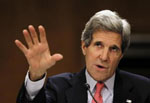
 UPI: The White House will make “absolutely certain” Iran “never has a nuclear weapon,” U.S. Secretary of State John Kerry said before returning to Washington Monday. He was to return a day before appearing before skeptical lawmakers on Capitol Hill. United Press International
WASHINGTON, Nov. 11 (UPI) — The White House will make “absolutely certain” Iran “never has a nuclear weapon,” U.S. Secretary of State John Kerry said before returning to Washington Monday.
He was to return a day before appearing before skeptical lawmakers on Capitol Hill to defend a proposed deal that would temporarily freeze some of Iran’s nuclear programs in exchange for a partial easing of Western sanctions.
Congress is threatening to push through additional economic sanctions against Tehran, a move diplomats say would likely complicate the talks.
The additional sanctions, which would end if an acceptable deal were reached, would be “insurance for the United States to make sure that Iran actually complies with an agreement that we would want to see,” Sen. Robert Menendez, D-N.J. — a member of the Banking Committee, which would vote first on the bill — told ABC’s “This Week” Sunday.
The possible deal with Iran, which did not come to pass during the weekend despite earlier diplomatic statements it was close, would be a first phase, lasting six months, followed by a bigger deal, Kerry told NBC’s “Meet the Press.”
The goal is to freeze part of Iran’s nuclear program during the first phase to create breathing room for the comprehensive agreement between Iran and the five permanent U.N. Security Council members — the United States, Russia, China, Britain and France — and Germany, he said. The world powers group is often known as the P5-plus 1.
“You have a set of guarantees that make absolutely certain that the goal of the president, to make certain that Iran never has a nuclear weapon, can be achieved,” Kerry told “Meet the Press.”
Besides Kerry’s return to Washington to defend the possible deal on Capitol Hill, other senior U.S. diplomats went to Israel and the Persian Gulf to try to win over skeptical allies and show the delay could ultimately lead to a better deal with Tehran, officials said.
Saudi Arabia and the other Gulf states see Iran as a regional threat and agree with Israel, in a rare coalition, that Tehran should have no ability to enrich uranium.
“We are not blind, and I don’t think we’re stupid,” Kerry told the NBC program.
“I think we have a pretty strong sense of how to measure whether or not we are acting in the interests in our country, and of the globe, and particularly of our allies, like Israel and Gulf states and others in the region.
“We are absolutely determined that this would be a good deal, or there’ll be no deal.”
The Wall Street Journal quoted diplomats involved in the talks as saying a number of P5-plus-1 miscalculations were behind the weekend failure to complete the first-stage agreement.
One miscalculation was the firmness of Israel’s opposition, the diplomats said. Washington and the other powers knew Jerusalem was against a deal but didn’t expect Prime Minister Binyamin Netanyahu to lobby leaders around the world against it as diplomats met in Geneva, Switzerland, the diplomats said.
They also didn’t expect French Foreign Minister Laurent Fabius to go public Saturday with a warning of a “fool’s game,” just as negotiations reached a critical point, the diplomats told the Journal.
The State Department had no immediate comment on developments in the talks.
A senior Israeli official told Israel’s Ynetnews website, “The Americans are anxious to sign a bad deal because they fear the only alternative left — sans deal — is a strike.”
Israel has said it reserves the right to attack Iran if it determines the country has reached a critical point in nuclear-weapons development. Iran insists its nuclear program is strictly for peaceful purposes.
“The deal really is bad,” the official told Ynetnews. “There’s no doubt that if they sign now, Iran will turn into a threshold state and there won’t be any deal that could stop Iran from developing its nuclear plan.”


