


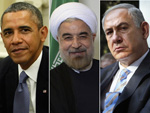
 The Hill: President Obama is pressing senators to ignore pleading from Israeli Prime Minister Benjamin Netanyahu and hold off on new sanctions on Iran. Netanyahu delivered exactly the opposite message over the weekend.
The Hill
By Julian Pecquet and Justin Sink
President Obama is pressing senators to ignore pleading from Israeli Prime Minister Benjamin Netanyahu and hold off on new sanctions on Iran.
Obama will host key senators of both parties at the White House on Tuesday to personally ask them to postpone new action while the administration pursues diplomatic talks with Iran over its nuclear program.
Netanyahu and his allies have launched a full-court press to get the Senate to buck Obama, with Ambassador to the U.S. Ron Dermer meeting with lawmakers.
“It’s the president’s view that it’s the right thing to do for Congress to pause,” White House spokesman Jay Carney said Monday, “so that we can test whether or not the Iranians are serious about resolving this issue diplomatically.”
Netanyahu delivered exactly the opposite message over the weekend.
“I think you should not only keep up the pressure,” he told CNN, “I think you should increase the pressure because it’s finally working.”
The dueling efforts are playing out as the Senate considers new sanctions on Iran’s energy sector. The House passed similar sanctions by an overwhelming 400-20 vote in July.
Obama’s unpopular request has put Democrats, already under pressure because of the health law’s troubled rollout, in a tough spot.
The White House has pushed back in recent days by intensifying its rhetoric, arguing that being too inflexible with Iran could make a military confrontation inevitable.
Netanyahu for his part argues that it’s Obama’s proposal to loosen sanctions in exchange for a freeze of Iran’s most advanced nuclear research that has put Israel at risk. Iran rejected the proposal, aimed at building support for a comprehensive deal, earlier this month, but Secretary of State John Kerry said the two sides were “extremely close” to a deal ahead of a new round of talks starting Wednesday.
Netanyahu’s economy minister, Naftali Bennett, was in Washington last week and urged lawmakers to “ratchet” up the pressure on Iran. And Dermer, who is scheduled to meet with Democrats and Republicans in Congress this week, tweeted out a message from Netanyahu on Friday calling an Obama-backed proposal to loosen sanctions in exchange for a freeze of Iran’s most advanced nuclear research as a “bad deal.”
“The ambassador is reiterating the public position of the PM, which is endorsed by the entire government and the opposition in Israel,” an Israeli official told The Hill via email.
The two sides have also clashed over the outlines of the pending deal. The administration has disputed Israeli estimates that Iran’s crippled economy would get an infusion of $20 billion to $40 billion, with Obama calling the relief “very modest” and reversible.
The American Israel Public Affairs Committee and other pro-Israel lobbies are also keeping up the pressure on the Senate. The sanctions bill is in the hands of the Senate Banking Committee but Republicans have vowed to bring it up as an amendment to the pending defense bill if Sen. Tim Johnson (D-S.D.), Banking’s chairman, continues to honor the administration’s request to sit on the bill.
“We continue to be supportive of bipartisan Senate efforts to enhance sanctions,” an AIPAC source told The Hill.
The administration can count on a handful of supporters as it makes its case.
Rep. Keith Ellison (D-Minn.) is hosting a congressional briefing with two experts opposed to new sanctions on Tuesday. And the liberal pro-Israel lobby J Street wrote in Israel’s Haaretz newspaper last week that passing new sanctions now would “undermine” Iranian President Hassan Rouhani “vis-a-vis hardliners in Iran.”
“There are two alternatives to a negotiated agreement,” wrote government affairs director Dylan Williams. “A nuclear-armed Iran and war — which many American and Israeli security experts believe will also ultimately result in a nuclear-armed Iran.”
Netanyahu has also sought to exploit differences between the United States and its international allies. He lavished praise on visiting French President François Hollande as a “true friend” of Israel over the weekend after France objected to a deal with Iran earlier this month.
The White House has downplayed talk of a rift with Israel over Iran.
U.S. officials “consult with Israel constantly on these issues,” Carney said Monday. He said there was “no daylight between the United States and Israel” on the mutual goal of preventing Iran from obtaining nuclear weapons.
Kerry for his part defended Netanyahu’s outspoken criticism of a deal his own State Department helped put together.
“I have great respect for his concerns about his country,” Kerry said at a press conference with visiting Turkish Foreign Minister Ahmet Davutoğlu. “The prime minister should express his concerns and he has every right in the world to publicly state his position and defend what he believes is his interest.”


