


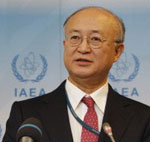
 Reuters: Iran is making “steady progress” in expanding its nuclear program and international sanctions do not seem to be slowing it down, the U.N. nuclear agency chief told Reuters on Monday. By Fredrik Dahl
VIENNA (Reuters) – Iran is making “steady progress” in expanding its nuclear program and international sanctions do not seem to be slowing it down, the U.N. nuclear agency chief told Reuters on Monday.
Yukiya Amano’s comments underlined the difficult challenges facing world powers in seeking to persuade the Islamic state to scale back nuclear activities they suspect could be used to make atomic bombs, a charge Tehran denies.
The surprise victory of moderate cleric Hassan Rohani in Iran’s presidential election last Friday has raised hopes for an easing of tension in the decade-old nuclear dispute.
Rohani pledged on Monday to be more transparent about Tehran’s atomic work in order to see sanctions lifted but he also said Iran was not ready to suspend its enrichment of uranium.
Amano, director general of the International Atomic Energy Agency, said he remained committed to dialogue with Iran to address the IAEA’s concerns about what it calls the possible military dimensions to the country’s nuclear program.
But no new meeting has yet been set after 10 rounds of talks since early 2012 failed to make progress in reviving a stalled investigation into suspected atomic bomb research by Iran.
“There is a steady increase of capacity and production (in Iran’s nuclear program),” Amano said in an interview.
Asked if international punitive steps aimed at making Iran curb its atomic activity were slowing it down, he said: “I don’t think so … I don’t see any impact.”
Iran, a big oil producer now under harsh Western sanctions against its lifeblood export sector, says its nuclear program aims to meet the electricity needs of a growing population.
STONEWALLING
But its refusal to suspend nuclear activity with both civilian and potential military applications in defiance of U.N. Security Council demands, and its lack of full openness with the IAEA, have fuelled suspicions abroad about its ultimate goals.
Western diplomats accuse Iran of stonewalling the IAEA, whose task it is to halt the spread of atomic arms in the world.
Amano made clear he did not agree with critics who say his agency is relying too much on intelligence data from the United States and its allies.
In late 2011, the IAEA published a report with a trove of intelligence indicating past research in Iran which could be relevant for nuclear weapons, some of which might still be continuing. Iran dismissed the findings as baseless or forged.
“The information comes from a larger number of countries (and) we have our own information,” said Amano, who has taken a tougher approach on Iran than his predecessor Mohamed ElBaradei.
The IAEA continues to receive information on possible activities in Iran that may be relevant for developing nuclear weapons, he said, adding: “It is difficult to say whether it is taking place today or not because we don’t have access.”
Amano said he did he did not want to speculate on whether the outcome of Iran’s election was a positive sign but he noted Rohani’s experience of nuclear issues. The mid-ranking cleric was Iran’s chief nuclear negotiator in 2003-05.
Western and Israeli worries about Iran are focused largely on its uranium enrichment work, as such material refined to a high level can provide the fissile core of an atomic bomb.
But diplomats and experts say a heavy water research reactor being built near the town of Arak could give Iran an alternative ingredient – plutonium – for nuclear bombs, if it were to decide to build such weapons of mass destruction.
Amano said Iran had made advances in building Arak but that it was difficult to say whether its timetable, which envisages it starting operations next year, was realistic. “Significant work remains (to complete the facility),” he said.


