


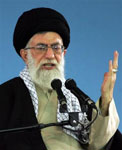
 UPI: Iran Supreme Leader Ayatollah Ali Khamenei issued a stern warning last week against the international community, which imposed sanctions last month targeting the regime’s vital oil exports and central bank. By ALI SAFAVI, UPI Outside View Commentator
WASHINGTON, Feb. 10 (UPI) — Iran Supreme Leader Ayatollah Ali Khamenei issued a stern warning last week against the international community, which imposed sanctions last month targeting the regime’s vital oil exports and central bank.
Immediately afterward, the regime launched new military exercises, threatening once again to close the Strait of Hormuz, through which a significant amount of global oil shipments pass each day.
In his remarks, Khamenei vowed to continue with the regime’s nuclear program even as broadened sanctions are beginning to inflict major economic pain.
“Iran will not give up,” he said, adding, “We will respond to threats of war and oil sanctions.”
Two days later, the deputy head of the regime’s Islamic Revolutionary Guards Corps issued another threat to regional countries, warning, “Any spot used by the enemy for hostile operations against Iran will be subjected to retaliatory aggression by our armed forces.”
Tehran’s bellicose posture should be taken seriously. But, underneath its belligerence and periodic war games, the regime is hurting. Oil exports, accounting for roughly 80 percent of state revenues, are gradually drying up and the national currency has reportedly lost about 60 percent of its value against the U.S. dollar over the past six months.
Deep fractures and unbridled infighting within the regime are becoming commonplace. And social discontent, already at critical levels, is sounding alarm bells in Tehran’s ruling circles just weeks before a parliamentary election.
Khamenei is desperate to consolidate. On Friday, he urged the “losers” of the upcoming elections to “surrender” to the results and avoid protesting. He knows the regime is vulnerable.
He was clearly trying to obfuscate a chaotic situation permeating the highest levels of his crippling regime, not to mention his deep trepidation over renewed social protests in the context of the Arab Spring.
Tehran’s rulers aren’t taking lightly the fact that their long-time ally in Syria is on the verge of demise. A completely different regional make up, disrupting the regime’s well-established routes to supply terrorist outlets, is undermining Tehran’s strategic depth.
Faced with strategic and concrete losses on all fronts, Khamenei is seen as trying to blackmail the international community by upping the ante in the hopes of reopening divisions in the united international front against his unremitting dash toward the bomb.
If that is in fact the regime’s ultimate calculation, it should be proven wrong. The only way to strengthen the unity of the international front is to close all loopholes in the sanctions regime that may provide even the most insignificant of lifelines to a desperate theocracy on the brink of collapse.
The international community must stand firm and relentless in its attempts to curb a major global threat emanating from Tehran. Clearly, without a fundamental transformation in the state structure of Iran, Tehran’s threats will continue to grow.
The regime knows that it is domestically doomed and the only way to survive is to push ahead with the nuclear program, continue its crackdown at home, reflected in 69 hangings so far this year, 16 of them in public, and spread its terrorism. Its military budget for the Iranian calendar year beginning in March, despite all the sanctions, has been increased by at least 127 percent. That isn’t the type of decision by a regime that is willing to compromise.
Khamenei is whistling past the graveyard. The world must not give in to the regime’s blackmail tactics. Not another moment can be lost to dithering and procrastinating while the regime inches toward the bomb.
Sanctions must be placed into a new paradigm of change of the regime instead of the old and unfruitful paradigm of change of behavior. In that spirit, the world must stand with the Iranian people and their organized opposition movement.
—
(Ali Safavi, the opposition National Council of Resistance of Iran, is president of Near East Policy Research, a policy analysis firm in Washington (www.neareastpolicy.com).)


