


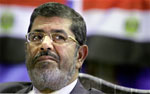
 Bloomberg: Israel and Hamas have claimed victory after their 8-day conflict, but both probably lost. The clear winners, for now, are Iran and Egypt’s President Mohamed Mursi. Bloomberg
By Marc Champion
 Israel and Hamas have claimed victory after their 8-day conflict, but both probably lost. The clear winners, for now, are Iran and Egypt’s President Mohamed Mursi.
Even taking at face value the Israeli military’s statistics on its success in destroying 40 percent of Hamas’s medium range rockets and the undoubted value of testing Israel’s Iron Dome rocket defenses, the prospect of any lasting peace between Israel and the Palestinians has been pushed one step further into the distance.
There are 163 more Palestinian “martyrs” to add to the litany of grievances, in addition to the six Israeli dead. The result is that Palestinians are yet more convinced that there is no possible long-term coexistence with Israel to be had, further radicalizing the future.
Israel also emerges yet more isolated within its own region. The fact that Hamas carefully provoked the conflict by firing repeated salvos of rockets into Israel has been conveniently ignored by other Middle Eastern leaders and media, who focus only on the more fatal Israeli response and its child victims.
Hamas has been celebrating victory, too. Without doubt it has upstaged its more moderate rival in the West Bank: Fatah. But as anyone who has reported from Gaza can attest, Hamas’s daily concern is not just Israel, but also the even more radical Palestinian factions in Gaza that Hamas does not control and with which it competes for local support.
The Iran-backed Islamic Jihad, by contrast, was a political winner, emerging as Hamas’s equal partner in the fighting. So were the radical Salafist groups that always benefit from violence and chaos. Unlike Hamas, the Salafists don’t have to govern or deliver salaries. In the past, some were jailed by Hamas for firing rockets at Israel without authorization. For the longer term, Hamas may have little to celebrate.
For Iran the Gaza conflict was a clear plus. It revived the Iranian regime’s claim, so badly battered by its support for President Bashar Al-Assad in Syria, to carry the flag for revolutionary Islamism across the Middle East, whether Shiite or Sunni in character. For more than a year it had seemed Iran’s ties to Hamas and Sunni radicals fighting against it in Syria had been weakened. After the ceasefire, Hamas publicly thanked Iran for its support.
For a time, at least, the lopsided Gaza conflict has redirected popular Arab anger at Israel, distracting attention from Iran’s support of the daily slaughter in Syria.
The fighting has also proved that Iranian-supplied and designed rockets can reach Tel Aviv from Gaza. Hezbollah’s more sophisticated Iranian weaponry in Lebanon, meanwhile, remains in the wings. That looks like a message, at a time when Israel is threatening to launch air strikes against Iran’s nuclear program.
Egypt’s President Mursi was also a significant winner. By mediating a cease-fire he proved his value and leverage as a dealmaker to Hamas, his own people, Palestinians and the Arab world at large, and to Israel, Europe and the U.S. The general conclusion is that while other Arab leaders grandstanded, Mursi prevented another Israeli ground invasion of Gaza, with all its consequences.
It’s no coincidence that Mursi chose this moment, when his indispensability to so many interested players is unquestioned, to issue a controversial decree sacking Egypt’s prosecutor and stripping the constitutional court of the power to review his executive orders. Both were holdovers from the old regime of former President Hosni Mubarak.
With parliament already dissolved and a new constitution still under construction, Mursi now wields absolute power in Egypt.
(Marc Champion is a member of Bloomberg View’s editorial board.)


