


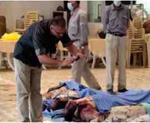
 UPI: While Washington is gridlocked on the federal budget dispute between the White House and U.S. Congress, there was consensus by U.S. senators from both sides of the aisle on the U.S. commitment toward Iranian dissidents in Iraq.
United Press International
By MURIEL TURNER, UPI Outside View Commentator
LONDON, Oct. 10 (UPI) — Bipartisan consensus is a rare commodity in Washington these days. While Washington is gridlocked on the federal budget dispute between the White House and U.S. Congress, there was consensus by U.S. senators from both sides of the aisle on the U.S. commitment toward Iranian dissidents in Iraq, residents of Camp Ashraf and the need for quick American actions to save the lives of seven exiles who were abducted by the Iraqi government on Sept. 1.
It happened when Oct. 3, the Senate Committee on Foreign Relations had a hearing regarding Iran’s nuclear program with the Undersecretary for Political Affairs for the State Department Wendy Sherman giving testimony. During her testimony, Sens. John McCain., R-Ariz., and Robert Menendez, D-N.J., questioned her about the events of Sept. 1 at Camp Ashraf in Iraq.
On Sept. 1, 52 innocent Iranian refugees were killed in cold blood, many while trying to receive medical treatment. They were handcuffed and executed. Seven individuals — six women and a man — were taken hostage by the attackers and haven’t been heard from since.
Given the security around Camp Ashraf, only the Iraqi Special Forces were capable of carrying out this attack. Iraq has of course denied any involvement in this horrific incident and continues to deny knowledge of the hostages’ whereabouts.
Both McCain and Menendez confirmed with Sherman that the United States had guaranteed the safety of the inhabitants of Camp Ashraf. When Sherman acknowledged that the United States had promised protection to these innocent Iranian dissidents, both senators spoke out that the United States should have backed up their promise of security for these refugees.
Menendez, the chairman of the Senate Foreign affairs Committee stated that “it is unacceptable to lose one more life when American commanders gave these individuals a written guarantee toward their safety and it sends a message to others in the world that when we say that we are going to do that, and we do not, that they should not trust us.”
Sherman went on to detail the actions that had taken place at a new camp in order to protect the refugees stating that “the government of Iraq has moved in 700 large T-Walls, over 500 bunkers, over 600 small T-walls and nearly 50,000 sand bags.” Menendez countered that “when elements of the Iraqi forces actually may very well be complicit in what took place, sand bags are not going to take care of the problem.”
Sherman said the easiest way to guarantee the safety of the Iranian refugees in Iraq is to move them out of Iraq entirely given the growth of Iranian influence and al-Qaida Forces in Iraq. Menendez offered that “the United States could be part of leading of the way in saying to a universe of these individuals that in fact you can be resettled to the United States and that would get the rest of the world to offer further resettlement.”
Given the government of Iraq’s role in the Sept. 1 massacre, McCain declared that Congress will “have to look at the kind of aid (Congress is authorizing) and how we are extending that to Iraq” if actions such as these are taking place. Menendez went one step further by suggesting that the United States would halt the sale of any and all arms to Iraq until the seven hostages have been freed.
While Sherman raised objections to that line of thinking, Menendez seemed firm in his resolve on this issue. He went on to say that “the seven hostages, which we believe the government of Iraq knows where they are, should they die, it would be complicating matters” regarding the United States’ relationship with the government of Iraq.
Given the rumored arrival of Iraqi Prime Minister Nouri al-Maliki to the United States soon, these words from the Senate Foreign Relations Committee cannot be spoken loud enough. The United States obviously knows that Iraq was responsible for the horrific Sept. 1 attack. Furthermore, they are finally taking action regarding the seven hostages held in Baghdad by Iraqi Special Forces at the behest of Tehran.
Hopefully, the words of the Senate Committee on Foreign Relations are also heard by the White House and the Obama administration demands that Iraq release the hostages or face the consequences in Washington.
While a majority of the Western World seems to be looking the other way regarding the attack at Camp Ashraf, the U.S. Senate has shown that its members are willing to lead on this issue and are willing to take steps to ensure the safety of the remaining Iranian refugees, as well as the seven hostages held captive by the government of Iraq’s Special Forces in Baghdad.
—
(Baroness Muriel Turner of Camden was deputy speaker of the British House of Lords until 2008 and she is a leading member of the British Parliamentary Committee for Iran Freedom.)


