Home Blog Page 272

Protests Continue in Khuzestan for the Seventh Night

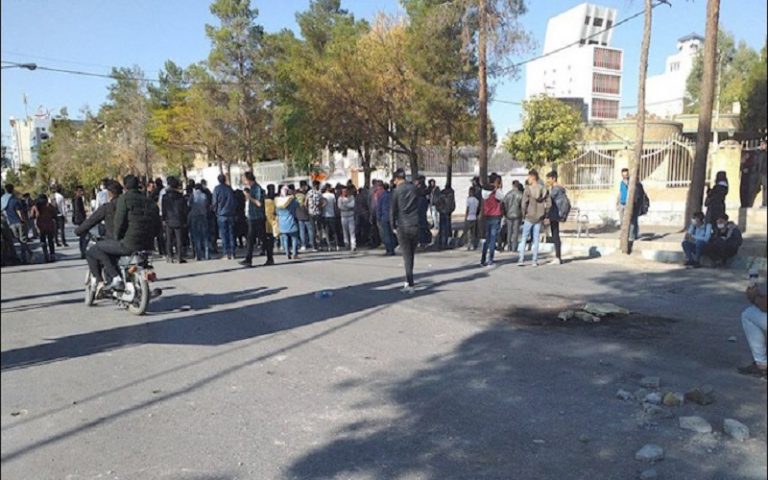
At night on July 21, the people of the southwestern Iranian province of Khuzestan once again took to the streets in the cities of Ahvaz, Dezful, Shadegan, Ramshir, Mahshahr, Khowr-e Musa, and Masjed Suleiman.

Furthermore, the protests over water shortages in Khuzestan expanded to other parts of the country, and residents of Yazdanshahr, Isfahan province, and Karaj, Alborz province, and Bushehr and Bandar-e Genaveh, Bushehr province, came onto the streets, declaring their solidarity with protesters in Khuzestan.

To silence demonstrators, authorities mobilized a significant number of security forces and members of the Islamic Revolutionary Guard Corps (IRGC) from various provinces and dispatched them to Khuzestan. However, fed-up people, who have nothing to lose, continued protests despite a heavy security atmosphere and the government’s atrocities.

In Izeh city, where people had chanted, ‘Death to [Supreme Leader Ali] Khamenei,’ security forces and IRGC members used live ammunition to disperse defiant youths. As a result of direct shooting at defenseless protesters, several people were killed and dozens more injured.

Simultaneously, the people once again flooded onto the streets in Susangerd and Ramshir despite the government’s cruel suppression. In Shadegan and Masjed Suleiman, outraged people held massive gatherings and marches in support of other cities. They called on citizens to unite against the oppressive government.

In Khowr-e Musa, the people joined the demonstrations and came to the streets. In Behbahan, protesters set tyers ablaze and blocked several roads to slow oppressive forces’ move and prevent more suppression. In Dezful, demonstrators blocked several streets. Security forces tried to intimidate them through air shooting and chasing youths. However, they extremely resisted and pushed back oppressive forces.

Moreover, youths in the Sheiban district of Ahvaz joined the protests against severe water shortages and blocked the main access road in the region. In the Zargan and Malashie districts of Ahvaz, the people once again took to the streets and chanted anti-establishment slogans against the religious dictatorship ruling Iran.

In Yazdanshahr, Isfahan province, the residents of Eidivand district rallied in solidarity with the people of Khuzestan. To disperse protesters, security forces attacked them. In response, people resisted and chanted against Khamenei as the root of Iran’s dilemmas.

In Karaj, Alborz province, the residents of  Mahdasht district went on the rooftops and chanted in support of the people of Khuzestan. “Khuzestan is not alone,” they chanted. Furthermore, the residents of Bushehr and Bandar-e Genaveh cities took to the streets in solidarity with the protesters in Khuzestan and blocked several streets, preventing the government from dispatched oppressive forces to Khuzestan.

The recent protests, which have continued for a week, have severely shocked the authorities. In tandem with oppressive measures, they try to portray a popular image of themselves. Khamenei, who was targeted by outraged chants, reposted his deceitful remarks on Instagram to evade responsibility.

“Officials are tasked to follow up Khuzestan’s problems. If someone thinks about the people, they cannot remain comfortable versus the hard issues in Khuzestan. This is a definite, urgent, and ongoing task of governments to think about the people,” Khamenei posted.

On the other hand, the government continues oppressive measures and dispatches more riot forces to the region. Authorities also disrupted mobile internet to prevent leaking more information about Khuzestan protests and pave the path for more suppression.

“Network data from NetBlocks confirm a significant regional disruption to mobile internet service in Iran beginning Thursday 15 July 2021, ongoing almost a week later as of Wednesday 21 July 2021,” The Internet’s Observatory NetBlocks reported on July 21.

In the Real World, China and Russia Are Turning Away From Iran

Negotiations to revive the 2015 Iran nuclear deal JCPOA have stalled, and the task of the seventh round of talks is still unclear. At a time when there is no clear prospect of talks between Iran and the United States, some of Iran’s political figures say that Iran is turning to the Eastern powers and claim that the problem of sanctions will be solved by signing 25-year cooperation documents between Iran, Russia, and China.

These largely principled political figures, speak about the Chinese $ 400 billion in capital inflows, saying that the way out of the pressure of sanctions is to take refuge in the world’s second-largest economy, China and, of course, Russia.

The signing of the 25-year Iran-China cooperation document had many ramifications. Many Iranians, who did not have happy memories of China’s economic interactions with Iran, opposed the signing of the document in various ways, but the signing took place while the regime had previously signed a similar document with Russia.

None of these documents made the years of sanctions on Iran easier. Even in 2016 and after the JCPOA, Iran was able to enter negotiations with the United States to buy Boeing aircraft, but Russia did not accept to sell its Sukhoi aircraft to Iran.

Now that the window on the JCPOA’s revival talks is said to be closing, some opponents and even supporters of the JCPOA in this regime see China and Russia as a replacement to the United States and believe the two Eastern trading partners will be able to move Iran out of the economic stalemate.

But the narratives of some other political and economic figures about how the Eastern powers interacted with Iran are very different and even contradictory.

In the meantime, we can mention the recent speech of Eshagh Jahangiri, Iran’s first vice president, held at the Central Bank.

He said: “We did not think that even India would not buy oil from Iran and would not revalue it, and even Russia and some neighboring countries for which we have sacrificed our children for the independence of their country did so, and we were alone in this economic war and did not retaliate. We could only circumvent the sanctions, move the goods, and bring in the money to buy the goods by adopting policies after the banking sanctions.”

After the sanctions against Iran, China was not only one of the first countries to withdraw its capital from the oil and gas, automobile, and infrastructure projects, such as highway and rail projects, etc., even blocked the regime’s resources. Iran is said to have about $40 billion in blocked assets in five countries, half of which are in China.

But China not only blocked a significant amount of Iranian assets, but also took advantage of sanctions to buy Iranian oil at below world prices and at high discounts, and even, according to petrochemical industry activists, brokered some Iranian oil products, such as urea, and bought it at a cheap price from Iran and exported it to India.

This is a simple example of why many regime’s opponents say that the regime is selling and auctioning the country. Meanwhile, China’s trade volume with the United States, Saudi Arabia, the United Arab Emirates, and even Israel is so large that Iran is not a major trading partner for it, and it seems that it prefers its national interests in trade and, according to economic activists, friendship has no meaning in trade.

It is good to know that currently, the volume of trade between Iran and China has reached the lowest figure in the last 16 years. Majid Reza Hariri, head of the Iran-China Chamber, told ILNA in this regard:

“As our total international and cross-border trade shrinks, so does our share of trade with China, as Iran and China have not had so little trade with each other in the last 15 or 16 years.”

According to him, according to statistics, by the end of 2020, the volume of trade between Iran and China was about $16 billion, which, including the unofficial sale of oil, still does not reach $ 20 billion.

Hariri also stressed: “The decline in our foreign trade last year has been unprecedented in the last 10 or 12 years. In other words, in terms of the volume of our foreign trade, we are back to the mid-1990s, an important part of which was due to heavy sanctions in 2020 and declining oil sales. Naturally, in these circumstances, we cannot provide the necessary currency for imports.”

Referring to some problems in Iran-China exchanges, he said: “However, it is difficult to buy some goods from China and from US-licensed companies that are either American-owned, have US shareholders, or are active in US markets. Of course, this is not a decision made by the Chinese government, but corporate decisions.

“This is a problem not only for vaccines but also for many other commodities from companies that work with Americans, are listed on the US stock exchange, or use American raw materials.

“Businesses ultimately prefer corporate interests even in the case of oil, China has officially stated that it will not accept unilateral US oil and non-oil sanctions. But many Chinese companies do not work with us lest their corporate interests are jeopardized.

“There are other issues, such as port sanctions, all of which affect trade between the two countries. If Iranian ship anchors in a port, the port, and its operator face US sanctions. The oil companies in China are commercial enterprises and do not prefer political issues to commercial ones.” (ILNA, July 18, 2021)

Shoaib Bahman, an expert on Russian issues, told ILNA: “Over the past years, one of the major challenges in Iran-Russia relations has been the development of trade relations. The trade volume between the two countries has always been below $2 billion, which is not a significant figure in international trade relations.

“The amount of trade agreements signed between Iran and Russia reaches more than $25 billion, but you can see that the level of operational trade relations between the two countries is less than $2 billion.”

About the regime’s backwardness in economic relations, he added: “For example, the trade volume between Turkey and Russia is more than $ 30 billion, and the two sides planned to increase this figure to $100 billion, which is a determining factor in political issues.”

He said that even other countries do have not a good economic relation with Iran and added: “And of course, even neighboring countries like Iraq have behaved similarly with Iran’s trading partners, and not only they have considered higher tariffs on imports from Iran than their other partners but repeatedly refused to settle its $5 billion debt with Iran under various pretexts.”

Iran Economic Collapse, As Explained by State Media

The Iranian economic crisis, caused solely by the mullahs’ corruption and failed policies, is now at a critical point as President Ebrahim Raisi prepares to take office, according to the state-run media.

The Setar-e Sobh wrote that the “most important challenge” Raisi will face is the millions of people living under the poverty line, who will “lose their trust in [the mullahs]” if they’ve not already done so.

The Jahan-e Sanat explained on Sunday that 71% of food items have increased in price to a “crisis level”. The largest month-on-month price increases were pasteurized butter (up 121.4%), chicken (118.8%), and cooking oil (89.0%). This essentially equates to an annual inflation rate of 24%. They described the commodity market’s current state as “deplorable”, saying that the government can’t control the market, which is why commodity prices are rising.

The paper quoted economist Massoud Nilly as saying: “We are really on the verge of severe uncontrollable inflation. Currently, financing, energy supply, services, public budget, social services, and the world exchange system are the six priority problems of the country, whose functions are currently completely disrupted.”

Of course, the reason for the inflation mentioned above is banknote printing, which causes liquidity of nearly  $150 billion.

The Hamdeli daily wrote that the 228 trillion Tomans liquidity growth since 2020 has resulted in 25 items increased in price two to five times, meaning that even very cheap food has become a luxury that most Iranians cannot afford.

Hamdeli wrote: “[Based on] the latest statistics released by the Ministry of Industry, Mines and Trade show that the prices of 25 goods have increased by about two to five times in the second month of spring this year alone. It is said that the prices of some types of livestock and poultry feed, rice, oil, poultry, as well as metal and rubber in May this year have increased by more than 100% and between two to more than five times and 40 goods including meat, rice, dairy, Beans, sugar, and tea became more than 50% more expensive.”

The fact is that the government cannot resolve the economic crises that the country is facing because they are responsible for the wrong policies and corruption that have caused the problems in the first place. The people see this, which is why they boycotted the election in June. They support regime change as the only way to change their fate.

Drought in Khuzestan Due to the Implementation of a Non-Expert Water Transfer Project

The water crisis in Iran has become one of the main crises. One of the worst-hit areas is the south-western province of Khuzestan.

Now many days the farmers in this region are protesting water scarcity. But the situation is not limited to the of the farmers and the daily life of the people is collapsed having no drinking water. The provincial water and electricity organization is forced to supply water to many villages in the province by tanker, which of course is not enough, and, in many situations, it does not even cover the daily need of one day.

Many people in this province consider the transfer of Khuzestan water to the central plateau of Iran as one of the most important causes of water shortage in their province these days. And mismanagement of water resources added to the drought has made the people of this province become thirsty.

About one-third of the country’s current water resources should flow naturally to Khuzestan province, but since the beginning of the ’80s, various projects have been implemented in Karun and Dez springs, and now a large part of the water of these two rivers is directed to Isfahan and Yazd provinces.

Meanwhile, before the water stress this year, about 700 villages in Khuzestan were supplied with water by tanker, and now, with the drying of the end branches of Karkheh, the number of these villages has exceeded a thousand, which is a clear indication that the thirst of the people has nothing to do with the claims of the government about the drought.

Seyed Ahmad Avaei, an MP, described the transfer of Khuzestan water to the central plateau of Iran as the most important cause of water shortage in his province and said to the state-run news agency Rokna: “Unfortunately, the implementation of water transfer projects from the sources of Dez and Karun began from the government of the late Hashemi. This, of course, was a grave mistake from the beginning, and subsequent governments are continuing to do so.”

He added: “Transferring water from Khuzestan to the central plateau of Iran is a mistake, unprofessional and highly anti-environmental, which has harmed the people of Khuzestan, especially the people of the cities and villages below these rivers. After the ‘economy-first’ government (Akbar Hashemi Rafsanjani), while the governments continued to make this mistake, many experts emphasize that the solution for the development of the central provinces is not the transfer of water from Khuzestan.

“Even some officials of this government admit that the continuation of water transfer from the sources of Dez and Karun to the central plateau of Iran is wrong, and when I spoke with the current head of the Environment Organization, he also acknowledged that this should not be done.”

Then he confessed about the misuse of this transferred water while he acknowledged that this water is used for agricultural and industrial issues which in many cases are the unnecessary projects lead by the IRGC and said:

“If the officials of the previous governments wanted to provide only drinking water to the people of the central provinces, they could have solved the problem of the people of Isfahan, Yazd, etc. by building pipelines that carry only as much water as the drinking water of these provinces. But unfortunately, the share of water that can lead to the development of Khuzestan has been transferred to the central plateau of Iran for many years for the development of industry and agriculture.”

Many others in this government also criticized this action, including Ahmad Avai, MP from Dezful, who said, “The strategy for the development of these provinces was not the transfer of water from the sources of Karun and Dez from the very beginning, and this measure has led to unbalanced development in the country so that agricultural water and industrial water of the central provinces are often provided, but the people of Khuzestan, especially the farmers of this province, face the water crisis at many times.”

Koohrang 2 pipeline was one of the most important pipelines for transferring water from Khuzestan to the central plateau of Iran and currently the Ministry of Energy is building the Koohrang 3 pipeline to complete water transfer projects from Dez and Karun springs to the central plateau of Iran.

AMIA a Case of Unresolved Terror by Iran’s Regime

On Sunday, May 18, family members of the bombing victims of the Argentina-AMIA Jewish Center building which happened 27 years ago, a terror attack which was decided at a meeting of the Iranian regime’s Supreme National Security Council, commemorated their loved ones and demanded that the case be pursued.

On July 18, 1994, a car bomb with a powerful explosive turned the Jewish charity building in Buenos Aires into a pile of debris. The blast killed 85 innocent people and more than 300 were wounded. The operation was designed such that no one could easily find the perpetrators.

Survivors of the harrowing terror act said they were “outraged” that as the years passed, Argentina’s judiciary has yet to put anyone behind bars.

A ceremony to commemorate the victims of the AMIA building explosion was held virtually this year under the slogan “27 years without justice, but full of memories.”

Argentina’s President Alberto Fernandez also tweeted a tribute to the families of the victims, saying, ” In memory of every one of (the victims) and in honor of those that lost their loved ones, we must unite against impunity.”

The terrorist blast, which targeted the Jewish central building in Buenos Aires, remains the most dramatic and bloody terrorist incident in Argentina’s history.

It should be noted that a lengthy investigation by Argentina’s investigators, judiciary, and police about the terrorist blast was quickly tied up with financial corruption and complex jobbery, and even moved away from its original targets, which is finding the wrongdoers so that there are not spared from the right punishment.

Three weeks after this terrorist adventure, the National Council of Resistance of Iran (NCRI) made a major revelation, capturing the attention of news agencies.

According to information leaked by the Iranian Resistance, the decision to carry out the bombing was made at a meeting of the Iranian regime’s Supreme National Security Council, headed by Ali Akbar Hashemi Rafsanjani, on Saturday, August 14, 1993, in the presence of military advisers and fixed members, and after final approval by the Supreme Leader Ali Khamenei, the supreme leader ordered that Brig. General Ahmad Vahidi, then commander of the IRGC-Quds Force, should carry out this terror.

In a meeting of the Quds Force’s Command Council, Vahidi assigned the implementation of this mission to the regime’s terrorist diplomats, Ahmad Reza’eh Asghari, and Mohsen Rabbani, as well as Imad Fayez Mughniyeh, an element of the Hezbollah.

Morteza Reza’i (IRGC Intelligence Protection), Tehrani (Commander of the Quds Force Support), and Ahmad Salek (Khamenei’s representative in the Quds Force) also attended this meeting.

How were the bloody hands of Iran’s clerical regime covered up in the AMIA explosion?

The Iranian regime paid $10 million in bribes to the then President of Argentina Carlos Saúl Menem to cover up the regime’s bloody hands.

The Washington Post unveiled the dirty deal in January 2007. Carlos Menem lost credibility. Juan Jose Galeano, the investigating judge in the case, was also arrested for derailing the judicial process.

After the incident, Alberto Nisman headed an investigative team. Finally, on October 26, 2006, Argentina’s federal prosecutors formally charged Rafsanjani and seven of his government ministers and demanded that they be arrested.

Ali Akbar Velayati was Iran’s foreign minister at the time of the attack and, as mentioned above, was actively involved in the decision and the subsequent coordination of this terror attack.

On 12 January 2015, the blood-stained body of Alberto Nisman was found at his home, next to a 22mm caliber colt. His murder occurred just as he wanted to testify behind closed doors the same day by attending a congressional hearing, unveiling a deal with bloody dollars between Cristina Fernandez Kirchner’s government and the Iranian regime.

Iran: “Do Not Maneuver So Much on This Money”

Recently the US government issued a license allowing South Korea and Japan to repay their debts to Iran in a non-cash form but in the form of goods from these countries or third countries.

On this subject, the state-run daily Jahan-e-Sanat on July 15 wrote: “(Washington) Free Beacon reported that the US State Department informed Congress late Tuesday that it would lift some of the trade sanctions to gain access to Iran.

The purpose of this waiver, signed by Secretary of State Anthony Blinken, means the transfer of Iranian funds in limited accounts to exporters in Japan and the Republic of Korea. The State Department, meanwhile, has said it will not allow funds to be transferred to Iran and will only allow repayments of Japanese and Korean companies that exported non-sanctioned goods and services before the US administration tightened US sanctions.”

And the media affiliated with the faction of the regime’s President Hassan Rouhani reacted in two different ways to the action of the US government.

Some of them called it the revival of the JCPOA (Iran nuclear deal) and a positive sign from the US government, and some of them watched this event with skepticism and even concern.

Because what has raised the concern of even state media is not the release of these funds, but the corruption that has penetrated in the entire regime’s government, and the fate of any fund and money coming into the country is ambiguous.

Regarding the ambiguity of this issue, Aftab-e-Yazd newspaper in an article titled ‘These should be told to the people’ wrote:

“What is the exact story of this blocked money and why people and society should not rely too much on it!” (Aftab-e-Yazd daily, July 15, 2021)

This short expression is a clear statement about corruption and that the people will not gain anything from this money.

Regarding the maneuvers of the government with this fund, this media added: “We wished that the gentlemen of the new and old governments do not maneuver so much on this money. This is the unreasonable provocation of society. If the JCPOA is revived, no money will run into the country, but the doors may be opened for investment to some extent. With optimism maybe tomorrow Biden will have a stroke and Trump will come again and say I do not accept the JCPOA.

“The JCPOA, Trump, internal barriers in Iran, etc. are bitter experiences that no powerful foreign investor is willing to repeat. These must be told to the people. Is this right?” (Aftab-e-Yazd daily, July 15, 2021)

Jahan-e-Sanat newspaper quoted a government expert named Ali Bigdeli as saying that he is less hopeful about allowing Iran access to its money. “He said: ‘What has been said in the news about the exchange of blocked Iranian money is actually about the joy they show, but it cannot be very pleased. Let us not forget that the recent orientation of the Americans shows that they are frustrated with the negotiations with Iran and are likely to take other paths.

“They seem to be forming a new front in the Middle East and the Persian Gulf. This front consists of Turkey, Saudi Arabia, Israel, and Egypt, and if it is formed, it will be very dangerous for us because it will put us in political and economic isolation in the region.”

Jahan-e-Sanat newspaper, while calling the American action insignificant and calling it a ‘gleam of hope’, considered it unnecessary to show this action as a big deal and wrote in this regard:

“As some people think, the dollars are not on the way for Iran to spend it for its wishes and its daily needs.”

Then this media about the expectations of the US government contrary to this action said: “As in the old times said, what goes around comes around. If the US has opened the pocket for us and with a little flexibility, it allows us to use our money, it has definitely expectations, expectations that must have a positive answer, to lead to the settlement of cases and the agreement in Vienna.”

Although this media has not given a clear explanation about these expectations, the US officials have made it clear since the start of the JCPOA talks that the 2015 JCPOA alone is not enough for them and that the regime must negotiate its missile program, regional policy, and human rights.

Destroyed Capacities of Iran’s Economy

Iran’s economy is grappling with several crises due to structural corruption. Crises that result in negative growth, inflation, liquidity, declining people’s baskets, poverty, and misery for at least 60 million people.

A part of this critical situation is clearly seen in the pouring of thousands of liters of milk by deprived ranchers in front of the regime’s administrative centers or dumping agricultural products in front of the regime’s Agricultural Jihad offices. It is also seen in the protests of farmers and ranchers against water scarcity, high costs, and shortage of livestock inputs.

The situation is so grim that the regime’s experts, not out of pity for the people who are crushed under the burden of a shattered economy, but in fear of the uprising of the deprived, warn each other of a devastating flood that will sweep everyone away.

“Now, Iran’s economy is held hostage because of the interests of the mafias, and the blow of this mafia is enduring the people. We are facing the phenomenon of the conquest of the power structure by greedy people, brokers, and corrupt people. The main issue is that Iran’s economy is in the hands of the unproductive. Rent-seekers and speculators are occupying the economy.” (State-run daily Etemad, July 14, 2021)

These freeloaders and mafia gangs have also made every effort to isolate and imprison Iran in the name of independence from other countries especially the West so that they could plunder Iran’s reserves and wealth safely and, destroy national assets.

“In recent decades, Iran’s economy has moved away from development. Political tensions and the escalation of sanctions, along with mismanagement and inefficiency of managers in various governments, have exacerbated this issue and prevented the Iranian economy from achieving growth and development, and led to the spread of poverty as much as possible. Today, Iran’s economy is like an island far removed from the world economy.” (Akhbar Sanat, July 14, 2021)

“Today, we do not have stable exports and imports from neighboring countries and the world, and in trade agreements, we have not defined a reciprocal flow for any of the countries and international unions,’ said a spokesman for the country’s merchants and traders.” (Donya-e-Eghtesad, July 10, 2021)

In the Presidential election, each of the candidates made a series of bogus promises, none of which are practical. But suppose their fantasies become real, and we can see it four years later. For example, a subsidy of 450,000 Tomans should be paid to 40 million Iranians. A marriage loan of 500 million Tomans has been given and two million houses are under construction.

This situation can be considered almost similar to the time of Ahmadinejad, of course minus the legendary income of oil. Such money-wasting has no other benefit than causing more severe inflation and a major mess in the financial and budgetary system.

Even now, the crushing budget deficit has flattened the Rouhani government. So higher costs mean higher inflation and more severe economic and social crises.

Mohammad Tabibian, an economist described this tumultuous and dangerous situation as follows: “If these slogans are implemented in the coming 2025, they will not achieve much other than creating a new turmoil in the budget, banking, financial, social, and economic systems. The country’s economic problems cannot be solved by paying more subsidies and loans.” (Tejarat News, July 14, 2021)

This expert pointed to the economic crisis and summarized:

“If they think that the government can solve the housing problem by building houses. It is not bad to study the hundred-year history of governments trying to solve the housing problem.

“Now see what has happened to Tehran. All the gardens and green spaces around Tehran have been turned into residential lands and there is still not enough housing in this city.

“See what a disaster has happened in this city and the cities that have grown too big. The degree of the plainness of the minds of some officials is astonishing, they imagine that young people do not get married because they are waiting for their marriage loan to be approved so that they can get married.

“Young people avoid marriage because they do not have a job and their future and that of their children are unclear. Were they lending money to someone in the pre-revolutionary period and throughout history?

“These gentlemen think that money should be paid to solve the problems of all fields. For a nation to have a better life, real commodities are needed, and money does not work.

“Money only creates inflation. Regarding the fact that 70% of the production capacity is empty, does it mean that the current government did not know how to deal with and use the out-of-work production capacities and Mr. Candidate does?

“This view is not right. This is the entire performance of our economy, and its potential capacity is this situation which you can see. As long as there is no investment, there is no potential to take advantage of it.” (Tejarat News, July 14, 2021)

While the Ayatollahs Hold Power, No Journalist Is Safe

On Wednesday, July 14, the U.S. Justice Department charged four Iranians for an abduction plot against Iranian-American journalist Masih Alinejad. Alireza Shavaroghi Farahani, also known as Vezerat Salimi and Haj Ali, 50; Mahmoud Khazein, 42; Kiya Sadeghi, 35; and Omid Noori, 45, was involved in the plot, according to a DoJ indictment.

Furthermore, the indictment revealed that a resident of California, Niloufar Bahadorifar, also known as Nellie Bahadorifar, 46, is alleged to have provided financial services that supported the plot.

The Iranian opposition National Council of Resistance of Iran strongly condemned Tehran’s Ministry of Intelligence and Security’s plot against Ms. Masih Alinejad and four other Iranians in Canada and the United Kingdom, as reported by the U.S. Department of Justice and the media.

“For the past four decades, in addition to torturing, executing, and massacring political prisoners, Iran’s ruling religious fascism has always made the most of terrorism, kidnapping, and hostage-taking as well as all political, diplomatic, and economic resources as a tool against the opposition and to advance its criminal policies,” the NCRI statement read. “This regime must be shunned by the international community, and its leaders must be brought to justice for their crimes against humanity.”

Tehran orchestrated the plot while Iranian negotiators have already expressed their enthusiasm for prison swamp with the U.S. “Negotiations are underway on the exchange of prisoners between Iran and America, and we will issue more information if Iranian prisoners are released and the country’s interests are secured and the talks reach a conclusion,” said Ali Rabiei, the spokesman of outgoing President Hassan Rouhani’s cabinet, on April 27.

Iran’s Terror Attempts in the U.S. and Europe

However, the recent foiled kidnapping operation was neither the first nor the last of Tehran’s terrorist attempt in the U.S. or Europe. Back in August 2018, Ahmadreza Mohammadi-Doostdar, 38, a dual U.S.-Iranian citizen, and Majid Ghorbani, 59, an Iranian citizen and resident of California, were arrested in accordance with a DoJ indictment. They were charged with conducting surveillance and gathering information on behalf of Iran on the NCRI–U.S. Representative Office.

“Ghorbani attended a MEK rally in New York on Sept. 20, 2017, to protest the current Iranian government, taking photographs of the participants, which he later passed on to Doostdar and was paid about $2,000,” the indictment read. “The photos, many with handwritten notes about the participants, were found in Ghorbani’s luggage at a U.S. airport as he was returning to Iran in December 2017.”

During the investigations, Doostdar admitted under oath that he traveled from Iran to the US three times to give Ghorbani directions from the Iranian government. Ghorbani then attended two MEK rallies, in New York City and Washington, D.C. in September 2017 and May 2018, respectively.

Read More:

Two Iranians Indicted for Spying on the US for Iran

Earlier, in October 2011, Federal Bureau of Investigation and Drug Enforcement Administration agents disrupted a plot to commit a ‘significant terrorist act in the United States’ tied to Iran, ABC News reported.

“The officials said the plot included the assassination of the Saudi Arabian ambassador to the United States, Adel Al-Jubeir, with a bomb and subsequent bomb attacks on the Saudi and Israeli embassies in Washington, D.C.,” U.S. federal officials said.

“The plan was ‘conceived, sponsored, and was directed from Iran’ by a faction of the government and called it a ‘flagrant’ violation of U.S. and international law,” said then U.S. Attorney General Eric Holder. “The U.S. is committed to holding Iran accountable for its actions.”

Furthermore, the MOIS and the Islamic Revolutionary Guard Corps–Quds Force (IRGC-QF) masterminded several terror attempts against the NCRI and the Mojahedin-e Khalq (MEK) on European soil. In March 2018, Albanian authorities foiled a bomb plot attempt against MEK members in the capital Tirana.

They later exposed that the terror plot was backed and supervised by the Iranian embassy. Later, in December 2018, the Albanian government expelled Tehran’s ambassador Gholam-Hossein Mohammad-Nia and his first deputy Mostafa Rudaki—the head of Tehran’s intelligence station in Albania—from its territory for involving in the attempt and disturbing the country’s national security. Authorities also expelled several other ‘diplomats’ and ‘agents’ in this regard.

In June 2018, in a joint counterterrorism operation, Belgian, German, and French authorities foiled a bomb plot against the NCRI annual gathering Free Iran 2018 in Villepinte, a suburb of Paris. Prosecutors detained Tehran’s third counselor in Vienna Assadollah Assadi, as the plot’s architect in the German state of Bayern. They also arrested Assadi’s three accomplices.

In February, a Belgian court convicted Assadi to 20 years in prison for transporting 1lb explosive material TATP on a civil flight with diplomatic coverage, hiring an Iranian-Belgian couple, and delivering the bomb to them in Luxembourg. The further investigation exposed that Assadi was the chief of Tehran’s intelligence station in Europe. He had derived the post from Roudaki in 2013.

Moreover, MOIS agents freely conducted several terror plots on Turkish soil. They abducted NCRI member Abolhassan Mojtahedzadeh in 1989; assassinated NCRI member Zahra Rajabi and her assistance Ali Moradi in 1996; and abducted and awkwardly tortured and killed Ali-Akbar Ghorbani in 1992. All plots were masterminded and backed by Tehran’s embassy and consulate in Ankara and Istanbul, respectively.

Read More:

Tehran Exploits Diplomatic Privileges to Strike Dissidents

More recently, Tehran’s intelligence officers assassinated television executive Saeed Karimian and social media activist Massoud Molavi Vardanjani in April 2017 and November 2019, respectively. They also lured social media activist Habib Chaab to Istanbul and abducted and transferred him into Iran in October 2020. MOIS agents had lured social media activist Ruhollah Zam to the Iraqi holy state of Najaf, then abducted and transferred him into Iran. Zam was later convicted to ‘Moharebeh’—waging war against God—and was hanged in December 2020.

In a nutshell, as several politicians recently mentioned in the Free Iran 2021 virtual rally hosted by the NCRI, today, the Islamic Republic of Iran has turned from a state-sponsor of terrorism to a terrorist state. Indeed, not only did Tehran support and fuel terror activities across the Middle East and the globe but also directly use its diplomats and embassy agents to conduct terror plots.

“We must not repeat the mistakes of 2015 when the regime was handed billions and billions of dollars which were then used to support terrorist proxies to commit acts of state terrorism, to kill hundreds of thousands in Syria and around the region, and to expand the arsenal of missiles and other weapons,” said Robert Joseph, former undersecretary of state for arms control and international security on July 11.

“Assadi was an Iranian diplomat convicted of using his diplomatic cover to fly a bomb from Iran to Europe. It was to be exploded at a Free Iran rally. This was state terrorism, not just state-sponsored terrorism, but at a direct act of the regime to commit a terrorist attack outside Iran,” said Michael Mukasey, U.S. Attorney General (2007-2009) at the same conference.

“We have seen in the past couple of years in Europe and elsewhere increasing evidence that it is indeed the government of Iran itself, their diplomats, and their officials who are directing and aiding terrorist activities,” said John Bolton, U.S. National Security Advisor (2018 -2019).

On the other hand, the West’s acquiesce versus the ayatollahs ruling Iran only encourage them to continue their oppressive measures inside and aggressive policies abroad. In the past 42 years, they had proven that they only understand the language of power and firmness. The people of Iran have well grasped this reality and find protests as the main instrument to obtain their demands.

Officials in the U.S. and the European States must recognize this reality and adopt a powerful and firm approach toward Iran. Not only cannot concessions and sanction reliefs stop Tehran’s malign and provocative behavior but also aid them to expand their outlaw activities. “The 2015 Iran nuclear deal leaves the mullahs closer to a nuclear weapons capability than ever before,” said Stephen Harper, Prime minister of Canada (2006-2015) at the Free Iran 2021 World Summit.

Already former hostage Xiyue Wang had warned about giving ransom to the Iranian government for releasing hostages. “Foreign hostages in Iran MUST be released, but NOT through paying the terrorist regime ransom. If team Biden releases any fund to IRI for the release of hostages, it practically flushes morality and American interest down to the toilet,” he tweeted on May 2.

Iran: “Do You Not Believe That Society Is Exploding?”

Esahq Jahangiri, the vice president of Iran, in a gathering of officials of the regime, referring to the crises such as poverty, coronavirus, water scarcity, power outages, and other disasters, acknowledged the dangers and their destructive consequences and said:

“If we cannot deal with the problems and challenges in time, they become complex issues.” (State-run daily Jahan-e-Sanat, July 11, 2021)

This speech is a security alarm because the regime has no solution for these problems. And at the same time, the problems of the people with this regime are far beyond these challenges.

The truth is that besides all the economic, social, and environmental challenges, the problem of the people with this regime is political.

And the other problems are because of the political corruption of this regime. Therefore, the people have boycotted the regime’s election and every protest is becoming a scene against the regime, like the protests of the people because of the power outages which were along with slogans against the regime like ‘Down with Khamenei’.

In such a government, the people have no kind of security. The state-run daily Jahan-e-Sanat in an article entitled “The cost of Iran’s security” wrote:

“The fact is that in Iran, for various reasons, this feeling and the need for internal security is not high. The shortcomings of the government decision-making system in all post-war (Iran-Iraq war) governments and the numerous violations that governments have had and continue to have against citizens have led to mistrust, and Iranian citizens do not have peace of mind and feel that they are provided with sufficient security.

“It can be mentioned that in the last few months, numerous violations of the vaccination by the National Coronavirus Taskforce Headquarters have occurred despite their duty and the citizens do not feel safe. Iranian citizens willing to incur higher costs and more suffering and move to Armenia to feel more secure.” (Jahan-e-Sanat, July 11, 2021)

The same newspaper in an article titled ‘People do not believe in the officials’ while acknowledging that due to the actions of the regime, people’s security in society is declining day by day and the consequences that have appeared in the form of adverse economic, political, psychological, and cultural effects in society, is considered to cause distrust among the people, so that:

“Officials are seen as liars in the eyes of the people. The trust between the people and the government is so shabby that if one day the officials tell the whole truth, many people will still not believe it.”

The state-run Arman newspaper considered the distrust and anger of the people as the base for a ‘social explosion’ and wrote with the headline ‘You do not believe society is exploding’:

“The reason why the situation in the country has reached this point is that the officials do not do anything with a plan and are just talking. This has been happening in the country for almost a year.

“The power outage in the country is happening at a time when there have been various criticisms and protests in recent days. What is your assessment of the sociological dimensions of this event?

“Power outages are an excuse. The high-voltage electricity are unemployment, poverty, and inflation. People are exploding based on this high-voltage electricity.” (Arman daily, July 11, 2021)

“Warning for a dangerous gap” is the title of the editorial of the state-run daily Ebtekar, which mentioned: “According to statistics and objective observations, the class gap is in a deplorable state.”

“It is better to fill the class gap with a series of effective actions of decision-makers else it will be filled with the anger of the lower classes without any political support and will reach the boiling point because of poverty.” (Ebtekar, July 11, 2021)

About the Iranian society’s situation, this daily added: “The people of our society are very angry and these days the volume of bad news is so great that it has put everyone’s tolerance threshold at risk. Instability, uncertainty, and economic pressures are feelings of discrimination and inequality. Ignoring the demands of society and ignoring its growing expectations is the cause of this anger, our society is an angry society, and this is a great warning to the officials who are causing a considerable amount of this social anger.

“High anger in society has many destructive effects. An angry society becomes a destructive society if these negative energies want to be concentrated because there is a possibility of its eruption. In an angry society, there is nothing, but destruction and the officials must be afraid that this anger will burst. The eruption of angry is something normal when people cannot access their rights.” (Aftab-e-Yazd, July 11, 2021)

The repeated warning of the regime’s officials about the explosive situation is a confession to the readiness of the society for regime change.

Economic Ways Ahead Iran’s Government

Iran’s economy is worrying. The government’s severe budget deficit, heavy current government spending, rising unemployment, impending droughts, sanctions, and dozens of other problems have made Iran’s economic situation difficult and overwhelming for a large population.

The regime’s new president needs financial resources for productive and employment-generating investments to save the country’s economy from these crises.

Iran needs hundreds of billions of dollars to invest in key areas such as rail, air and road transport, power plants, oil, gas, and petrochemical industries, and other important economic infrastructure.

Iran’s private sector has not been strengthened enough to take on an important part of the economic development burden.

Therefore, considering all the conditions prevailing in Iran, the main burden of the country’s economic development will be on the government. The most important sources of income for the country are:

  1. Taxes
  2. Oil and gas revenues
  3. Proceeds from the sale and transfer of property
  4. Revenue from government ownership

The total revenue sources of the government in 2021 are estimated at 420 trillion tomans. And such revenue will not cover government spending, and the government will face a significant budget deficit in 2021.

Which of the above sources of income will the new government be able to increase in the short term?

Due to the problems of various occupations caused by the coronavirus pandemic, a significant increase in tax revenues is not possible.

A significant increase in revenues from the sale and transfer of property is also not conceivable due to the problems in the stock market during 2020 and the prevailing atmosphere in the country’s economy.

Revenues from government ownership in 2020 were about 30 trillion tomans and include a small percentage of government revenues for which there is no significant increase.

Revenues from the sale of oil and gas in the budget of 2020 were about 50 trillion tomans. Iran can produce and export 3 million barrels of crude oil per day, which in terms of $ 70 value will be worth more than 75 billion dollars. This amount is about 4 times the total government revenues in 2020.

For the reasons stated here and here and other analyzes, the price of oil will gradually decrease in the coming years to about $ 30 a barrel, and in the next two decades there will be no idea of ​​$ 70 oil, so if the Iranian government cannot produce and export oil with all its might and capacity, in concept it will waste billions of dollars of income for the country and the future generations.

Therefore, the most logical, fastest, and most practical solution for the government to save the country from various economic crises and negative growth of the national economy and attract resources to develop important economic infrastructure, is focusing on increasing oil exports to more than 3 million barrels in the day and restoring Iran’s lost share in the OPEC oil export basket over the past years.

But this has become an unobtainable issue for the Iranian government because of the sanctions, which are the results of its behavior such as its nuclear program and global terrorism support threatening the global community. Therefore, best said with this behavior the country’s economy has no solution and will face a harder situation in the coming months and years.

Bahman Eshghi, Secretary-General of Tehran Chamber of Commerce in an interview with the state-run website Gostaresh on July 11, 2021, about the regime government’s situation said:

“The Iranian government cannot provide the means for development with this current mechanism. Let us be. Therefore, who is the president does not affect the general situation in the country, because, with this mechanism, the current vision, and the model of interaction with the world, we should not expect an efficient and advanced government. The situation will be the same as long as we form a base to manage the chicken price.”