


Iran Focus
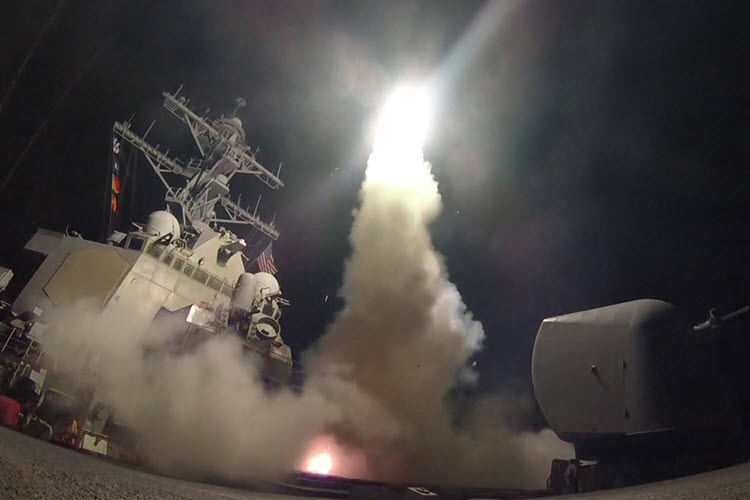
London, 10 Apr – On Friday, the US fired missiles on a Syrian airfield, believed to have been the base for last week’s chemical attack by the Syrian Government.
This is a major shift from the former US policy where Barack Obama drew a red line on the Assad dictatorship’s use of chemical weapons and then did nothing when Bashar al-Assad crossed the line in 2013- an attack which left 1,400 dead.
Following the attack, Donald Trump said: “Tonight, I call on all civilised nations to join us in seeking to end the slaughter and bloodshed in Syria and also to end terrorism of all kinds and all types.”
However, it is not just a change in the US as other nations have since pledged their support for strikes against the Assad Regime and their belief that Assad should be held responsible for his crimes against humanity.
German Chancellor Angela Merkel and French President Francois Hollande released a joint statement in which they laid the blame for the U.S. airstrikes on Assad’s Al-Shayrat airfield solely on Assad.
They said: “President Assad alone bears responsibility for this development… His repeated use of chemical weapons and his crimes against his own population had to be sanctioned.”
The missile attack and international support have been praised by the Syrian Resistance who have spent six years fighting for democracy.
This strike does not only target the Syrian Regime but also its major ally Iran, as the airfield was also used by members of Islamic Revolutionary Guard Corps (IRGC) and the Quds Force, who are currently fighting in Syria as mercenaries of the Syrian Regime.
They used the base not only for operations in Syria but also for those in Iraq, where Iran is also fighting.
Reza Shafiee, a member of Foreign Affairs Committee of the National Council of Resistance of Iran (NCRI), wrote on American Thinker: “Since the start of the bloody six-year-old Syrian war, Bashar al-Assad and his allied goons, the Islamic Revolutionary Guard Corps (IRGC), including Quds Force commander Qasem Soleimani, thought that they could get away with anything…they thumbed their noses at every element of international law. Soleimani was caught on camera many times in Iraq and later in Aleppo walking around unencumbered as if he was a tourist there and not the international thug he was, blacklisted by UN resolutions banning him from travelling.”
The Iranian President Hassan Rouhani responded to the attack by criticising Trump for helping terrorists; strange, considering that Iran is the number one state sponsor of terrorism in the world.
Then the US Senate introduced a bill to safeguard human rights for Syrian civilians, called the Syrian War Crimes Accountability Act. It instructs Secretary of State, Rex Tillerson, to report on war crimes, crimes against humanity, and genocide in Syria, as well as to authorise assistance for investigations and other credible transitional justice efforts, including a hybrid tribunal.
However, former Secretary of State Hillary Clinton pointed out that the US could not bomb Syria for attacking civilians if it were also unwilling to take in Syrian refugees.
Shafiee wrote: “Now it seems that a new plan is unfolding in Washington to stop the genocide in Syria with the U.S. administration’s firm respond to Assad’s use of chemical weapons against his people. The attack may not have a major military significance but it has a firm political tone to it. The action no doubt has resonated as far east as Tehran. To put more teeth to what U.S. means in terms of ending Iran’s influence in Syria, an even more effective step forward would be to expel the IRGC and all its proxies from Syria. It would certainly help with the broader war in the region against Islamic fundamentalism in all its shapes and forms. To get rid of terrorism, get rid of the Iran’s proxies.”


