

The Purpose of the Baghdad Summit and Its Impact on the Iranian Government
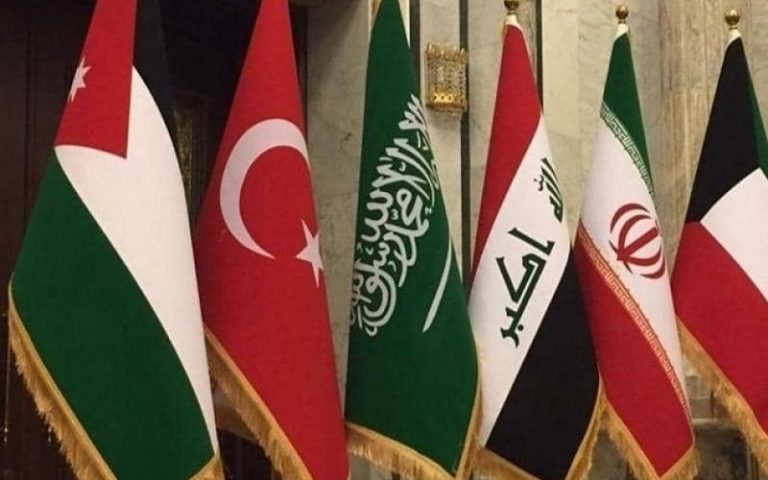
The Baghdad Summit was held in the Iraqi capital on August 28, 2021, with the presence of the leaders and senior officials of the neighboring countries of Baghdad. Apart from the apparent reasons given for holding the summit, what is the nature and purpose of this summit?
The Middle East is brim with many crises and turbulences. Observers say that there are just a few moments and days that this crisis-prone region is not burning in the flames of wars, which is flaring from a corner of this region, no conflict arises between the two countries, and no serious challenges are posed to the region, governments, and people of the Middle East.
Occasionally there are meetings in this region between the countries who are trying to decrease their disagreements, while not every time the outcome is not zero but is not always perfect and the conflicts continue.
The issue of cooperation and dialogue between Saudi Arabia and the Iranian government has sometimes led Iraq, which is self the victim of the Iranian government’s intervention in the country, to host the two countries, east and south to its borders, and try out its chances for an agreement that could bring relative stability to Iraq which is damaged by the conflicts mainly executed by Iran’s regime.
Before the start of the Vienna talks on the Iranian government’s nuclear program, French president Emmanuel Macron said any new negotiations about the Iran nuclear deal (JCPOA) should include Saudi Arabia and other countries of the region.
“Saudi Arabia and its ally the United Arab Emirates have said that Gulf Arab states should be involved in any talks this time which they say should also address Iran’s ballistic missile program and its support for proxies around the Middle East.” (Reuters, January 29, 2021)
The Iranian government, in the name of the so-called Iraqi Initiative, met with Saudi Arabia in Baghdad to prevent Arab countries, from interfering in the Vienna talks and that the regime’s regional inference should not be included in new nuclear negotiations. This could and be a heavy impact on the Iranian government, as it is still strongly opposing it.
Aligned with the Vienna talks some secret and sometimes official meetings were held between Iran and Saudi Arabia without any specified result.
The Iranian government thought to have reached its desired goal, which was keeping the Arab countries away from the Vienna talks, did not show any serious desire to continue the talks which finally came to a standstill on June 20, which is continuing until now.
Now with the host of the Iraqi government and Iranian-Saudi talks have started again. The two countries met in Baghdad on August 28, along with other Iraqi neighbors, except Syria.
The Saudi Foreign Ministry and its Iranian counterpart also attended the Baghdad summit.
Iran’s Foreign Minister Hossein Amir Abdullahian, who attended the Baghdad meeting on behalf of the Iranian government, said the Iranian government is ready to develop bilateral and regional cooperation with Saudi Arabia.
It is worth mentioning that the Iraqi Foreign Minister had previously invited Ibrahim Raisi to attend the Baghdad Summit, but in the end, the Iranian Foreign Minister left for the Baghdad Summit.
Earlier, Iraqi officials said one of the main goals of the Baghdad summit was to improve relations between Tehran and Riyadh as regional rivals. Now, why Baghdad seeks to improve relations between Saudi Arabia and Iran is a question that needs to be considered.
There is no doubt that after the fall of the former Iraqi government, the Iranian regime has had very extensive interventions in Iraq, which have also spread to other countries such as Yemen, Lebanon, Syria, etc., endangering the interests of Saudi Arabia and the stability of all the countries in the Middle East.
Something that the regime is not paying its price but the people of Iran and the people of other countries. So, countries like Iraq are looking for a way to end these proxy wars between Saudi Arabia and Tehran.
Saudi Arabia and the Iranian government have not had diplomatic relations for six years after the attack on the Saudi embassy and consulate in Tehran and Mashhad and have been waging a proxy war in Yemen.
Some time ago, it was thought that with the continuation of negotiations between Saudi Arabia and Tehran, representatives from Saudi Arabia would go to Tehran for the inauguration of the regime’s new president Ebrahim Raisi, but this does not happen, it seems that the level of talks and cooperation is still not developed and instable.
But another hidden goal of the Iranian government to attend the Baghdad summit can be considered the country’s concern about the Abraham Accord between Israel and Arab nations, which has caused concern to the Iranian government in recent years.
Certainly, Iran’s regional dialogues with Arab countries conflict with the Abraham Accord, and the strengthening of one of the two negotiations inherently undermines the other. The Iranian government’s participation in the Baghdad Summit can also be examined from this perspective.
Severe Shortage of COVID Medicine Is a Threat to Life for Iranians
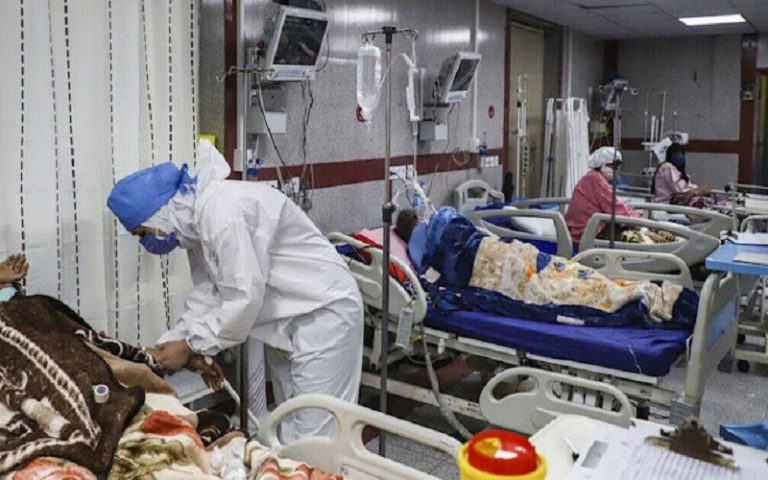
Faces a rising number of Covid-19 cases and an overwhelming rate of deaths due to the pandemic, the Iranian regime continues to ban vaccine imports and hoard medicines meant to treat those afflicted.
Government officials have blamed medicine shortages on overcrowded pharmacies. The reality, however, is that hoarding by the drug mafia in Iran has prevented patients from accessing necessary medications.
According to a report from the IRNA news agency from August 15, at least 18 tons of the medication used to treat Covid-19 patients are awaiting clearance at the airport. The report, states that “more than four tons of raw materials for Favipiravir, 800 kilograms of Betadex raw materials and more than 13 tons of Remdesivir have been stored in the relevant cold storages.”
However, custom statistics have revealed that a shipment of 200,000 packages of 100mg syringes of Remdesivir remains stuck at customs, waiting for a decision from the Health Ministry as to when and where they’ll be distributed.
Also, in ports and docks, medicine is stored in large quantities. However, they become scarce and expensive in the market. One of the rare and expensive medicines is now the ones needed to treat black fungus caused by covid.
Jamejam online reported that Iran is facing a serious shortage of fungal infection medication, Amphotericin B. Due to an increase in cases of black fungus caused by Covid-19, demand for the drug in the Iranian market has risen dramatically.
While the drugs being used to treat covid patients are helping, the medication and corticosteroids they are being given have been found to have more side effects than Covid-19 itself. The head of Yas Hospital in Tehran said, “More than half of the deaths of covid patients are due to the side effects of the drugs that are prescribed.”
Mardomsalari, a state-run daily, wrote in their publication that the regime attempted to procure 60 million Sputnik vaccine doses. In the end, only 900,000 doses were imported into Iran, all of which were only given to ‘certain sections of the society.
From the very beginning of this pandemic, this entity opposed the import of vaccines and regularly promised to produce millions of doses of indigenous vaccines. It is now clear that these domestic vaccines are not very effective, and at the same time, the regime is plundering the Iranian people by storing drugs in customs and leaking them to the black market.
The Executive Headquarters of Khomeini’s Order is said to be Iran’s largest economic cartel. With the regime’s Supreme Leader, Ali Khamenei in control, and the regime’s First Vice President, Mohammad Mokhber supervising, the Order controls the production and import of pharmaceuticals.
Up to 96 percent of Iranians live below the poverty line and struggle daily to make ends meet. For these people, purchasing medicine has become impossible, leaving millions of Iranians fighting to survive during this terrible pandemic.
The people blame the regime and Khamenei for the current extremely critical situation, an issue that has recently prompted government officials to justify Khamenei’s orders to distance him from public anger and hatred.
To Expand Repression, Iran’s Judiciary Takes Control of the Internet

In December 2020, when Iranian society was struggling with small and big problems from the coronavirus to the lack of water and power outages, in hidden and a silent atmosphere a plan called the ‘Requirement to publish data and information plan’ was presented to the parliament, and until a few days ago no one was aware of the existence of such a plan.
Then suddenly everyone began to speak about it, and many lawyers in Iran called it a plan worse than the plan ‘to protect the rights of users in cyberspace.’
Once this plan is finalized and approved, the government will own information about all people’s lives and businesses, and it seems that the scars of this plan will go deeper into the body of society than the wounds of the ‘protection of the users’ rights in the cyberspace.
According to the written law of this regime who is one of the leading governments in the suppression of freedom of speech and information access, everyone has the right to access public information unless prohibited by law, while it is stated in this plan put on the agenda of MPs that the specialized committees under the Supreme Council for the Supervision of the dissemination of Information will be formed to check the availability of public data and information published by individuals.
It is also prohibited to upload data and information to systems or websites that have not received permission from the Council after the finalization and notification of this plan.
One of the issues that seem to have difficulty publishing and free access to information if this plan comes into force is the lack of direct reference to everyone’s right to access information. The proposed plan further emphasized the bans.
On the other hand, it seems that with the approval of this plan, the authority to disseminate information and data is out of the hands of the government and the Commission for the Publication and Open Access to Information, which is under the supervision of the Ministry of Culture and Islamic Guidance and is provided to the Supreme Council for monitoring the dissemination of information under the judiciary, and even government agencies must ask for permission from this council that is under the judiciary to publish their information.
According to the ‘Requirement to Publish Data and Information’ plan, a council should be formed to monitor the dissemination of information, supervise the implementation of laws relating to transparency, protect the rights of communication and information privacy, monitor the rules governing the sovereign secrets of the Supreme Council for The Monitoring of The Dissemination of Information, within one month of the notification of this law in the Judiciary.
The 20-member council is headed by the Head of the Judiciary and attended by the First Vice President, the Minister of Information, the Minister of Communications, the Chief of The General Staff of the Armed Forces, the Head of the Inspector General’s Office, the Head of the National Cyberspace Center, three expert judges familiar with the field of information dissemination and data protection (for three years), five members of parliament as observers without the right to vote, three experts and reliable experts active in the field Dissemination of information (selected by the Supreme Council of Cyberspace), an expert and activist in the field of information dissemination is chosen by the Expediency Council and one of the experts active in the field of information dissemination is chosen by the Supreme Court of Calculation.
According to the projections made by the Council, it must set standards for the production, processing, operation, publication, transmission, disclosure, and protection of data and information. The Council is also responsible for determining the criteria and instances of sovereign secrets, job secrets, and communication and information privacy.
The Council shall provide information related to crimes related to violations of the communication and information privacy of individuals and the expose of government secrets and occupational secrets of individuals to security and judicial institutions and authorities.
At the end of this plan, the Council has been obliged, from the date of notification of this law, in cooperation with the Ministry of Communications and relevant agencies, to prepare the criteria for the creation, administration, and updating of the websites and information bases of the persons concerned in terms of content, ease and access of users, reliable and understandable to the public, and after approval in the Board of Ministers for implementation.
It is important to note that from the date of entry into force of this plan, the Law on the Publication and Open Access to Information approved in 2008 will be abolished, which means that Iran’s parliament, by submitting this plan, seeks to obsolete the law on the publication and free access to information, and take the authority to disseminate information and data from the government and give it over to the judiciary.
Each government launches a system to facilitate its affairs, as well as to review and comment on various matters, to maintain the public safety of the community. Therefore, an organization must have access to public information and protect it from abuse.
But this law will allow abuse of the people’s privacy, if such a thing even exists in Iran, because the government could spy on every element of the people’s lives, according to social rights activists.
Iran’s Government in the Name of a Free Market Plunders the People
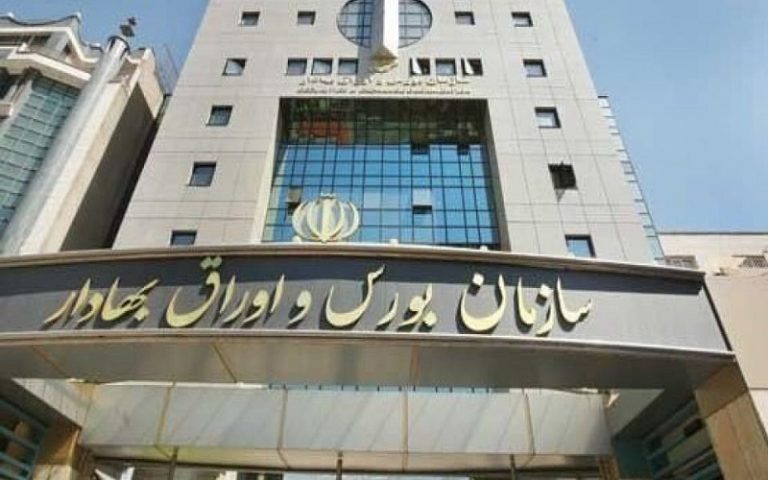
The growth of the Iranian Stock Exchange index led to about two million units in August 2020 so that many people went to invest in the stock exchange.
Returns and profits in the stock market had snatched the competition from other less risky areas of investment, including housing, coins, and dollars, and many people poured their money into the capital market. However, after a short time, Iran witnessed a fall in the stock market – an earlier issue that was predicted by many of the government’s economists, who described it as a fast-blowing bubble that would explode very soon.
There is a ratio in the economy that shows how much the country’s financing structure has become a capital-driven market. This ratio is higher in Iran than in the world. This ratio is nearly 80 percent in Iran.
While the ratio of the role of capital market in financing structure in countries such as Turkey and China is 30 percent and Germany, and the United Kingdom is about 40 percent.
This ratio is not normal in Iran at all, and the main cause is the bubble that has been created in the Iranian stock exchange.
Iranian politicians have turned the use of stock exchanges to finance and maintain the stock exchange bubble into a looting ideology and are even promoting it.
Their excuses for this harmful propaganda to the country’s economy are the small shareholders. Interestingly, the misery, poverty, and death of many people due to coronavirus and many other issues of the people are not very important, but they are still allergic to the situation of small shareholders.
The false boom in the stock market and the preservation of the bubble in different ways is a policy that has been implemented over the years under the pretext of micro-shareholders, but to gain access to the people’s dollars.
The fact that the financial structure of the country depends so much on the capital market has many consequences. One of the consequences is that the country’s public resources are not available to small and medium-sized enterprises and the public.
Iran’s Stock Exchange is practically an archipelago of private but government-controlled enterprises whose managers are non-governmental enterprises and entities. These entities are plundering the people and the economy in the name of the free market, so the financial resources of the capital market are practically in the hands of stock exchange firms that are private but government-controlled.
Regarding the rise of the price of the dollar, which in the last 10-12 years has increased about 25-times, and the effects of these entities on the dollar price, it should be said that for large firms to be able to make big profits on the stock exchange, these stock exchanges must keep the dollar price high, as well as the inflation of the commodities, should hold high so that this ailing and crisis-ridden economy can survive.
Last year, the government’s budget deficit was 250 trillion tomans. In the same period, 20 stock exchanges have had a net profit of 250 trillion tomans.
All their profits have been practically from rent-seeking sources, oil, and gas energy. If this rent is cut, these firms will also lose. The profit growth comes as the taxes paid by these firms in previous years were less than 6 percent. But the operating income of these 20 enterprises was higher than the government budget.
These so-called private but government-controlled enterprises are benefiting from various government concessions and economic and political rents and on other the side, they are allowed to sell their products at any desired price. Therefore, this trend is not competitive for real private and small entities.
People suffered great losses in these stock exchange conditions, and the huge losses that were inflicted on people because of this ailing economy are much more than the money those small shareholders lost on the stock exchange.
It should be noted that people’s wages have doubled in the last three years, but people’s purchasing power has decreased to a fifth. People can no longer afford to buy a home, while property owners’ assets have increased between 8 to 10 times.
No one in the government mentions these losses caused by the increase in the role of the capital market in the financing structure of the country’s economy and the power of rent-seeking private government-controlled enterprises. This is a fact about the corruption from which most of the officials benefit.
Big Hurdles on the Path of the New Iranian Government
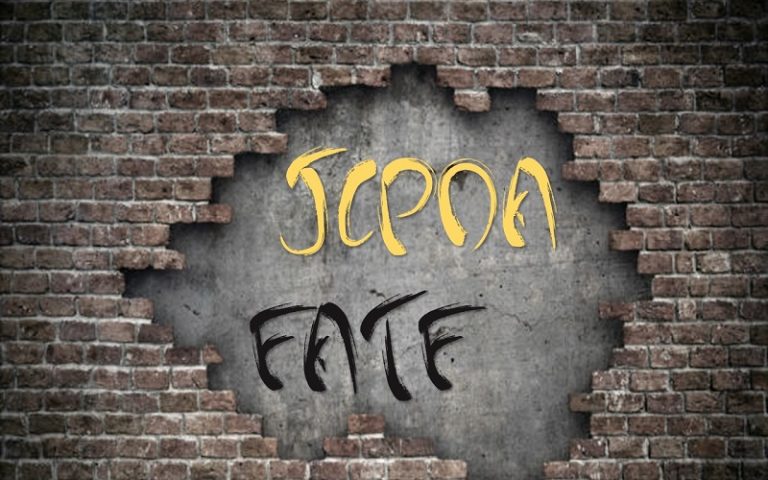
Iran’s government is making its lasts steps, therefore is showing its concern and fear about many issues which each of them are becoming a painful challenge without having any solution for it.
Two of these subjects which are related to its foreign policy but have a serious impact on the regime’s internal policy are its approach to the Financial Action Task Force (FATF) and the 2015 nuclear deal with world powers known as the Joint Comprehensive Plan of Action (JCPOA).
“All our foreign policy issues are directly or indirectly involved in foreign policy issues. The withdrawal of the United States from the JCPOA and the cessation of the fulfillment of its obligations is a big stone in front of us that has stopped our movement, and as long as we do not remove this stone from the path, it will be very difficult for us to continue.”
“Western governments, which claim to resolve the JCPOA immediately, they do not hate it because of their hostility that we remain these subjects unresolved, as all of our movements in the development of economic relations, economic diplomacy, the development of relations even with our neighbors and our strong presence in international forums are tied to this problem.” (Khabar Online, August 26, 2021)
Despite all the regime’s boasts having the upper hand, these phrases show that the regime’s foreign policy and the connected interior policy are stuck. So that even for simple trade and trade relations with neighboring countries, despite many countries are showing their goodwill, and serious determination to engage, but the regime still faces serious problems, at least the problem is that they say if our countries decide to engage, they fear that because of cooperating with the regime they get caught up in sanctions.
Therefore, many of the regime’s officials say that the priority of the new government will be to solve the JCPOA case. In addition to the issue of the JCPOA, the issue of removing Iran from the list of high-risk countries of the FATF is the second priority, if not a parallel priority. The issue of passing FATF-related laws has also deprived the regime of large-scale financial transactions and international banking transactions.
Even if the regime’s assets are released by resolving the implementation of western parties’ obligations in the JCPOA and the regime is going to use these assets to invest domestically, it will definitely need healthy ways to bank and credit exchanges, one of which is membership in FATF, that has created a big headache, because the regime must money laundering and its financial support of terror proxy groups in the Middle East.
Its third problem is losing its dominance in the Middle East which is isolating the regime.
“In the next priority, we can also discuss improving relations with our neighbors, and by fueling Iran fear, our enemies have been able to move away from many potentially friendly and partner countries from Iran to regulate their relationship with Israel. We must take Iran-fearing weapons from the enemies of Iran and remind our neighbors of the good relations that have always been our country’s foreign policy plan and practically take action to solve the problems between us.” (Khabar Online, August 26, 2021)
Changing the entire government and expelling all the members of the so-called reformist faction from the government will not help and solve any of the regime’s problems and priorities. According to observers, the regime is forced to solve these problems, or will it witness the slow dusk of its 42-year reign.
Iran’s Strange Oil Revenue Statistics
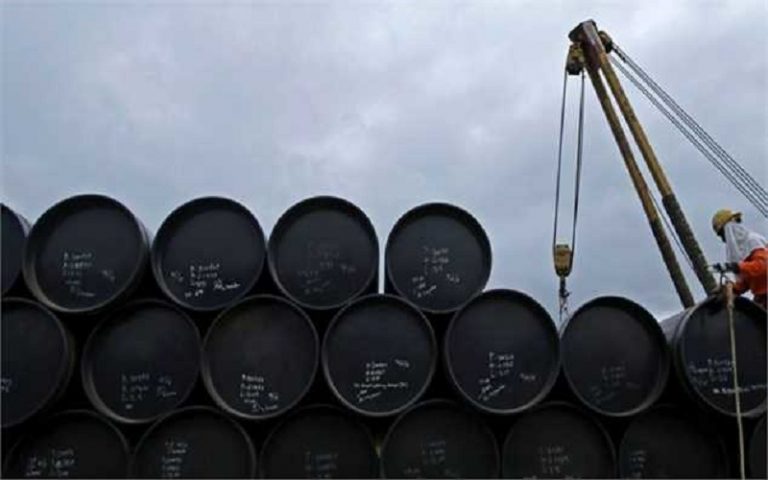
The U.S. Energy Information Administration says Iran’s crude oil production has hit a 40-year low under US sanctions.
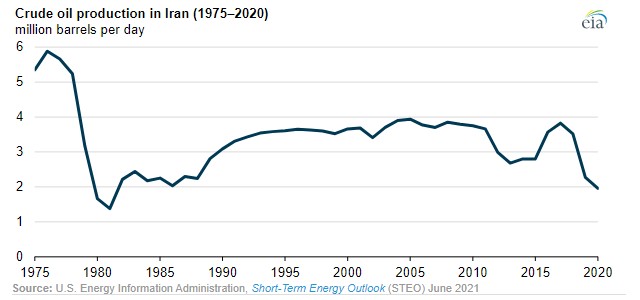
Iran’s crude oil production has fallen to less than 2 million barrels per day under U.S. sanctions specifically targeting the country’s oil industry, as well as the negative impact of the coronavirus pandemic on global crude demand, the Energy Information Administration said in its report which was published on August 12, 2021.
“In 2020, Iran produced less than 2 million barrels per day (b/d) of crude oil, an almost 40-year low in Iran’s production levels according to our analysis, which we updated in July. Several factors contributed to Iran’s low crude oil production in 2020, including the global economic decline that resulted from the COVID-19 pandemic and international sanctions on Iran’s crude oil that limited its crude oil exports.”
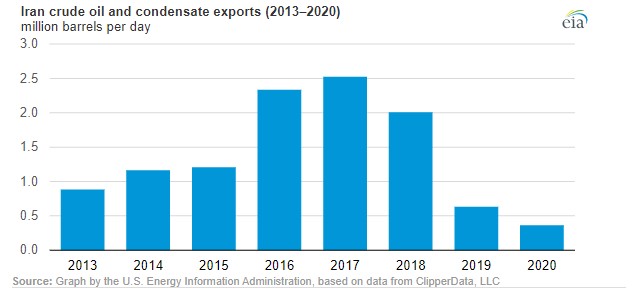
Before the U.S. withdrawal from the 2015 nuclear deal between Iran and world powers and the restoration of sanctions, Iran produced about 3.6 million barrels per day of crude oil and exported 2.5 million barrels of it.
After the U.S. withdrawal from the nuclear deal and after the completion of waivers granted to oil importers from Iran, the country’s average exports in 2020 fell to less than 0.4 million barrels per day.
“We estimate that exports of Iran’s crude oil and condensate fell from more than 2.5 million b/d in 2017, the year before the United States re-imposed sanctions, to an average of less than 0.4 million b/d in 2020.”
 Ebrahim Raisi Iran’s new president on August 22, 2021, at the outset of the Parliament’s examination of the competence of the ministers proposed by the Thirteenth Government regarding the sale of oil, stated that “there are people who are concerned about oil sales, there are many possibilities and fields to this issue, so don’t worry.”
Earlier, Javad Owji, the proposed minister of oil in Ebrahim Raisi’s administration, said at a meeting of the Strategic Faction of the Parliament: “We promised Mr. Raisi that the will is to sell oil by using the capable managers present at the ministry and using the methods that exist today in the oil sales debate.”
But the statistics of the country’s budget are saying something else. The details of the performance of the budget resources and expenditures in the spring of this year have a vague point, which is the revenues from oil and petroleum products, which indicates the realization of three percent of the approved rate.
In this year’s budget, exports of 2.3 million barrels of oil per day were priced at $40, which was very optimistic, and given the continuation of the sanctions, it was clear from that time that this figure would not materialize. Of course, oil prices rose and the average price of $60 per barrel of oil was registered this year.
In such circumstances, the realization of 3 percent of projected oil revenues is very strange. Simply put, if the total projected oil revenue in the budget was to be realized in the spring of this year based on $40 oil and exports of 2.3 million barrels of oil per day, that would mean $92 million a day and about $8.5 billion in the entire spring.
When it is said that only 3 percent of spring oil revenues have been realized, the total oil revenue this spring was $256,680,000, considering about $60 per barrel of oil, which means that less than 4.3 million barrels of oil were sold over three months, that is, 46,000 barrels a day.
Ebrahim Raisi Iran’s new president on August 22, 2021, at the outset of the Parliament’s examination of the competence of the ministers proposed by the Thirteenth Government regarding the sale of oil, stated that “there are people who are concerned about oil sales, there are many possibilities and fields to this issue, so don’t worry.”
Earlier, Javad Owji, the proposed minister of oil in Ebrahim Raisi’s administration, said at a meeting of the Strategic Faction of the Parliament: “We promised Mr. Raisi that the will is to sell oil by using the capable managers present at the ministry and using the methods that exist today in the oil sales debate.”
But the statistics of the country’s budget are saying something else. The details of the performance of the budget resources and expenditures in the spring of this year have a vague point, which is the revenues from oil and petroleum products, which indicates the realization of three percent of the approved rate.
In this year’s budget, exports of 2.3 million barrels of oil per day were priced at $40, which was very optimistic, and given the continuation of the sanctions, it was clear from that time that this figure would not materialize. Of course, oil prices rose and the average price of $60 per barrel of oil was registered this year.
In such circumstances, the realization of 3 percent of projected oil revenues is very strange. Simply put, if the total projected oil revenue in the budget was to be realized in the spring of this year based on $40 oil and exports of 2.3 million barrels of oil per day, that would mean $92 million a day and about $8.5 billion in the entire spring.
When it is said that only 3 percent of spring oil revenues have been realized, the total oil revenue this spring was $256,680,000, considering about $60 per barrel of oil, which means that less than 4.3 million barrels of oil were sold over three months, that is, 46,000 barrels a day.
 But it is unlikely that this amount of oil exports is correct, and it seems that these statistics have problems. Part of this statistic is related to the export of petroleum products. Unless the price of Iranian oil exports is much less than $60 and there is a high discount.
This 3 percent figure, given that according to OPEC statistics, Iran’s oil production has increased slightly this year, is the sign of the increase in the volume of Iran’s oil storage this spring in the hope of lifting the sanctions.
What didn’t happen, of course, and it’s unlikely to happen anytime soon. But in any case, the realization of 3 percent of oil revenues is a serious challenge to the budget this year, which necessitates a reform of the budget by the Raisi government if sanctions are not lifted.
But it is unlikely that this amount of oil exports is correct, and it seems that these statistics have problems. Part of this statistic is related to the export of petroleum products. Unless the price of Iranian oil exports is much less than $60 and there is a high discount.
This 3 percent figure, given that according to OPEC statistics, Iran’s oil production has increased slightly this year, is the sign of the increase in the volume of Iran’s oil storage this spring in the hope of lifting the sanctions.
What didn’t happen, of course, and it’s unlikely to happen anytime soon. But in any case, the realization of 3 percent of oil revenues is a serious challenge to the budget this year, which necessitates a reform of the budget by the Raisi government if sanctions are not lifted.
Ebrahim Raisi Iran’s new president on August 22, 2021, at the outset of the Parliament’s examination of the competence of the ministers proposed by the Thirteenth Government regarding the sale of oil, stated that “there are people who are concerned about oil sales, there are many possibilities and fields to this issue, so don’t worry.”
Earlier, Javad Owji, the proposed minister of oil in Ebrahim Raisi’s administration, said at a meeting of the Strategic Faction of the Parliament: “We promised Mr. Raisi that the will is to sell oil by using the capable managers present at the ministry and using the methods that exist today in the oil sales debate.”
But the statistics of the country’s budget are saying something else. The details of the performance of the budget resources and expenditures in the spring of this year have a vague point, which is the revenues from oil and petroleum products, which indicates the realization of three percent of the approved rate.
In this year’s budget, exports of 2.3 million barrels of oil per day were priced at $40, which was very optimistic, and given the continuation of the sanctions, it was clear from that time that this figure would not materialize. Of course, oil prices rose and the average price of $60 per barrel of oil was registered this year.
In such circumstances, the realization of 3 percent of projected oil revenues is very strange. Simply put, if the total projected oil revenue in the budget was to be realized in the spring of this year based on $40 oil and exports of 2.3 million barrels of oil per day, that would mean $92 million a day and about $8.5 billion in the entire spring.
When it is said that only 3 percent of spring oil revenues have been realized, the total oil revenue this spring was $256,680,000, considering about $60 per barrel of oil, which means that less than 4.3 million barrels of oil were sold over three months, that is, 46,000 barrels a day.
But it is unlikely that this amount of oil exports is correct, and it seems that these statistics have problems. Part of this statistic is related to the export of petroleum products. Unless the price of Iranian oil exports is much less than $60 and there is a high discount.
This 3 percent figure, given that according to OPEC statistics, Iran’s oil production has increased slightly this year, is the sign of the increase in the volume of Iran’s oil storage this spring in the hope of lifting the sanctions.
What didn’t happen, of course, and it’s unlikely to happen anytime soon. But in any case, the realization of 3 percent of oil revenues is a serious challenge to the budget this year, which necessitates a reform of the budget by the Raisi government if sanctions are not lifted. Ministers Approved for Ebrahim Raisi’s Cabinet
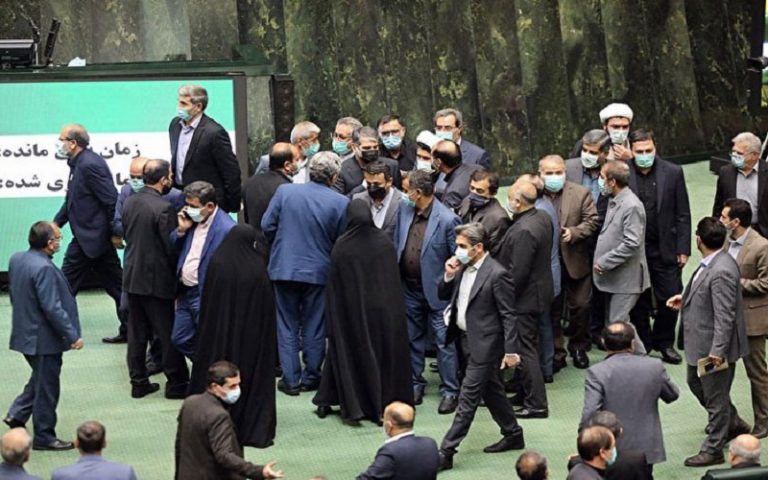
The parliament of the Iranian government officially approved the chosen ministers for the new president, Ebrahim Raisi’s cabinet on Wednesday, August 25 under orders from the country’s Supreme Leader, Ali Khamenei.
The parliament approved 18 ministers proposed by Raisi and only rejected one of them, Hussein Baghgoli, the proposed minister of Education.
Raisi himself was selected for the presidential position by Khamenei. His history of human rights abuses leads to the suspicion that he was selected to help Khamenei consolidate power within the regime. During the vetting process of the candidates for the ministerial positions, the infighting in the regime became evident.
The infighting reached a point that Speaker Mohammad Bagher Ghalibaf acknowledged and reminded the parliament that the entire vetting process is a show. It is Khamenei who makes the ultimate decision.
Ghalibaf stepped in when the quality of one of the prospective ministers was questioned by a regime MP and stated that Khamenei is ‘personally responsible for defense, security, and foreign policy matters’, and that previous governments also sought Khamenei’s approval for the appointment of key ministers.
Ebrahim Raisi has claimed he intends to resolve Iran’s economic and social crises, and ‘The situation requires this administration to start working’. But he refused to say how his administration would resolve Iran’s crises.
The Minister of Interior position has been filled by Ahmad Vahidi, a Brigadier General in the Islamic Revolutionary Guard Corps (IRGC) and former head of the IRGC’s Quds Force, known for their terrorist activities. He currently has an arrest warrant out for him in Argentina in regards to his role in the Jewish Community Center bombing in the country that took place in July of 1994.
Javad Owji has been assigned to the role of Minister of Oil. He has previously served as a manager for two financial institutions under the control of Khamenei, the ‘Execution of Khomeini’s Order’ and the ‘Mostazafan Foundation’.
The Execution of Khomeini’s Order (EIKO) is the same plundering institution tasked with producing vaccines but has only devoured billions of dollars. The lack of vaccination has resulted in over 372,000 deaths due to the novel coronavirus across Iran.
The construction minister position went to Rostam Ghassemi, who previously served as oil minister under Ahamdinejad and was once involved in one of the largest embezzlement cases in Iran’s history, the corruption case of Babak Zanjani.
As for Raisi’s Foreign Minister, that position went to Hossein Amir Abdollahian, a key member involved in the regime’s terrorist schemes.
During the Sunday session of the Majlis, [Abdollahian] vowed to support the “resistance front,” an umbrella term the regime uses to refer to its proxy terrorist groups in the Middle East region. Amir Abdollahian previously vowed to continue the path of “Qassem Soleimani,” the eliminated commander of the Quds Force.
The majority of the cabinet is made up of men with extensive criminal histories, and the question remains as to whether or not they are the best people to control the crises that Iran is currently facing.
Khamenei handpicked this government and selected Raisi to complete his policy of consolidating his regime by increasing oppression and plunder. Khamenei has chosen this path out of desperation because his regime cannot resolve people’s problems, as it has created them.
Leaked Images of Iran’s Evin Prison Scare the Officials
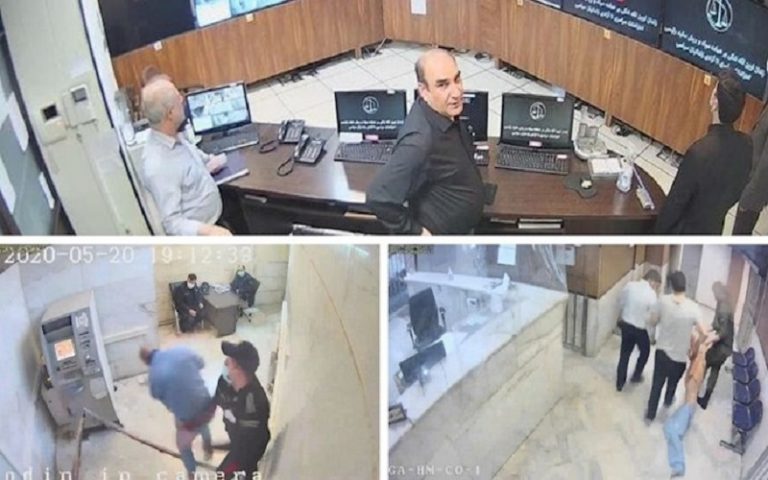
Four days after the release of images and videos of some hacked cameras in Evin Prison on social media which is showing only a corner of the brutal and inhumane treatment with defenseless prisoners by the Iranian regime, many of the regime’s officials have been forced to react to this event.
This chain of desperate reactions started with the apology of Mohammad Mehdi HajMohammadi, the head of the prisons organization which was expressed in a tweet.
The shared reaction between all of them is the blow on the Iranian regime, fearing its consequences in the public, while the situation of the regime is very unstable and facing many challenges. This event was absolutely not with pleasure for the regime’s news President Ebrahim Raisi and his entering government who are trying to show a ‘Justice Seeking’ face of themselves.
Some fearing its consequences on the regime’s human rights case, especially at a time when the trial of one of the perpetrators of the 1988 massacre Hamid Nouri is taking place now in Sweden. Other officials and regime officials are fearing its impact on the JCPOA negotiations (Iran’s 2015 nuclear deal with world powers) and raising their concerns that the regime’s human rights case will be attached to the JCPOA case, and the regime will have no chance to reject or circumvent this situation.
But despite all this, this is just a small proof of the years-long struggle of the Iranian opposition, the MEK, and NCRI to attract the attention of western governments to the human rights situation in Iran.
Below are just some of the hundred reactions by the regime’s officials.
MP Ebrahim Rezaei at the parliament meeting of Wednesday said: “It must be dealt with the doers of the Evin events.”
Parliament Speaker Mohammad Bagher Ghalibaf said: “The Commission of Principle 90 has followed up on the issue.”
“A member of parliament called for dealing with the perpetrators of what happened in Evin prison. Prosecutor General’s Office investigates Evin prison pictures.” (State-TV, August 25, 2021)
“The First Deputy of the Judiciary is investigating the publication of images of Evin Prison.” (State-run news agency Daneshjoo)
“The Speaker of the parliament instructed the Commission on Article 90, in coordination with the Attorney General, to investigate the story of the films released from Evin.” (Parliament Session August 25, 2021)
“Mahmoud Sadeghi’s letter to Ejei following the publication of CCTV footage of Evin Prison: Your immediate order to address this issue, as well as the head of the Prisons Organization, to accept responsibility for the unacceptable behavior of the guards and to declare the commitment not to attempt to repeat such bitter events…” (Asr-e-Iran, August 25, 2021)
“Mir Mohammad Sadeghi, lawyer: The prisons organization’s stance after the publication of images of Evin prison should be taken as a good omen.” (Official Parliament website Mizan, August 25, 2021)
“The shock of leaking controversial images from Evin prison sparks storm. With the release of CCTV footage from Evin Detention Center, the country is in a strange shock. – These pictures are in Iran’s most famous detention center in the north of the capital, which has been repeatedly named because of the presence of political defendants…” (State-run website Hadeseh 24, August 25, 2021)
“Esmaili, the then head of the Prisons Organization, denied beatings in Ward 350 of Evin Prisons. In the recent issue of the leaked films of Evin Prison, an apology is not enough. The perpetrators of this tragedy, which shows that beating prisoners has been a routine task, including by the officers.” (State-run website Tik Tak, August 25, 2021)
The Jomhouri Eslami (Islamic Republic) newspaper reacted to the publication of Evin prison videos, saying: “Should public opinion know what is going on in prisons and what is all this violence for? And as soon as possible, Evin officials and the prison guards will be prosecuted so that the system is not more in the crosshairs of the opposition’s goals.”
“A TV presenter reacts sharply to leaked films from Evin prison. Television presenter Mohammad Delavari reacted to the footage released from Evin prison, describing it as unfortunate.” (State-run website Jamehe 24, August 25, 2021)
“Evin Prison from within: The release of CCTV footage of Evin Prison over the past two, three days has been met with widespread public reaction, especially from social media users.” (State-run website Rooz-e-no, August 25, 2021)
“Ejei order to the attorney general: Check the mistreatment of Evin prisoners without wasting time.” (State-run website, Ofogh News, August 25, 2021)
“Mohammad Hassan Asefri calls for treatment of sewing officers in Evin prison: The Representative of Arak, regarding the publication of images of Evin Prison, says that prison is not a place for creating criminal and that the perpetrators should be treated seriously.”
“What is behind the story of the images of Evin Prison? Some of the images from the Evin Prison are neither defensible nor acceptable. It is worthy to appoint an experienced team to handle and announce the results publicly.” (State-run daily Ofogh News, August 25, 2021)
“What pictures have been published of Evin Prison? The head of the Prisons Organization, emphasizing on respecting the rights of prisoners, promised to compensate for unacceptable behavior in Evin.” (State-run daily Aftab, August 25, 2021)
Iran’s Taxing System, Extortion of the Underprivileged
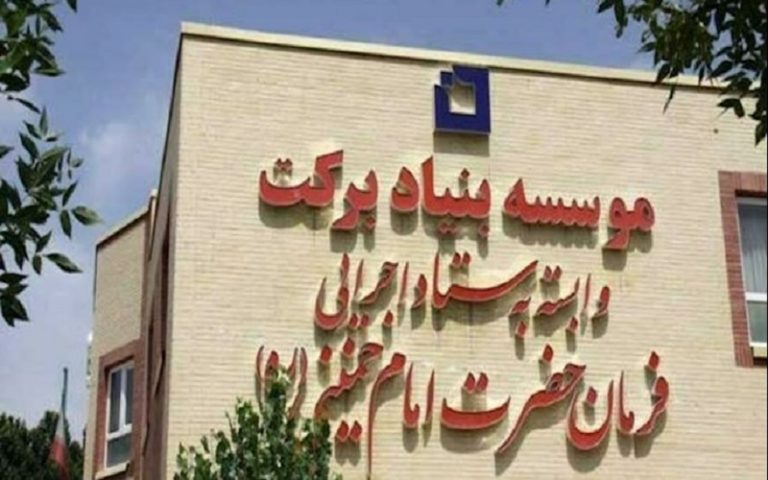
In Iran gold and the supreme leader Ali Khamenei’s financial foundations are not subject to tax, but the poor society especially the working class must tolerate the burden of much of the government’s spending by paying taxes.
Rich institutions like the Execution of Imam Khomeini’s Order (EIKO), the Mostazafan Foundation, the Foundation of Martyrs and Veterans Affairs, etc., and other entities, such as the financial empires of the Revolutionary Guards (IRGC), are exempt from paying taxes.
Furthermore, the gold tax has shrunk to zero. It is in large part in the hands of government officials and institutions.
On July 7, 2021, the newspaper Industry, Mine and Trade wrote, “With the current inverted tax system, the main burden of taxation has fallen on wage earners.”
And the state-run daily Vatan-e-Emrooz confirming this process on August 22, 2021, wrote: “Due to poor regulatory structure and lack of transparent information systems, the lower classes of society have always been at the forefront of paying taxes, and the main beneficiaries of the economy most of whom are active in the unrealistic and speculative sector are exempt from paying taxes.”
‘The main beneficiaries are the institutions mentioned above. Government economic experts estimate that institutions affiliated with Khamenei hold 80 percent of the country’s economy and resources, while 96 percent of people live below the poverty line.
And their share of the country’s incomes and wealth is so low that it is not counted, as we see during the Coronavirus crisis that the country’s health and treatment system is so backward that they cannot afford to treat the patients.
The state-run daily Hamdeli on August 15, 2021, wrote: “Now that COVID-19 is killing many Iranians, the authorities should be asked what you did with people’s money. Tax money and oil sales in all previous years, if it was not supposed to help the Iranian people in a critical situation like a disease, then what was its purpose? Where has the money been spent? What have the people achieved?
“If the authorities say there is money, but it is not possible to provide vaccines, medicines, and other items for any reason, why should people give their money to those who don’t know how to break down barriers and provide them with the right services at the lowest cost?
“If people are going to treat themselves at home in the face of illness, why should they pay for health care services under the name of premiums? These people who now do all the health work by themselves have no right to ask the authorities what you did with the tax and oil money that was sold in all the past years?”
In the meantime, the government’s budget deficit is an unbelievable amount of 400 to 450 trillion tomans. According to a lawmaker, most of the budget deficit is related to the lack of tax collection from the government institutions as a pending tax, which amounts to ‘270 trillion tomans.’
In July 2021, media outlets affiliated with both regime factions wrote, as the head of the Tax Administration said, tax evasion in the country reached 100 trillion tomans.
Regarding the tax evasion, the regime’s TV moderator said to Mohammad Reza Pour Ebrahimi, chairman of the Economic Commission of the parliament:
“The share of taxes in GDP is almost an average of around 20 percent all over the world, we approved in the Sixth Plan law around 10 percent. The number that was approved in 2020 is 5.5 percent, the simple concept is that as much as we are taxing, almost we are witnessing the amount of tax evasion.” (State-TV Channel Five, August 5, 2021)
Jabar Koochaki Nejad, an MP from Rasht city, pointing 120 trillion tomans of the government’s budget, about the tax exemptions and evasion said:
“Unfortunately, tax evasion in our country is more than 70 trillion tomans. Of course, this is other than tax exemptions, and the number of tax exemptions is very high.” (State-run website Bazar News, August 8, 2021)
Iran’s Next Foreign Minister Shows Support for Middle Eastern Terror Groups
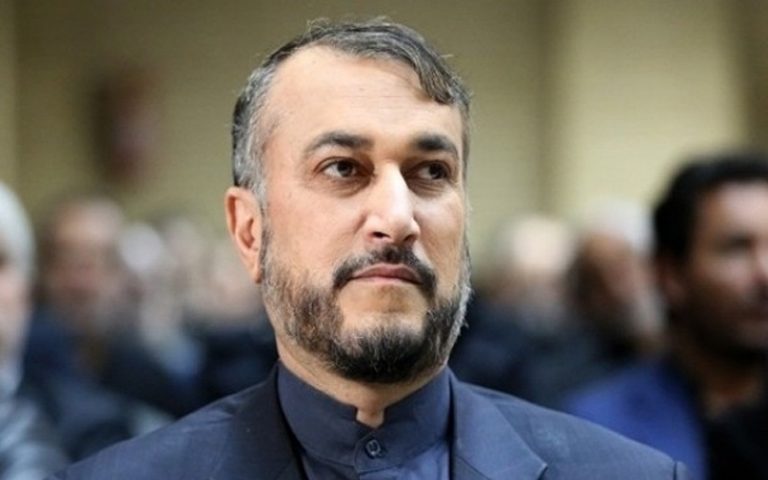
The Iranian regime’s incoming foreign minister, Hossein Amir Abdollahian has once again confessed his support of terrorism regarding the regime’s foreign policy.
In a session of the Majlis (parliament) last Sunday, Abdollahian, who has been nominated and destined for the Foreign Minister position in the administration of the regime’s new president, Ebrahim Raisi, professed his support of the ‘resistance front’, the name used by the mullahs’ clerical regime to refer to their many proxies’ terrorist groups, based across the Middle East region.
The regime is currently funding, training, and providing logistics support to more than a dozen terrorist groups in Iraq, Syria, Lebanon, and Yemen.
Abdollahian had made his comments in a speech during the meeting of the parliament, as officials were showing their support towards his appointment to his new role as Raisi’s top diplomat. His will to push terrorist policies comes as no surprise, considering his close relationship with the former leader of the IRGC’s Quds Force and the mastermind behind the regime’s terrorist activities, Qassem Soleimani, who was killed in January 2020 during a drone attack in Iraq.
He previously held the role of Deputy Foreign Minister for Arab and African Affairs under the previous administration, so he is no stranger to the regime’s policies.
Amir Abdollahian has a long history of enabling the regime’s terrorist policies in Iraq and other countries of the region. And he makes no secret of his ties to the regime’s terrorism apparatus.
Abdollahian announced, in an earlier meeting with the parliament’s culture commission, that he ‘cooperated with Soleimani in the foreign policy domain’ and that he will ‘continue Soleimani’s path’.
The regime’s diplomacy is closely controlled by the Revolutionary Guards (IRGC) and its foreign terror arm the Quds Force, a fact that regime officials have made no secret of.
The former Foreign Minister of the regime, Mohammad Javad Zarif highlighted in a recent interview that the regime’s foreign policy is heavily dominated by IRGC and that 98 percent of the diplomatic achievements, regarding the regime, were attained by the Quds Force and, specifically, Soleimani himself.
Hassan Rouhani, the regime’s former president spoke at a cabinet meeting on April 8, 2021, seemingly confirming that the regime’s diplomacy is based around terrorism. He said that from his 32-year experience in the Supreme National Security Council, ‘the frontline and diplomacy are two arms’ of the mullahs’ regime. During his speech, Rouhani went on to say, “If anyone believes that either the frontline of the negotiations must-win, then I must say that their words are incorrect.”
Many of the regime’s senior diplomats and embassy staff were members of the Quds Force and reported to Soleimani, including Assadollah Assadi, a Vienna-based diplomat who is currently serving 20 years in prison for a failed attempt to bomb a major rally of the Iranian resistance in France in 2018.
