Esahq Jahangiri, the vice president of Iran, in a gathering of officials of the regime, referring to the crises such as poverty, coronavirus, water scarcity, power outages, and other disasters, acknowledged the dangers and their destructive consequences and said:
“If we cannot deal with the problems and challenges in time, they become complex issues.” (State-run daily Jahan-e-Sanat, July 11, 2021)
This speech is a security alarm because the regime has no solution for these problems. And at the same time, the problems of the people with this regime are far beyond these challenges.
The truth is that besides all the economic, social, and environmental challenges, the problem of the people with this regime is political.
And the other problems are because of the political corruption of this regime. Therefore, the people have boycotted the regime’s election and every protest is becoming a scene against the regime, like the protests of the people because of the power outages which were along with slogans against the regime like ‘Down with Khamenei’.
In such a government, the people have no kind of security. The state-run daily Jahan-e-Sanat in an article entitled “The cost of Iran’s security” wrote:
“The fact is that in Iran, for various reasons, this feeling and the need for internal security is not high. The shortcomings of the government decision-making system in all post-war (Iran-Iraq war) governments and the numerous violations that governments have had and continue to have against citizens have led to mistrust, and Iranian citizens do not have peace of mind and feel that they are provided with sufficient security.
“It can be mentioned that in the last few months, numerous violations of the vaccination by the National Coronavirus Taskforce Headquarters have occurred despite their duty and the citizens do not feel safe. Iranian citizens willing to incur higher costs and more suffering and move to Armenia to feel more secure.” (Jahan-e-Sanat, July 11, 2021)
The same newspaper in an article titled ‘People do not believe in the officials’ while acknowledging that due to the actions of the regime, people’s security in society is declining day by day and the consequences that have appeared in the form of adverse economic, political, psychological, and cultural effects in society, is considered to cause distrust among the people, so that:
“Officials are seen as liars in the eyes of the people. The trust between the people and the government is so shabby that if one day the officials tell the whole truth, many people will still not believe it.”
The state-run Arman newspaper considered the distrust and anger of the people as the base for a ‘social explosion’ and wrote with the headline ‘You do not believe society is exploding’:
“The reason why the situation in the country has reached this point is that the officials do not do anything with a plan and are just talking. This has been happening in the country for almost a year.
“The power outage in the country is happening at a time when there have been various criticisms and protests in recent days. What is your assessment of the sociological dimensions of this event?
“Power outages are an excuse. The high-voltage electricity are unemployment, poverty, and inflation. People are exploding based on this high-voltage electricity.” (Arman daily, July 11, 2021)
“Warning for a dangerous gap” is the title of the editorial of the state-run daily Ebtekar, which mentioned: “According to statistics and objective observations, the class gap is in a deplorable state.”
“It is better to fill the class gap with a series of effective actions of decision-makers else it will be filled with the anger of the lower classes without any political support and will reach the boiling point because of poverty.” (Ebtekar, July 11, 2021)
About the Iranian society’s situation, this daily added: “The people of our society are very angry and these days the volume of bad news is so great that it has put everyone’s tolerance threshold at risk. Instability, uncertainty, and economic pressures are feelings of discrimination and inequality. Ignoring the demands of society and ignoring its growing expectations is the cause of this anger, our society is an angry society, and this is a great warning to the officials who are causing a considerable amount of this social anger.
“High anger in society has many destructive effects. An angry society becomes a destructive society if these negative energies want to be concentrated because there is a possibility of its eruption. In an angry society, there is nothing, but destruction and the officials must be afraid that this anger will burst. The eruption of angry is something normal when people cannot access their rights.” (Aftab-e-Yazd, July 11, 2021)
The repeated warning of the regime’s officials about the explosive situation is a confession to the readiness of the society for regime change.
Iran’s economy is worrying. The government’s severe budget deficit, heavy current government spending, rising unemployment, impending droughts, sanctions, and dozens of other problems have made Iran’s economic situation difficult and overwhelming for a large population.
The regime’s new president needs financial resources for productive and employment-generating investments to save the country’s economy from these crises.
Iran needs hundreds of billions of dollars to invest in key areas such as rail, air and road transport, power plants, oil, gas, and petrochemical industries, and other important economic infrastructure.
Iran’s private sector has not been strengthened enough to take on an important part of the economic development burden.
Therefore, considering all the conditions prevailing in Iran, the main burden of the country’s economic development will be on the government. The most important sources of income for the country are:
Taxes
Oil and gas revenues
Proceeds from the sale and transfer of property
Revenue from government ownership
The total revenue sources of the government in 2021 are estimated at 420 trillion tomans. And such revenue will not cover government spending, and the government will face a significant budget deficit in 2021.
Which of the above sources of income will the new government be able to increase in the short term?
Due to the problems of various occupations caused by the coronavirus pandemic, a significant increase in tax revenues is not possible.
A significant increase in revenues from the sale and transfer of property is also not conceivable due to the problems in the stock market during 2020 and the prevailing atmosphere in the country’s economy.
Revenues from government ownership in 2020 were about 30 trillion tomans and include a small percentage of government revenues for which there is no significant increase.
Revenues from the sale of oil and gas in the budget of 2020 were about 50 trillion tomans. Iran can produce and export 3 million barrels of crude oil per day, which in terms of $ 70 value will be worth more than 75 billion dollars. This amount is about 4 times the total government revenues in 2020.
For the reasons stated here and here and other analyzes, the price of oil will gradually decrease in the coming years to about $ 30 a barrel, and in the next two decades there will be no idea of $ 70 oil, so if the Iranian government cannot produce and export oil with all its might and capacity, in concept it will waste billions of dollars of income for the country and the future generations.
Therefore, the most logical, fastest, and most practical solution for the government to save the country from various economic crises and negative growth of the national economy and attract resources to develop important economic infrastructure, is focusing on increasing oil exports to more than 3 million barrels in the day and restoring Iran’s lost share in the OPEC oil export basket over the past years.
But this has become an unobtainable issue for the Iranian government because of the sanctions, which are the results of its behavior such as its nuclear program and global terrorism support threatening the global community. Therefore, best said with this behavior the country’s economy has no solution and will face a harder situation in the coming months and years.
Bahman Eshghi, Secretary-General of Tehran Chamber of Commerce in an interview with the state-run website Gostaresh on July 11, 2021, about the regime government’s situation said:
“The Iranian government cannot provide the means for development with this current mechanism. Let us be. Therefore, who is the president does not affect the general situation in the country, because, with this mechanism, the current vision, and the model of interaction with the world, we should not expect an efficient and advanced government. The situation will be the same as long as we form a base to manage the chicken price.”
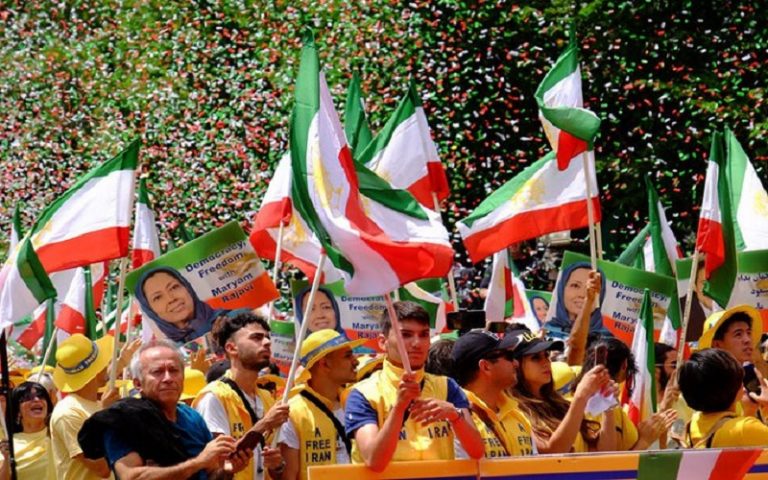
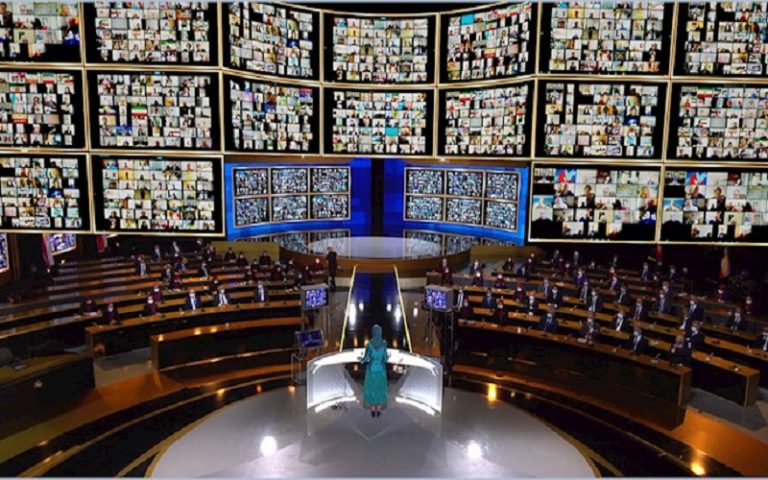
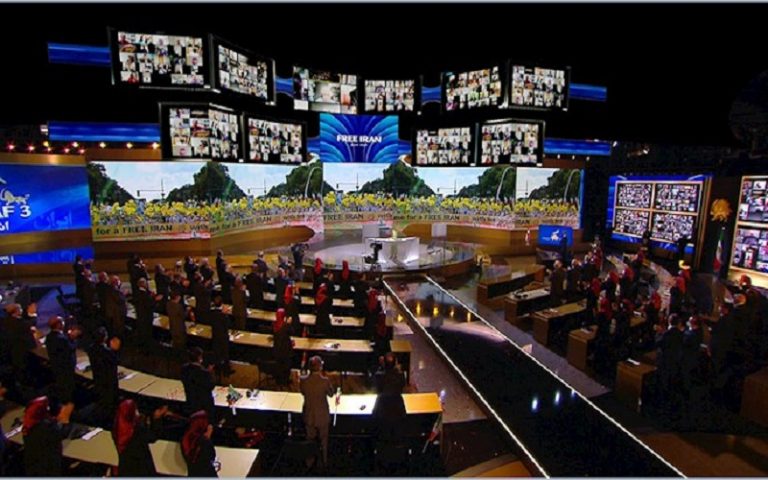
The third and last day of the “Free Iran World Summit” was held today, with this section of the conference entitled “End Iran’s Regime Systematic Human Rights Violations”. All participants in the Summit, organized annually by the National Council of Resistance of Iran (NCRI), promised to increase their efforts to help the Iranian people to overthrow the brutal and theocratic regime that crushes them.
The main topics of discussion at the conference were:
systematic human rights abuses by the regime
the 1988 massacre of 30,000 political prisoners
the immediate need to bring senior regime figures, especially Supreme Leader Ali Khamenei, President Ebrahim Raisi, and Judiciary Chief Gholam-Hossein Mohseni-Eje’I, to justice for the above topics
The first speaker was NCRI President Maryam Rajavi, who explained that Raisi is “the henchman of the 1988 massacre” and his appointment as president indicates that the regime is about to collapse under the weight of the people’s protests. She advised that this showed, once and for all, that there are no moderates in the regime and that appeasement with the “genocidal regime” has not worked.
She said: “As far as the international community is concerned, this is a test of whether it will engage and deal with this or whether it will stand with the Iranian people. We say to the world community, especially to Western governments, that Mullah Raisi is a criminal guilty of genocide and crimes against humanity in 1988. He is guilty because as one of the regime’s highest Judiciary officials during the last 40 years, he played a decisive role in the execution and murder of the Iranian people’s children.”
Rajavi noted that as Raisi has reported being proud of his crimes, it indicates that he will only continue his crimes and that they may get worse as his position in the regime rises. (He’s believed to be the next in line for Supreme Leader.)
She said: “On behalf of the Iranian people and their Resistance, I emphasize that the United Nations and the international community should recognize the 1988 massacre in Iran as genocide and a crime against humanity. I call on the UN Security Council to take action to hold the leaders of the mullahs’ regime, especially Ali Khamenei, Raisi, and Ejeii, accountable for committing genocide and crimes against humanity. The United Nations must not allow Raisi to participate in the next session of the General Assembly. This would be an unforgivable insult to the peoples of all countries who send their representatives to the United Nations.”
Following Rajavi is a long-time supporter of the NCRI and former Colombian Senator Ingrid Betancourt, who doubled down on cracking the myth of moderation in the regime, explaining that all mullahs are “part of this blood-thirsty monster” no matter what they say.
However, Betancourt vowed that the regime isn’t going to survive and that is because of the hard work of Rajavi and the rest of the Resistance, whom Betancourt praised for their consistent effort to free Iran.
She said: “It is because young Iranians know this that they are following you. It is because there is the face of a woman that has suffered and doesn’t give up that represents the strength and the good in sheer contrast to the evil faces of the mullahs that Iranians are envisioning today the end of their nightmare.”
Another friend of the NCRI, who has spent years advocating for them, is former US Senator Robert Torricelli, who spoke about the massacre, which he described as a “war on [the regime’s] own people”, and advised that any mullah who protested the crime against humanity – no matter how small the rebuke – was removed from power. This is a reference to the then-second-in-command who privately criticized the Death Commissions and was removed from power and put under house arrest.
He said: “We may have our differences on many issues in America, but when it comes to ending this regime and standing alongside the Iranian people, you cannot get a thin piece of paper between us on our resolve. It builds by the year. One voice, one policy, from one country.”
Torricelli called on the rest of the world to “take a stand”, saying that if the United Nation welcomed Raisi at the next General Assembly, “then the United Nations does not belong in New York”, because how could the Land of the Free host “terrorists, despots, and mass murderers”?
Former Italian Prime Minister Matteo Renzi then insisted that the global community, especially the European Union, must stop appeasing the regime and start supporting the people and Resistance if they want to continue claiming that they value freedom
Fredrik Reinfeldt, the former Prime Minister of Sweden, explained that some 100,000 Iranian ex-pats now live in Sweden because they’d fled the regime, but highlighted that the majority able to get out of Iran are the academics, the highly-skilled, and the creatives, who can get hired elsewhere. He said that this had contributed to the country’s collapse, which is the direct result of the regime’s suppression.
He said: “The autocrats, the people with absolute power, are always afraid of their own population. They are always controlling their own people because that is the kind of paranoia that always evolves in this kind of country. We also see that where there is absolute power, we have seen that they want to show themselves as being more democratic.”
Reinfeldt then called on the rest of the world to stand up and support the Resistance in order to bring democratic elections to the country because “no one should have absolute power”.
The former Prime Minister of Ireland, Enda Kenny, then urged the UN and European Council to do more to confront the regime on human rights at every opportunity, citing gross abuses like floggings, disappearances, and executions.
Another former Italian Prime Minister and Director of the International Monetary Fund Carlo Cottarelli said: “Iran’s poor economic performance points at mistakes in domestic policies, lack of economic reform, and severe shortcomings in the economic governance framework. Over the last decades in the post-revolution era, the Iranian economy suffered from severe economic mismanagement, which added to the economic consequences of the political mismanagement.”
Then, former Belgium Prime Minister Guy Verhofstadt explained that the regime will never transform into a democracy, no matter how much the West harps on about “hardliners and moderates”, which he described as a “hoax”.
He spoke about the “farce” elections that made Raisi president last month, advising that Raisi would not accept any of the needed reforms inside Iran, like nuclear inspections by the International Atomic Energy Agency to preserve the 2015 nuclear deal, because he hates democratic values and is under US sanctions for the killing of political prisoners.
Verhofstadt said: “I believe we should strive to revive the deal but not at any cost. I think it would be a fatal mistake to only focus on the nuclear threat and regard human rights violations as a secondary issue. We must pursue a dual strategy in which we put human rights higher on the agenda while trying to establish a safer environment in the Middle East.”
The next speaker was former Romanian Prime Minister Petre Roman said that the Iranian people and their Resistance give the world hope “for a peaceful and prosperous Iran”, especially now that the new Iranian president is someone known for “perpetrating crimes against humanity”. Roman called for UN investigations into these atrocities to support the people’s fight for freedom.
Then, it was time to turn to the live videos from Resistance members in Iran, who risked their lives to send out these messages because of the regime’s violent crackdowns on dissent.
One speaker from Ahvaz explained the problems that the people are facing because of the regime, including a lack of drinking water despite living near one of the biggest rivers in the country, while a caller from Tehran shared their hopes that next year Rajavi will make her address from Tehran’s Freedom Square.
Another speaker said: “During the past 40 years, the Iranian people have endured great pain and agony, and they are subject to brutal oppression by the rule of despotic models who have tried to silence our voices… your struggle is for their liberty and equality in a free Iran, and it has given us hope.”
Former US Senator Joe Lieberman then spoke about regime change as the only solution to the crisis in Iran, as everything else has failed and it’s “obvious” that the regime won’t change and the people of Iran, with help from the rest of the world, must change it.
He said: “I have never been more optimistic, my friends, that the regime in Iran is rotting at its core and is ready to fall. In August of this year, instead of entering the presidential office in Tehran, Ebrahim Raisi should be led to the docket at the International Criminal Court in The Hague and charged with crimes against humanity.”
Lieberman spoke about the fact that the regime has long tried to smear the “competent and capable” Resistance, which has always sought to reveal the regime’s crimes (i.e., nuclear weapons and terrorist actions).
He said: “How can world leaders, including America’s leaders, rationally negotiate with the regime that has killed thousands of American citizens and citizens of our allies and citizens, of course, of Iran itself? How could we negotiate with a nation that has constantly proven itself incapable of keeping its diplomatic promises, and how could we now possibly negotiate with a regime that has handpicked as its next president a mass murderer?”
Lieberman noted, as many others did, that Raisi’s presidency smashes the moderation myth, which is something that the Resistance and the people have been loudly saying is not true for many years now as they called for regime change.
He said: “Each of us who live outside Iran must now decide and plan what will we do to support the Iranian Resistance as it rises up in revolution. Here in America, we should work to convince the Biden administration that its own policies and values, which the President has said are to put human rights and democracy promotion at the heart of our foreign policy once again, must lead the administration to stop trying to negotiate with the evil government in Tehran and start supporting the people of Iran who want to overthrow it.”
Then, Robert Joseph, the former US undersecretary of state for arms control and international security, explained that the regime is now increasingly desperate in the face of increased calls for regime change.
He said: “The people of Iran are rising up. They have simply had enough. They have seen their beloved country become a prison to those on the inside and a pariah to those on the outside. The selection of Raisi as president is a reflection of the moral bankruptcy of the mullahs. Raisi is a documented mass murderer.”
Joseph called on the world not to do anything to extend the regime’s time in power as they would go down as “pure evil” in the history books. He said that the international community must support human rights, rather than repeat the mistake of negotiating with the regime as in 2015.
He said: “It is a common but false argument that stopping the regime from acquiring a nuclear weapon by re-joining the JCPOA must be the first priority. In fact, the resources that would flow to the regime would prolong the regime. It would prolong the repression of the Iranian people and it would also prolong the nuclear threat itself.”
Joseph further advised that there’s no point agreeing to a deal with the regime as they’ve reneged on every agreement they’ve ever made.
Former FBI Director Louis Freeh then spoke about how Raisi is “a documented suspect in war crimes”, as well as crimes against humanity. He called for the legal community and heads of states to push for the mullahs to be held to account for this.
He said: “Our government should keep [the regime’s criminal record] in mind as it tries to renegotiate a new pact [with the regime]. We will keep in mind this perspective which is a long view but a critical accountability issue that has to be addressed, and we will have the means and the will to do it and it will be the final act of justice against the regime that has abandoned any notion of justice.”
Then, former US National Security Advisor John Bolton, a long-time Resistance supporter, explained that it was obvious that Raisi would be the next president because the need to suppress protests was more important than the façade of a moderate wing in the regime.
He said: “I fear even an increase in internal repression since the people of Iran, and a continuation and even increase in belligerence internationally, in Iraq, Syria, Lebanon, and Yemen. The real objectives of the regime in Tehran are not peace and security in the region. It is hegemony.”
Bolton explained that concessions towards the regime won’t improve the situation as they’re seen as a “sign of [the West’s] weakness”, which is why he said the US should not re-enter the nuclear deal.
He said: “The United States should not lift its economic sanctions. They should continue in place and we should aid the people of Iran who are legitimate opponents of the regime who seek nothing more than freedom and the opportunity to pick their own government. Our declared policy and its declared objective should be to overthrow the regime of the mullahs and replace it with a popularly elected government of the Iranian people.”
Then, it was the turn of several former political prisoners to describe the horrific conditions inside Iran’s prisons, especially focused on the 1988 massacre and Raisi’s role.
Matin Karim, who was just 15 at the time, described her first-hand experience of how Raisi treated political prisoners, which included torture and mock executions. While Saleh Kohandel, who spent 12 years in prison for supporting the Resistance, explained that he knew several people executed and advised that political prisoners were tortured and denied medical treatment.
Majed Karim described Raisi’s actions in Karaj prison, particularly those against students involved in the Resistance movement, describing the torture and execution of his friends on Raisi’s orders. Mohammad Farmani, who was arrested in 1981, further described how Raisi was involved in his arrest and the issuing of fake charges against him, as well as having to watch several executions.
The first two days of the Summit were the largest online event echoing the Iranian people’s call for regime overthrow and the establishment of a democracy in Iran. It connected 50,000 locations and featured over 1,000 politicians plus many more Resistance activists.
July 11, 2021, was the second day of the Free Iran World Summit 2021, which the National Council of Resistance of Iran (NCRI) holds every year to promote democratic regime change in the country as the Iranian people have made very clear that they want. This is especially important considering the volatile state of the country right now.
The main focus of the Sunday event was for dozens of global dignitaries from all over Europe and the Arab world to show their support for regime change by and for the Iranian people. We will look at their speeches here.
The first person to speak was Maryam Rajavi, President of the NCRI, who said that the international community must end its support of the “nuclear-armed butcher” that is the regime, saying that it’s “on the brink of collapse” as the crises (water shortage, food insecurity, economic collapse) increase across the country.
She said that appeasement was only enriching the regime and allowing them to increase their nuclear activity, terrorism, warmongering, and domestic repression, which is counter to the international community’s intention.
Rajavi said that any deals with the regime must ensure the withdrawal of “the Revolutionary Guard Corps (IRGC) from Iraq, Syria, Yemen, Afghanistan, and Lebanon”, as well as the end to the torture and execution of Iranians.
She said: “Anything less, in any wrapping, is tantamount to caving into the mullahs’ nuclear catastrophe [which is] an important part of Khamenei’s strategy to escape his overthrow… Despite all these sufferings, the Iranian people and their Resistance are determined to overthrow the religious dictatorship. And it will not matter if the regime is nuclear-armed or not, we will overthrow it.”
The British delegation then took the virtual stage, with former House of Commons Speaker Baroness Betty Boothroyd speaking about the recent presidential elections and the people’s boycott after the Resistance’s campaign. She advised that the Iranian people had made their feelings very clear when they didn’t come out to vote, showing that they want “genuine change”.
Boothroyd said: “After Raisi emerged as president in Iran the United Kingdom, European Union, and the United States of America must unite behind the NCRI, its president-elect Mrs. Maryam Rajavi, and the people of Iran because they are our best allies to secure a free Iran.”
She called for the UK government and the West to take a firm policy on Iran over its abuse of Iranians, terrorism, regional interference, and hostage-taking. She laid out the need for “tougher sanctions” because the regime has “contempt” for positive talks or change.
Baroness Sandy Verma also supported the need to do more to hold the regime to account for “crimes against humanity”, particularly Raisi. She further advised that Iran, unlike many other states under a regime, has a “democratic alternative” that can provide “a viable roadmap to establish a free and democratic and secular” country.
She said: “The future of Iran is determined by its people, and they have risen under the leadership of women to secure a free and democratic Iran. The UK and the West and the rest of the world should stand by you, recognizing and backing the popular struggle for democratic change in Iran led by NCRI.”
Then, MP Steve McCabe agreed with the need to support the Resistance, saying that if the West had listened to them years ago, then we might be in a very different state right now about the regime.
He said: “We have a second chance. We’ve seen the farce of the latest presidential election in Iran. We’ve witnessed the treachery over the nuclear deal. Now is the time to stand with the democratic aspirations of the Iranian people.”
Next up was MP Bob Blackman, who advised that there is major support for bringing the Iranian regime to justice for their crimes, particularly the 1988 massacre, and said that the United Nations Security Council must refer Raisi to the International Criminal Court and try him for his roles in the execution of thousands of political prisoners, particularly in 1988 and 2019.
Then, it was the turn of the French delegation, beginning with MP Philippe Gosselin, who promised that French parliamentarians supported the Resistance and called on the French Foreign Ministry and Foreign Minister to encourage the international community to enact a firm policy on Iran and support the Resistance.
MP Michèle de Vaucouleurs said: “We are in solidarity with the cause of freedom of Iran and Mrs. Maryam Rajavi. We support the fight against terrorism. We are proud to call on our authorities to take action on Iran’s terrorist activities and its repression of its people. The recent election in Iran has confirmed there are no moderates in Iran.”
MP Yannick Favennec, who is on the Parliament’s Defense Committee, gave a frank assessment of the situation saying that there are two sides; one is “increased poverty and misery”, with money wasted on the regime’s military and nuclear ambitions, while the other side is a “growing resistance movement” made up of the people who want freedom.
Jean-François Legaret, the co-president of the Committee of French Representatives for a Democratic Iran, spoke about the “outrageous” election, calling it “an insult to democracy” and saying that there’s “no room for freedom” under the mullahs, especially now that Raisi, who “oversaw repression and executions”, is president.
Then, Jean-Pierre Muller, a member of the Departmental Council of Val d’Oise, said: “This regime does not respect human rights. Raisi was responsible for the massacre of prisoners in 1988. The Iranians are going through an economic crisis and a health crisis. The people are revolting. They organized an uprising in 2019. The regime can’t escape its fate.”
The delegation from the European parliament was the next group to speak. MEP Antonio López-Istúriz White was first to speak, saying that the pandemic has “wreaked havoc” on Iranians and the fact that they boycotted the presidential election proves that the people don’t trust the regime, so the international community needs to bring Raisi to justice for his crimes using the European Union’s existing tools because the regime is incapable of internal reform.
He said: “The right policy should not just focus on the regime’s nuclear weapons program but also its ballistic missile program, its sponsoring of terrorism, its regional malign influence, and its human rights violations. All these elements should be part of a coherent and comprehensive policy towards the regime. The European Union and the international community should stand with the people of Iran in their quest for freedom.”
Francisco Javier Zarzalejos Nieto, an MEP from Spain, said that it’s appalling that Raisi not only was involved in the 1988 massacre but also that he expressed pride in the murder of protesters.
He said: “We cannot have business as usual. We cannot close our eyes to human rights violations and the repression of women. We cannot ignore the Iranian regime of terrorism. We have to show our commitment to democracy and human rights and our support for the Iranian people.”
Then, Slovenia MEP Milan Zver expressed support for the Iranian people’s right to “to live in a free, stable, inclusive, and democratic country” and condemned the arrest of protesters and torture and execution of prisoners, saying that the international community must do everything in their power to end these human rights violations.
Zver said: “I have continuously appealed to the European Commission and Council to raise human rights violation as a core component of the bilateral relation with Iran and to impose targeted sanctions against those responsible for human rights abuses.”
Another Slovenian MEP, Franc Bogovič, explained that the Iranian people are demanding democratic change and hoped that those in the West who kept trying to moderates in this regime can see that there’s “no moderate within murderous dictatorships”.
Former Lebanese Interior Minister Ahmad Fatfat also spoke at this point, saying that Iran should be free from the regime, which is waging “destructive wars in the Gulf” through religious sedition, as well as the support of terrorists, like Hezbollah in Lebanon.
He said: “We must refuse the mullahs’ rule. We must promote peace and collaboration. We must pressure Europe and the US to avoid the trap of the nuclear deal. Some European countries are giving concessions to the regime even if it comes at the cost to the people of Iran and the region.”
At this point, the conference featured videos from inside Iran, with people from all sectors of society expressing their support for the NCRI and their hope for a free Iran.
Following the videos, former Algerian Prime Minister Sid Ahmed Ghozali said: “The NCRI is not only serving its own people, but it is serving stability and peace across the region and the world. Standing with this resistance against the regime is our duty. Long live the [NCRI]. We stand with you.”
Then, the Yemeni Ambassador to France Dr. Riyadh Yassin spoke about how the regime is supporting the Houthi militias who are currently destroying Yemen through civil war but noted that he is confident of victory because there is “no other path than the restoration of peace and stability”.
Afterward, the Albanian delegation addressed the conference, which is especially notable because thousands of Resistance members have been granted refuge in the country to save them from the attacks that they were being subjected to by the regime.
Democratic Party leader Edmond Spaho spoke first, saying that Albania supports all people oppressed by the regime and that he is concerned by ongoing human rights abuses.
He said: “Our government expelled the Iranian ambassador in Albania as well as three diplomats of the Iranian embassy for their engagements in terrorist plots against the [Resistance] in Tirana. Members of the Albanian Parliament from the Democratic Party of Albania support the National Council of Resistance of Iran as the legitimate alternative to bring about peace and freedom in Iran.”
Then, Foreign Affairs Committee Secretary Elona Gjebrea said that the regime’s installation of Raisi shows how desperate the regime is and stressed that Raisi must be brought to justice.
Former MP Namik Koplikut explained that the world has the “moral obligation” to support the Resistance and the people against the “evil” regime, while another former MP, Klevis Balliu, stressed that Rajavi’s alternative of democracy and freedom is “amazing” and “inspiring”.
After that, MP Orjola Pampuri advised that “dictators are not forever” and that she was happy to see change coming to Iran, but stressed that the country will not advance under the regime, which is why she supports the Resistance.
The German delegation then made their statements. Former German Bundestag Speaker Prof Dr. Rita Süssmuth spoke about how the regime is incapable of change and that the alternative is “the great organization of President Maryam Rajavi”.
She said: “Maryam Rajavi fights with a whole series of emancipated women. Women are not only the force of change but also the force that is building the future. Women are strong and live responsibly, and this belongs to the future of Iran.”
Bundestag Member Martin Patzelt explained that Europe has spent so long looking for moderates in the regime and this was a mistake because this idea was an illusion and it ignored the NCRI. He explained that the Iranian people’s protests and election boycott show that the regime has “completely lost [the] trust of the people”, while the Resistance has widespread support.
Kees de Vries, another Bundestag Member, said: “The fact that the majority of the Iranian friends has certified the illegitimacy of this regime by abstaining from the election is important. I stand by the Iranian people on the path to freedom and democracy.”
Next came the Italian delegation, with Senator Lucio Malan being foreright about what needs to be done.
He said: “Enough with appeasement. We must acknowledge that in Tehran there is a clerical regime whose only principle is to increase its power. The western world must stop pretending to think that Iran is a real democracy, and it must acknowledge the real situation. It must recognize the resistance in Iran led by Maryam Rajavi.”
MP Antonio Tasso advised that this is the “final stage” of the “cruel regime” and that the western world must support the people and the Resistance in the fight for “human dignity, honesty, courage, rights, and freedom”.
MP Stefania Pezzopane said: “We will continue to insist on the fact that our relations with Iran must be conditioned to the improvement of human rights. This is a priority. We should not give up our convictions and the EU must not accept to have someone like the current president as a reference point for Iran.”
The next delegation was from Scandanavia. Kimmo Sasi, a former Finnish Minister, advised that “Iran is, unfortunately, a dictatorship”, which means that appeasement won’t work and the only way to ensure change is through “popular revolution”.
Sasi said: “It’s very important that the EU brings all the crimes of the Iranian regime to the International Court of Law to guarantee that these people cannot escape the proceedings of the court of law. It’s time for the European Union to cooperate with Iranian people and give all the resources to the people in Iran to use to make a better world.”
Former Iceland Environment Minister Edvard Júlíus Sólnes then spoke about the elections, which proved that internal reform is “impossible”, as the Resistance has consistently said. He advised western democracies that the regime only has contempt for them and that they should not be negotiating with “criminals”.
Then, former Denmark Culture Minister Uffe Elbaek said: “We stand in solidarity with the people of Iran. You deserve to live in a democratic republic. Iran’s election was not free and the man who became president is a criminal. I support Mrs. Rajavi and her plan for human rights and a democratic Iran.”
The next to speak was former Norwegian MP Lars Rise who stressed that the “overthrowing of the regime” by the Resistance was not far away and that Raisi “should be in the International Criminal Court in The Hague”.
The President of the Fatah faction in the Palestinian Parliament, Azzam al-Ahmad, explained that the “brotherhood” between Palestine and the Resistance went back “more than half a century” to stand up against injustice and that he believed that victory is coming.
A small delegation of women’s rights advocates was the next to speak. First was Zamaswazi Dlamini-Mandela, the daughter of Nelson Mandela, who advised that women are oppressed under the regime; including restrictions on education, employment, leaving their house, and freedom of dress.
She said: “We call upon the international community to condemn and demonize such acts against them. They need to support the people of Iran against this brutal regime. We must acknowledge the brave women and men who have laid their lives and given everything against the system.”
Then, Aude de Thuin, the founder and President of the Women’s Forum for Economy and Society in France, said that the international community could not “remain silent” any longer and praised the activism of the Resistance women who risk their lives for freedom.
Valentina Leskaj, Vice-President of the Council of Europe Parliamentary Assembly, said: “I have seen so many Iranian women who have bravely chosen to fight for human rights and justice against the dictatorship. But I strongly believe that the [Resistance] has given us a strong message regarding women’s rights. This resistance has shown respect for women’s rights and justice when they choose to have Madame Rajavi, a woman leader in front of the mullahs.”
Then Ranjana Kumari, the Director of Centre for Social Research in India, explained that Rajavi’s ten-point plan would guarantee women’s “fundamental freedom and rights, equality before the law, and equal participation in political leadership”.
Swiss MP Laurence Fehlmann Rielle said: “The women of Iran have stood against the misogynistic regime of Iran. The Iranian Resistance is a source of hope for the women of Iran. They deserve our support in restoring democracy in Iran. We will continue our campaign to rally Swiss parliamentarians to support the struggle of the people of Iran.”
The opening day of the Summit saw 50,000 locations in 105 countries across six continents connect virtually to urge the international community to support Iranians in their effort to overthrow the mullahs and institute a democratic government. During the largest online event ever, we saw 1,029 legislators, 11 former Prime Ministers, and 70 former ministers take part.
The event will conclude tomorrow.
The three-day Free Iran 2021 World Summit, which is organized by the National Council of Resistance of Iran (NCRI), has started on July 10. The Summit, was the largest online international event ever for Iran’s liberation, connecting 50,000 locations in 102 countries across six continents, and had an audience of over one million people.
The conference, which is held annually and had to be held virtually for the second time this year due to the coronavirus pandemic, is dedicated to the cause of regime overthrow in Iran to establish a democratic society that protects the rights of all people. It was attended by former senior government officials, lawmakers, non-governmental organizations, top military officials, democracy activists, and Iranian ex-pats from across the globe.
It was held less than one month after the Iranian presidential elections that saw the installation of Ebrahim Raisi, infamous as the henchman of the 1988 massacre of 30,000 political prisoners, due to the actions of Supreme Leader Ali Khamenei. The election was widely boycotted across the country following a successful campaign by the Iranian Resistance group the People’s Mujahedin Organization of Iran (PMOI/MEK), who had proclaimed that the people must “vote for regime change”.
The first speaker was NCRI president Maryam Rajavi, who predicted that because of all the crises facing Iran right now, the people are on the verge of an uprising like those of 2017 and 2019, but this one could well see the overthrow of the regime.
She explained that the regime knows that the uprising is coming, which is why they’ve ensured that Raisi became President last month. They need him to take his previous crackdowns on dissidents during the 1988 massacre or the 2019 uprising and intensify it to crush the coming wave of protests.
Rajavi said: “Fake notions of moderation and reformism will lose color, and the only brilliant option remaining will be a revolution and the regime’s overthrow. To achieve this glorious objective, the Iranian Resistance’s asset and greatest backing are the furious masses who are not satisfied with anything less than the overthrow of this regime.”
She explained that the MEK’s internal Resistance Units increased their activities throughout 2020 and this is helping to break the repressive atmosphere of the regime, but that the international community must end their appeasement of the regime, which has helped the mullahs to stay in power.
Rajavi asked the United Nations Security Council to bring mullahs, including Khamenei, Raisi, and Judiciary Chief Gholam-Hossein Mohseni Ejeii, to justice for the 1988 massacre, prevent Raisi from entering the next UN General Assembly session, and subject the regime to international sanctions to protect not just the Iranian people but also the rest of the world.
However, she said that the Iranian people and Resistance must be the ones to overthrow the mullahs, rather than a foreign power.
She said: “To achieve freedom, we are not betting on chance or pinning hope on a miracle that will break the spell of repression. The campaign for the overthrow is something we build with our own hands and through immense suffering. We have illuminated the path that the oppressed society is eager to follow. Yes, the army of the countless hungry and unemployed people has nothing to lose. And this will lead to the rise of the great army of freedom.”
Following Rajavi was former United States Secretary of State Michael Pompeo, who spoke about how the US began issuing sanctions against the regime in 2018, to put pressure on the mullahs and relieve repression against the Iranian people who’ve been struggling for freedom since way before the 1979 revolution.
He said that anyone who believed that there are moderates in the regime is mistaken because the mullahs are “craven”, “brutal”, and “kleptocratic” rulers who kill Iranians in their thousands and install the murderers to leading roles.
No matter if the mullahs are being appeased by the West or under sanctions, they behave the same, so the US imposed sanctions for violations of the nuclear agreement and brought the regime to “its weakest point in decades”, which is why the mullahs needed to install Raisi as president last month. Pompeo stressed that the election was widely boycotted and that “very few people actually voted for Raisi”.
He then argued for the US to put “human rights and counter-terrorism” at the center of its Iran policy and hold Raisi accountable for his crimes against humanity, saying that interaction with him would be “tantamount to dealing with a mass murderer”. He also stressed that the Iranian people must be supported as they “fight for a freer and more democratic Iran”.
Prime Minister of Slovenia Janez Janša was the next to speak. He said that the international community should support the Iranian people in their fight for “democracy, freedom, and human rights”.
Janša further stressed his support for an independent United Nations Commission inquiry into the 1988 massacre of 30,000 political prisoners, saying that it’s of “crucial importance” to shed light on the gruesome genocide, especially as Raisi became president last month.
The Summit then turned its attention to speeches from inside Iran, from people expressing support for the Resistance and overthrow of the mullahs, even though they are risking their lives because of the regime’s treatment of NCRI and MEK supporters.
Next up to speak was former Canadian Prime Minister Stephen Harper who advised that the 2015 nuclear deal, also known as the Joint Comprehensive Plan of Action (JCPOA), helped to expand the reach of Iran’s terrorist network, and the desire by some Western powers to renew it has only emboldened the regime to abandon all pretenses of moderation in the election.
He said: “Raisi is the very person whom the regime has long entrusted to jail or kill anyone who is actually moderate in 1988, as one of the four members of the prosecution committee he ordered the execution of some 30,000 political prisoners. Shame on any government in the world that would sit down and try to negotiate anything with an administration led by Ebrahim Raisi.”
The next person to speak was former Speaker of the UK’s House of Commons John Bercow, who expressed solidarity with the Iranian people and their struggle for democracy, freedom, and rights.
He said: “I support the NCRI president’s 10-point plan for the country’s future… I assure you that you will prevail. You will succeed. You will win and the fascist bigots who oppress you will be hissed out of office.”
He further stressed that Raisi should be investigated for his crimes against humanity, saying that Raisi has a lot to answer for and “is the very embodiment of the bloodthirsty tyrant”.
Then, former Italian Foreign Minister Franco Frattini stressed that sanctions on Iran should continue because they are not hurting the Iranian people, but weakening the regime and its ability to oppress the people.
He said: “If we fall in the trap to sit around the table and to negotiate again, we just legitimize the regime, a recognition of their role and their role is unfortunately also the one to destabilizes the entire Middle East… My colleagues in Europe should seriously consider not sitting at the same table with the Iranian regime officials whatsoever. We have to be very frank and very strict in respecting our constitution and the charter of fundamental rights of the European Union.”
Former Chair of the Democratic National Committee Donna Brazile then told the Iranian Resistance that they should never give up because they were on the right side of this fight and had the support of the US Congress.
The chair of the US Senate Foreign Relations Committee Senator Bob Menendez then spoke about how Iranian people are suffering under a regime with no interest in anything but self-preservation, chaos, repression, and nuclear weapons.
He said: “[The Resistance’s] continued advocacy remains absolutely vital. It is a beacon of hope that one day the people of Iran, the United States, and indeed all the world will rejoice in an Iranian government that is at peace with the international community and works to secure a better future for its people.”
US Senator Jeanne Shaheen noted that the regime “lacks legitimacy”, which is why it oppresses its people and stressed that it should not be solely up to the Iranian people to advocate for a free Iran. She further explained that the US must prioritize human rights in its Iran policy.
US Senator Thom Tillis said: “The new president of Iran has been involved in interrogation, murder, torture, and issuing death sentences for democratic activists and opponents for years. Sanctions should not be lifted and negotiations with state sponsors of terror should always be avoided. My colleagues and I in Congress support your calls for a free and democratic republic in Iran.”
US Senator John Cornyn said that the US stands in solidarity with Iranians in their call for freedom and expressed his support for an “effective and bipartisan approach” to the nuclear Iran threat.
Hakeem Jeffries, who is Chair of the House of Representatives Democratic Caucus, then spoke about how the regime “brutalizes its citizens and exports terrorism” worldwide, so he applauded the Resistance for its determination to ensure “a free, secular and non-nuclear Iran”.
Of the recent election, Patrick J. Kennedy, former House of Representatives member, said: “Electing a mass murderer like Raisi shows that Khamenei and his mullahs have given up any facade of moderation. There’s no excuse anymore for denying the truth. We can’t be in denial for what the mullahs’ regime represents.”
Pandeli Majko, former Albanian Prime Minister, expressed his concerns over “human rights violations” in Iran, especially now that Raisi as president, and said that he stood with the Iranian people.
Then, Lulzim Basha, Chair of Albania’s Democratic Party, expressed support for the Iranian people’s fight for freedom and Rajavi’s efforts to create a free, secular, and democratic country.
He said: “The recurring acts of unprovoked aggression and violence by the Iranian government against its own people, against its neighbors, and the global community of nations have hurt countless Iranians and other people in the region and around the world… We stand firmly against the Iranian regime’s illegal and terrorist practices on our soil and its structured enterprise to export fundamentalism to Albania.”
French Foreign Minister Michèle Alliot-Marie also thanked Rajavi for fighting for freedom and democracy in Iran, saying that the Iranian people “should be able to choose their own destiny”.
Former British Trade Minister Liam Fox said: “We have to deal with a dangerous, draconian, destabilizing regime which suppresses its own people and exports fanaticism and instability to its own region and beyond.”
He explained that the regime oppresses the Iranian people, exports violence, provokes conflict, and poses a nuclear threat to Israel, so the world must stop appeasing it.
Giulio Terzi, former Foreign Minister of Italy, said that the West must take heed of the regime’s appointment of Raisi, most known for “heinous and bloody repressions against any opposition”, and that if politicians continue to meet with Iranian leaders, they should remember the Iranian people’s “extreme suffering”.
He further called for a new Euro-Atlantic front to confront the threat from Iran and that the West should look to the Resistance’s strength and steadfastness.
The next speaker was human rights advocate Martin Luther King III, who is the son of civil rights leader Dr. Martin Luther King Jr. King said that he was concerned about human rights and freedom in Iran, quoting his father’s famous saying “injustice anywhere is a threat to justice everywhere”.
He said: “I wholeheartedly support legislation in the United States Congress to promote freedom and human rights in Iran. House Resolution 118, which expresses the Iranian people’s desire for a democratic, secular and non-nuclear republic of Iran also condemns violations of human rights and state-sponsored terrorism by the Iranian government.”
Congressman Joe Wilson, a co-sponsor of House Resolution 118, said that the mullahs “rely on terrorism against the [Iranian people and] the international community”.
Congressman Brad Sherman, a senior member of the House Foreign Affairs Committee, said: “The Iranian people are forced to live under an autocratic and corrupt regime that targets its own people, and is the chief state sponsor of terrorism internationally from Syria to Lebanon, Gaza, Europe, South America, and across the globe.”
He stressed that the world should not forget about the regime’s crimes and that the Iranian people are working towards “a new chapter in that great nation’s history”.
Congressman Tom McClintock, who serves on the House Judiciary Committee, said that the regime must be held to account before it inflicts more violence on the people, especially the members of the Resistance who have consistently exposed the crimes of the regime, including its nuclear weapons programs
He said: “Although the Iranian regime has become more oppressive and extreme, the international resistance to them has become stronger and more resolute. The more the story of Iran is told of its proud ancient heritage of freedom and civilization, and its current curse of despotism and terror, the more the world has rallied to its cause.”
Congresswoman Judy Chu said that the Summit sends a “powerful statement” to the mullahs that their repression is unacceptable, especially now that Raisi, “one of Iran’s most brutal killers”, is president.
Former US Secretary of the Air Force Deborah Lee James said that the Resistance’s “perseverance will never ever be silenced”. She then thanked Rajavi and the Resistance for sending a message to the regime through the election boycott last month that the people are “fed up with the broken promises, the economic incompetence, the systemic corruption, the disrespect for human rights, and the misogynistic treatment of the women of Iran”.
The Summit will continue through Sunday and Monday.
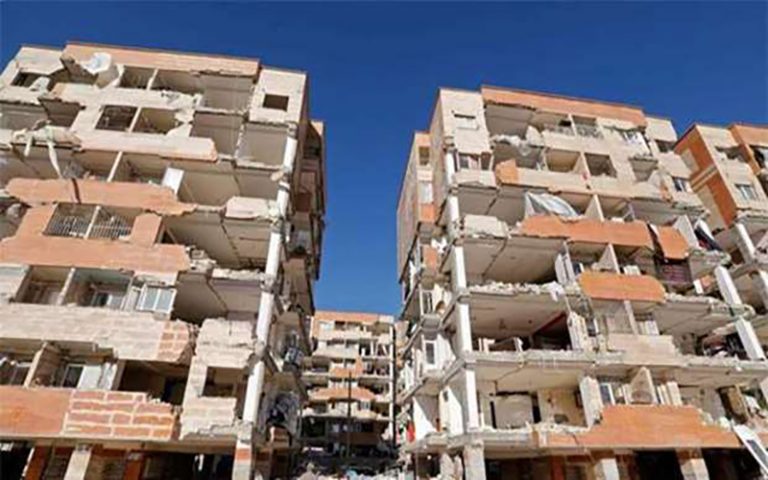
The Iranian plateau is sinking. According to Mostafa Fadaeifard, head of the specialized committee for flood assessment of the National Committee of Great Dams of Iran, 18 provinces are at high risk of land subsidence; subsidence that can engulf people’s vital infrastructure and homes and lands.
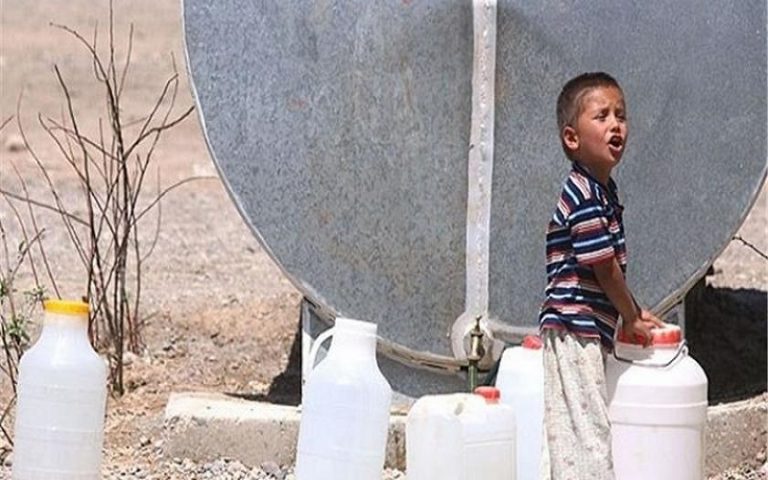
Water stress for large cities like Tehran means water rationing and consumption warnings, but for rural people, it means financial bankruptcy and migration, a process that has been going on for years. These people whose profession is agriculture are now forced to migrate to the outskirts of big cities and have become suburban people and day laborers. This shift, however, does not end here and has wider implications than we will discuss here.
According to statistics, 200 cities in the country are suffering from water stress this year. Perhaps it is not bad to give a definition of water tension that Iran is ranked fourth in the world; A country that has consumed more than 80% of its renewable resources. According to the ‘Falkenmark indicator’ or ‘water stress index’, when a region or country has less than a thousand cubic meters of water resources per person per year, the country suffers from water stress.
“This method defines water scarcity in terms of the total water resources that are available to the population of a region; measuring scarcity as the amount of renewable freshwater that is available for each person each year. If the amount of renewable water in a country is below 1,700 m per person per year, that country is said to be experiencing water stress; below 1,000 m it is said to be experiencing water scarcity; and below 500 m, absolute water scarcity.” (Global Water Forum, May 7, 2012)
What will this scarcity do with the country? Farmers in the east and west of Isfahan who live now for many years as farmers what will they do with their lives? The Kermanis who have no water anymore to plant pistachios what will they do? Cultivation pattern must change; True, irrigation should be change to drip irrigation, right, but in the absence of these scientific changes, people have found no way to escape their village for years.
Until now, migration from rural to urban areas has been mainly due to the repulsion of rural life; The repulsion that has occurred due to not finding a job and, in fact, a mismatch between the amount of land for the labor force; restrictive factors that have caused villagers to move from their hometowns to other cities.
Now, with water shortages, these migrations will increase. In this regard, we are witnessing migration to the north of the country. It is good if this migration is attracted by the destination and the person will find a job and is absorbed in the destination, but since such migrations are due to the repulsion of the origin, it must be said that it is a kind of migration is falling from the pit into the well.
This population is marginalized in the destination city and then suffers from a variety of social ills that challenge both themselves and the community of origin.
Iran’s cities even now cannot provide adequate urban jobs and facilities for its indigenous peoples, and if there is no culture and planning for these migrations in the cities of origin, then conflicts of interest can create new challenges for the cities, which we are seeing now.
Its manifestation can be seen in educational planning, a city must be able to calculate how many schools and teachers it needs for this population growth. But as we are witnessing due to an uncontrolled migration none of the cities are able to provide the migrated children with school and many of them are ending on the streets and being abused as workers.
Therefore, if these migrations are large and uncontrolled, changes must be made to the planning of the university, housing, roads, and urban infrastructure, as these are rapidly affected by migration and urban planning will be disrupted. Many young people in Iran who are scared because of water scarcity buys lands in the north of the country and decide to live there. Therefore, the population of the villages has shrunk by 50 percent in the last 40 years. Another effect of water scarcity in rural areas is reduced labor force and gender differences due to wider migration of men than women.
Lack of comprehensive and codified planning is one of the factors that has increased the damage to villages and cities. Especially in the long-term drought that has gripped the country for years, many agricultural products have been destroyed due to lack of water. Among the provinces where the effects of drought can be seen are Sistan and Baluchestan and Kerman, where many crops have been destroyed and where we are witnessing a flood of migration to cities, which has led to an increase in marginalization in large cities and provincial capitals.
It is evident from many facts that Iran after four decades of the mullahs’ rule has become a political, social, economic, environmental, and cultural ruin.
This situation becomes clearer when the regime’s officials are forced to confess and speak about this situation. And make it clear that such expressions are not just the opinions and propaganda of ordinary people and the Iranian opposition MEK/PMOI which the regime claims to be exaggerations and lies.
The former editor of the state-run daily Kayhan, Mehdi Nasiri, in a note which was published by the state-run daily Etemad on July 3, 2021, about such a situation under the title “Mr. [Ebrahim] Raisi, you took a ruin but not from [Hassan] Rouhani” wrote:
“Mr. Raisi’s office has also invited me to convey my views to the new president through a phone call, but for some reason, I prefer to share my content with Mr. Raisi on this public channel.
“Yes, I believe that the new president took ruins, but the cause of this ruin is not only Mr. Rouhani’s government but also all previous governments, statesmen, and officials, including Mr. Raisi and this humble servant who was the director of Kayhan from 1988 to 1994 and from 1994 to 1999 I was the manager of the personal magazine Sobh.
“Iran today is full of crises and super-crises, topped by a fragmented economy, growing poverty, social ills, managerial corruption, and moral weakness, and widespread popular distrust and despair of the future.
“Forty-two years later, the assessments show that the revolution and the Islamic Republic did not succeed in fulfilling the promises made to the people in 1979 to develop their religion and world (lives).
“The 2021 elections and the decline in popular participation are a sign of the frustration of Iranian society with the situation in which they live and breathe, even if some people still insist on presenting an epic interpretation of it.”
Then about the factors leading to this situation he added:
“What factors have led to this situation?
“If Mr. Raisi denies this destruction, I do not speak with him, but if he agrees, I will list the most important factors of destruction based on my understanding, maybe it will be some advice to the new president:
Charismatic and sacred management and leadership of the system instead of management being temporary and periodic and accountable for criticism and evaluation.
Lack of plans and programs for efficient and rational governance since the beginning of the revolution and the lack of need for the system to gain experience and use the knowledge and experience of domestic and foreign thinkers.
In other words, disregard for national and global collective wisdom and expert opinions at most management levels.
The desire for singularity and escape from political diversity from the early years culminated in the recent elections.
Anti-world foreign policy and enmity and little attention to diplomacy, whose role in the misery of Iran’s today may have the first place.
Although this policy is constantly documented in religion and ideology, in the opinion of the author (he self), it does not have the slightest relation with the rational political theology of Shiism.
We have failed to understand that not only the United States and the West but also Russia and China do not agree with adventurous Iran as the spoilsport and a regional troublemaker and will stop it whenever necessary.
A one-dimensional conception of power and its limitation to military power and the neglect of economic, cultural, national, and diplomatic power, and the failure to learn from the failed Soviet experience of conquering half the world with the Marxist revolution with equal military power with the United States and NATO, but it collapsed due to economic, political, and cultural backwardness.
Cultural and propaganda policies that polarize and interact with the people on the axis of religiosity and revolution are sometimes demonstrative instead of focusing on the Iranian people. This policy has been one of the most serious factors in the apostasy of the society and the non-voting of the majority of principlists.”
Finally, he warned the regime’s new president and wrote: “If Mr. Raisi, who, thank God, is in coordination with the higher institutions and the other two branches, can succeed in correcting and solving the above problems, he has done a great job and Iran owes him, but if he does not have such an analysis of the situation in Iran in 2021 and or if he is not able to make reforms, he will undoubtedly add to the destruction of the homeland.” (State-run daily Etemad, July 3, 2021)
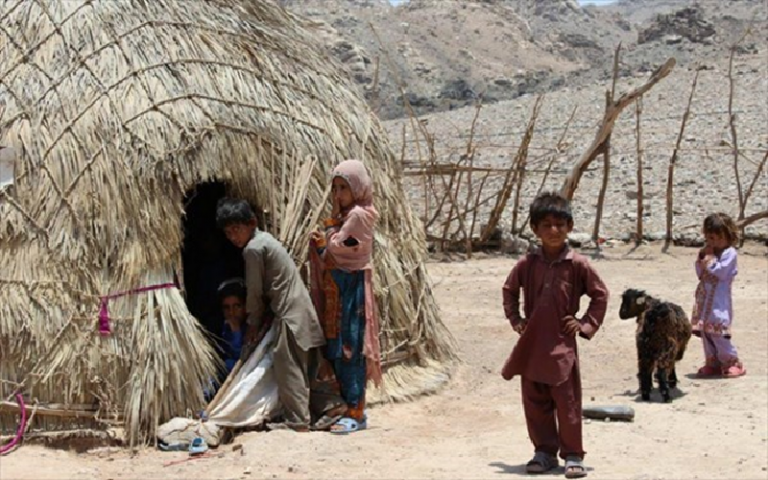
Iran, one of the richest countries in the world, is thanks to the mullahs’ rule one of the most deprived countries too. Mohammad Omid, the Deputy of Rural and Deprived Areas of Iran, in his latest statement claimed that due to their efforts (the 11-12th government) they have decreased the deprived areas of the country from 75 percent in 2009 to 25 percent in 2021, which is a decrease of 50 percent.
“In 2009, about 75 percent of the land of Iran was a deprived area, but according to the latest confirmed statistics, now about 25 percent of the territory of Iran is a deprived area and we are witnessing a 50 percent reduction in this deprivation in the country.” (Entekhab, July 3, 2021)
He counted the indicators of this ‘success’ and said:
“Some 25 percent of the country’s rural roads have not been paved yet and about 10 percent of the country’s rural areas still do not have gas. About 15 percent of comprehensive rural health centers also need to be renovated.” (Entekhab, July 3, 2021)
The question is how such a person in such a position can even dare to speak about such a ‘success’ in decreasing the percentage of deprivation when most evidence is contrary to this.
We will help him and count just a few of the crises for him which in any other country are the subclasses of deprivation.
“We are more involved in literacy than the student population,” Deputy Director of Literacy of the General Directorate of Education of Yazd Province, stating that in the census conducted in 2016, according to statistics, we had eight million illiterates, said: ‘This does not indicate a good situation in this area, and we are more involved in literacy than the student population.’” (ISNA, July 4, 2021)
State-run news agency IRNA reported: “Qassem Soleimani Dashtaki stated in a meeting to review the deprived areas of the province, which was held at the Khuzestan governor’s office and attended by the Vice President for Rural and Deprived Areas: ‘Khuzestan province in economic development due to large oil, gas, petrochemical, steel, agriculture and industry and… it has an influential role, but the citizens living in the province always face various problems and deprivations.
“The governor of Khuzestan pointed to some indicators of deprivation in the province and said: ‘Some cities in the province are facing 100 percent deprivation, the reduction of which requires serious and practical planning at the national and provincial levels.’
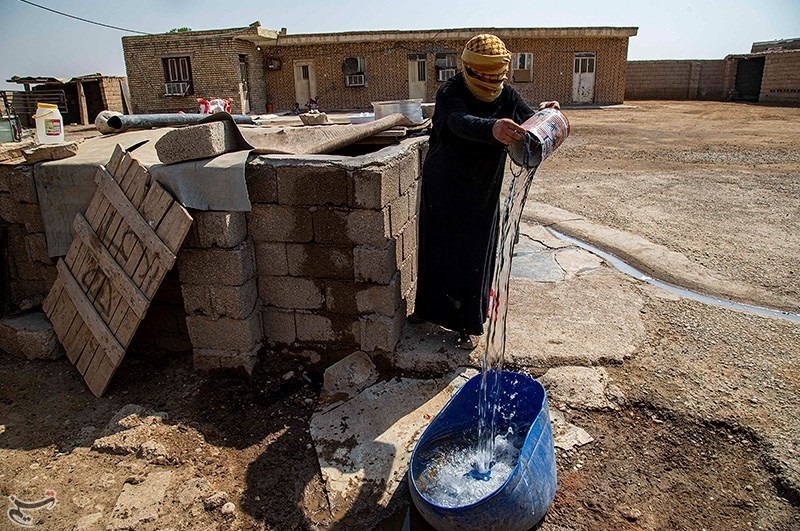
“Soleimani Dashtaki Rah said that Drinking Water and infrastructure facilities are among the essential needs in improving the living conditions of residents of deprived areas of the province and added: ‘For example, studies show that 730 villages in Khuzestan lack safe drinking water.’” (IRNA, July 3, 2021)
Pay attention this official is speaking about “Drinking Water” and said that 730 villages in Khuzestan which are without any doubt one of the richest provinces in the country lacks ‘Safe Drinking Water’ and not the lack of ‘paved ways’ and ‘gas’ which the so-called Deputy of Rural and Deprived Areas of Iran, Mohammad Omid counts as the indicators for the elimination of deprivation.
Iran, Khuzestan water crisis, source state-run news agency Tasnim, July 4, 2021
“The per capita consumption of red meat in the world is 12 kg per person per year, which due to successive jumps in the price of these products in the country, has decreased by 50 percent and reached 6 to 7 kg per year. Of course, this number may also decrease, given the 60 million population that is subject to subsistence subsidies.
“On the other hand, official statistical centers have also reported on the replacement of meat products with eggs and soy.
“If we add to the statistics on the consumption of meat and the substitution of other products instead of protein, the absolute poverty of 35 percent of the country’s population, we can understand the bitter truth of the livelihood of low-income families.” (State-run website Fekrshahr, July 4, 2021)
So, as a conclusion someone should say to this ‘Deputy of Rural and Deprived Areas of Iran’, no sir, the deprivation belongs to the country’s cities, and about the country’s rural areas and villages we should say they have crossed this border and are struggling to survive, having no drinking water which is the most primitive right of any human.
There are much more facts, like the disaster of the mass migration of the rural people to the suburbs of the cities which has created the critical crisis of marginalization for the country.
The violations of freedom of expression and other human rights will only increase under new Iranian president Ebrahim Raisi, who is otherwise known as the “henchman” of the 1988 massacre of 30,000 political prisoners.
Why is this specifically? Well, a bill is due to be considered by the Iranian parliament that will restrict freedom of expression, even though its title indicates the opposite. (It’s called the plan to “protect the rights of users in cyberspace and organize social media”.) Essentially, a committee made up of the Intelligence Ministry, Revolutionary Guards, and the State Security Force will monitor social media, basically allowing the armed forces to take over Internet management and showing new internet repression.
MP Hamideh Zarabadi admitted: “The content of this plan shows that it does not match the name chosen for it … We see the same thing in real space. They want to extend it to cyberspace and turn cyberspace into a security space that is also controlled by the armed forces.”
And the state-run website Kargar Online on July 3 wrote: “One million jobs depend on Instagram and virtual networks. But the parliament ignored this statistic, turned its back on the internet and the head of the parliament’s cultural commission says that they are standing by the plan to restrict the internet!
“It seems that the plan to organize cyberspace has not been removed from the agenda of the parliament, and the members of parliament are trying to approve this plan secretly and away from the eyes of the media and critics and to inform the government about its law.
“Morteza Aghatehrani, the head of the parliament’s cultural commission, announced yesterday: More than 130,000 posts have been posted from abroad about the plan to organize the media and cyberspace, and they have opposed it. But we stand by this plan, we have done our job.
“He said that we have prepared the law, we will take it to the parliament and we will do it. Because, according to Aghatehrani, the plan to organize cyberspace media has been in demand for many years, and this year we were able to achieve it.”
If people or groups post things online that the government does not approve of, they can be subjected to Ta’zir punishments, including:
imprisonment (91 days to six months)
fines (ten to twenty million Rials
floggings (11-30 lashes)
social rights deprivation (up to six months)
Of course, the regime has a long history of repressing its people online, as can be seen in the aggressive censorship seen of social media platforms around Iranian elections and during uprisings, such as the November 2019 protests that were violently repressed. The officials blocked many websites and messaging services to stop Iranians from discussing the protests amongst themselves and the rest of the world because the content was considered “anti-government propaganda”.
Reporters Without Borders (RSF) condemned this just days after the internet blackout began, which made it hard for Iranians to contact any outside body or media outlet to let them know about the crackdown.
The RSF wrote: “The Iranian regime must adhere to its obligations to respect international standards and put a stop to all digital discrimination.”
Iran Human Rights Monitor urged that all Iranian citizens have their freedom of expression respected and advised that the new internet plan indicates that the Revolutionary Guards wants to dominate cyberspace and all communication.
They wrote: “We condemn this plan and believe that the Iranian people should be able to have the right to freedom of expression.”
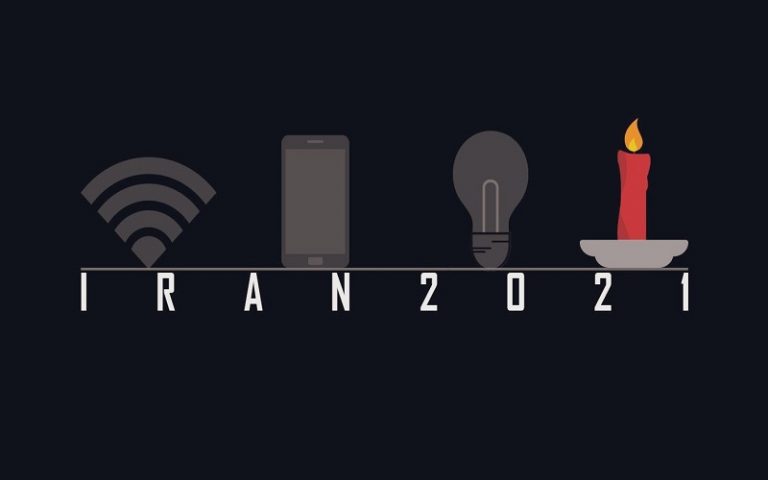
In recent weeks, large parts of Iran have witnessed widespread electricity blackouts. The blackouts have peaked again, and now, as the weather warms up, there is talk of wider and longer blackouts in Iranian cities.
Power outages in the cities of the world’s largest energy superpower
Iran has the second-largest natural gas reserves in the world and the amount of domestic gas production and consumption is very high. On the other hand, with an installed power plant capacity of nearly 85,000 MW, Iran is one of the 15 largest generators of electricity in the world. Accordingly, Iran generates even more electricity from more populous countries (such as Indonesia and Egypt) and more developed countries (such as Mexico).
But why does Iran, as an ‘energy superpower’ that ranks next to countries such as Russia, Saudi Arabia, Venezuela, Canada, and the United States, cut off electricity in both summer and winter?
There is a lot to be said about this. First, Iran has the highest rate of ‘energy intensity in the world. Simply put, Iran consumes more energy than any other country in the world but produces the lowest gross domestic product (GDP) per unit of energy consumed.
But that is not all. First, Iran’s electricity grid is severely worn out, and a lack of investment over the years has resulted in the loss of much of the energy in the transmission lines. In addition, evidence shows that despite warnings, cryptocurrency mining continues and puts severe pressure on Iran’s electricity grid. Currently, the consumption of unauthorized cryptocurrency mining is about 2,000 megawatts.
Another example of wasted energy is the so-called residential towers ‘Maskan-e-Mehr’ that even in hot provinces, despite a large amount of land, towers up to ten floors have been built in which energy insulation, which is the subject of Article 19 of the National Building Code, has not been observed. Coolers, firstly, impose reactive power on the network and increase losses, and secondly, they have greatly increased the home load of the network, so that the peak load of the network has been transferred from nighttime to daytime.
But to know how much energy is wasted in Iran, we must refer to some shocking global statistics. According to the International Energy Agency, in 2019, Iran allocated about 18.8% of its gross domestic product (GDP) to subsidize fossil fuel consumption, and in this regard, in holds first place in the world.
Thus, according to the report of the International Energy Agency, Iran alone has paid about 47% of the total subsidy allocated to the consumption of fossil fuels in the world in 2019.
Some 18.8% of Iran’s GDP in 2019 (before the coronavirus epidemic) was equivalent to about $86 billion. Considering 25,000 Tomans for each dollar, this amount will be equivalent to more than 2 thousand trillion Tomans.
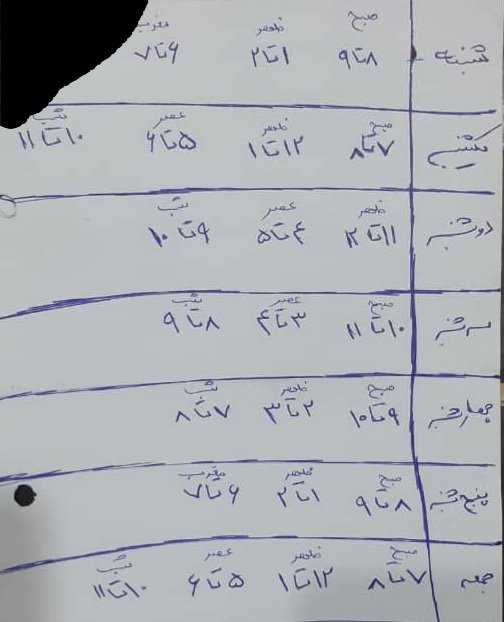
A note by an Iranian published on Twitter shows the times of power outage with the comment: “From free water and electricity we reached 4 times a day power outage at 40 degrees.”
And there are reasons for such a situation too. One of them is because of wrong administration. In the years of Ahmadinejad’s government and even after that, unfortunately, the use of managers without relevant expertise in this industry has grown increasingly, who are weak and lacking in decisions. For example, the CEO of Tehran Distribution Company was transferred from a security position to the CEO of this company, and a few days ago he was forced to resign. And the CEO of the parent company specialized in thermal power generation is a theolog graduate of Imam Sadegh University with a focus on Islamic economics.
Another reason is the country’s backwardness is the lack of investment in renewable energy by the parliament and the government, which has deprived the country of clean and cheap energy.
Can’t be this situation be managed?
Aside from these fundamental problems, is it possible to manage the current situation, at least until the end of the summer of 2021?
Just a few days ago, Gholam-Ali Rakhshani Mehr, Secretary of the Board of Directors of the peak of the electricity industry, said about the widespread blackouts in the country:
“About 24,000 MW of electricity produced in the country is allocated to cooling devices, and the peak of electricity consumption occurs between 12 and 18 o’clock. If we assume that this peak load occurs for three months, we have a peak consumption of about 450 hours per year, and to meet this consumption need, 7,000 to 8,000 MW power plant must be built.”
The largest conventional power plants in Iran have a capacity of about 2,000 megawatts, and thus, if we consider the words of this official, Iran will need to build four new power plants to get rid of the summer blackouts in the summer of 2021.
Just a few days ago, Hamid Reza Salehi, the head of the Energy Commission of the Iran Chamber, in an interview with the state-run news website ‘Fararo’, while pointing to the increasing possibility of blackouts in the country, said:
“Due to the lack of investment in the construction of power plants in recent years, power plants are under a lot of pressure, and unfortunately due to the approach was taken by the government, no new investment has been made in the construction of power plants, while according to official statistics, 8% of the country’s electricity consumption is increased annually.”
He continued: “The nominal capacity of electricity production in the country is 85,000 MW per day, while according to the Sixth Development Plan, 5,000 MW per year was to be added to the country’s production capacity. On the other hand, due to the existing problems, the current electricity generation capacity in the country is 60,000 MW per day.
“At present, the government buys between 50 and 60 tomans per kilowatt of electricity from power plants. On the other hand, the person who built the power plant must pay its foreign currency loan installments to the National Development Fund on time.
“Consider a power plant that generates 3 billion kilowatt-hours of electricity per year, and if we consider the purchase price of each kilowatt of electricity by the government between 50 and 60 tomans, the total revenue of the power plant will be 150 billion tomans per year. Meanwhile, the foreign currency loan of the power plant amounts to 52 million Euros, which is equivalent to 1500 billion Tomans, and must be returned to the National Development Fund.
“In practice, with such income and expenditure, the electricity industry cannot survive, and the output of this issue is the situation that we see in blackouts.”