


Iran Focus
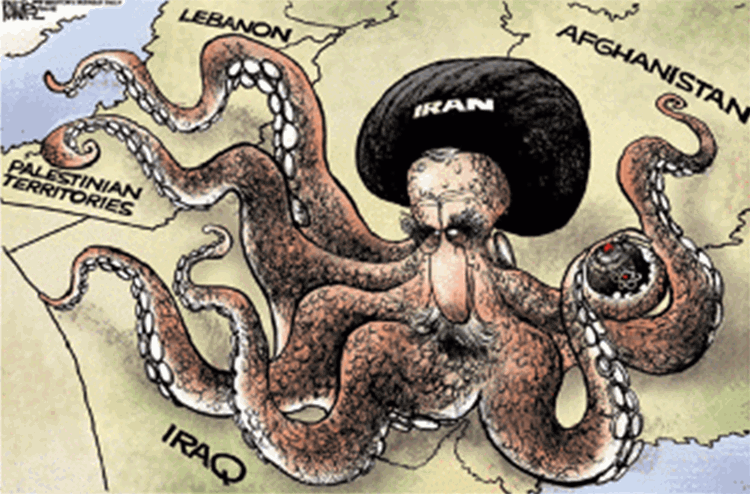
London, 17 Aug – The extremist ideology exhibited by the Iranian Regime is medieval and poses a threat to nation states in the Middle East, according to a Saudi Journalist.
Mohammed Al Shaikh wrote an op-ed for Al Arabiya, entitled “Extremist ideologies bane for nation states”, in which he assesses that prior to the 1979 Iranian revolution the countries in the Middle East lived in relative harmony.
He wrote: “Since the advent of this clerical regime, sectarian strife among members of the same religious community, both in the Arab and Islamic countries, has increased. The ongoing sectarian conflicts in Syria, Iraq and Yemen prove my statement… It is a historical fact that before Khomeini’s revolution in Iran, Arab societies lived in peace and harmony.”
Shaikh reports that sectarian differences within and among nation states lead to civil wars and widespread bloodshed, as is currently the case in the three countries mentioned above.
He wrote: “It seems the Arab people have yet to grasp the importance of coexistence among citizens of a society, even if they differ on the sectarian or doctrinal basis. Iraq, Syria and Yemen are currently in the throes of civil wars that cease momentarily only to start again. Unfortunately, I don’t see them ending anytime soon.”
Of course, it does not help that some nation states seem content to stoke the flames of sectarianism, as Iran does in order to seize power once they have created a power vacuum.
Shaikh wrote: “By using sectarianism to achieve its expansionist ambitions, Iran has invaded its neighbouring countries, stoked the flames of fanaticism in these societies, and targeted their stability and security by raking up Shiite fanaticism.”
Shaikh assessed that it is important for Gulf States to learn from the past and strive to end this Sectarian violence before it tears the Middle East apart as it did with Medieval Europe.
Shaikh wrote: “It is important for us in the Gulf to learn the lessons of the countries of the Arab North, and to refrain from sliding into those divisions that have the potential to obliterate all we cherish and cause enormous bloodshed. The ultimate losers in such wars will of course be citizens, regardless of their sectarian affiliations.”
But how did the people of Europe in the middle Ages end the sectarian thinking which led to discrimination, violence, and war?
Shaikh wrote: “They found out that the solution to their problem lay in overcoming differences and in developing the spirit of coexistence among different peoples, irrespective of the variance in their religious persuasions. This conviction led them to rebuild human society as we know now. They also believed that all those who indulged in sectarian violence should be condemned by law. This laid the foundations for a superior human civilization that the world enjoys today, with its benefits of progress, innovation and development in all spheres of life.”
He advises that the Gulf nations take the same path.
He wrote: “Thus, the only way for establishing security, stability and tranquillity lies in our taking lessons from these experiences. In order to get rid of fanaticism and animosity among sects and ideologies we have to replace them with values of loyalty and obedience toward the homeland, which should be a state that looks after all of its citizens regardless of their sectarian or doctrinal persuasion.”


