


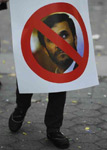
 Reuters: Iran’s President Mahmoud Ahmadinejad seems to relish a fight, which may be just as well for a man who has acquired so many enemies at home and abroad.
By Alistair Lyon, Special Correspondent
BEIRUT, July 19 (Reuters) – Iran’s President Mahmoud Ahmadinejad seems to relish a fight, which may be just as well for a man who has acquired so many enemies at home and abroad.
The hardline leader, already under fire from conservative and reformist foes, has also antagonised bazaar merchants. His populist government is facing economic pain as new foreign sanctions bite on the world’s fifth biggest oil exporter.
Yet Ahmadinejad jabbed at rival political factions last week by declaring that “the regime has only one party, which is the velayat” — a reference to Shi’ite Islam’s hidden Imam, for now represented by Supreme Leader Ayatollah Ali Khamenei.
Just as combative towards external pressure, he has derided sanctions as “pathetic” and vowed to pursue what Iran says is a quest for nuclear energy, not weapons as the West believes.
“Iran’s anaemic economy is fuelling discontent across the country. Sanctions have added to the sense of economic malaise,” said Alireza Nader, an Iran specialist at the RAND Corporation.
However, he saw little evidence to suggest that the Iranian government would change course on its nuclear programme.
“Faced by discontent, Ahmadinejad and the Revolutionary Guards may even tighten their grip on society, including the bazaar, to pursue their domestic and foreign policy objectives.”
Ahmadinejad, backed by Khamenei and the elite Revolutionary Guards, crushed the street protests that greeted his disputed re-election in June 2009, although he has yet to silence losing reformist candidates Mirhossein Mousavi and Mehdi Karoubi.
The president, first elected in 2005, also seems bent on displacing an older layer of conservative leaders and clerics whose influence dates back to the 1979 Islamic Revolution.
Many of them resent the rising economic and political power of Ahmadinejad’s allies in the Revolutionary Guards and are disconcerted by his mystical devotion to the hidden Imam.
Conservatives such as parliament speaker Ali Larijani, a fierce critic of Ahmadinejad’s economic policies, have tacitly urged Khamenei, the Islamic Republic’s ultimate authority, to rein in the fiery head of state, to little visible effect.
BAZAAR STRIKES
This month bazaar traders in Tehran and elsewhere, a group which decisively backed revolutionary icon Ayatollah Ruhollah Khomeini in his struggle against the shah, staged strikes against attempts to raise value-added tax by up to 70 percent.
The government compromised — even Ahmadinejad may have felt it would be rash to alienate the bazaaris and risk new turmoil.
“Any small incident could trigger another chain of events,” said Rasool Nafisi, of Strayer University in Virginia. “So the government tries to plug any sign of unrest at its onset, using maximum pressure, threats and efforts to co-opt the dissidents.”
The tax hikes were part of wider economic reform plans, including subsidy cuts, intended to bolster state finances.
Nafisi linked the discontent to the sidelining of the bazaar-based Motalefeh party, close to former President Akbar Hashemi Rafsanjani, and to fears among bazaar traders that they were losing their economic primacy to the Revolutionary Guard.
So far there have been few signs of any link-up between the traditionalist merchants and the more liberal “Green Movement”, much of whose energy derives from students and women.
Any such alliance, argued Kevan Harris, a sociologist at Johns Hopkins University, could only emerge if the reformists promoted an inclusive vision with a place for the bazaaris.
Even then, he said, the more capable state advocated by the likes of Mousavi, one better able to collect higher taxes or redistribute subsidies fairly and efficiently, might run up against the merchants’ traditional laissez-faire preferences.
The strikes seem to have been contained, but as in 2008, the bazaar has again forced government to moderate its tax demands.
REFORMIST VOICES
The broader-based “Green” opposition, with far more sweeping aims, has little to show for its street protests, which are now rare. But reformist leaders occasionally fire verbal broadsides.
This month Karoubi took aim at Khamenei, saying: “Shi’ite history abounds with instances where criticism of the ruler is not only regarded as necessary but a religious duty.”
Mousavi said Ahmadinejad’s dismissal of the June 9 U.N. sanctions resolution as worth no more than “a used handkerchief” masked the real damage that sanctions would inflict.
“It is perfectly clear that the resolution will negatively affect our country’s security and economy,” he said, forecasting slower growth, higher unemployment, lower living standards and a wider gap between Iran and other developing nations.
Another reformist group even blamed state “discrimination” for creating discontent that has emboldened the Sunni Muslim rebel group behind two suicide bombings that killed at least 28 people in a Shi’ite mosque in southeastern Iran last week.
More economic challenges lie ahead for Ahmadinejad, who has promised to start dismantling costly food and fuel subsidies from September, a strategy that risks stoking inflation but would also reduce Iran’s vulnerability to foreign sanctions by cutting consumption and reducing the government’s import bill.
“So sanctions can ironically end up strengthening the Iranian regime in the long term if it can survive the short-term unrest, which I expect it will be able to,” Mehrzad Boroujerdi, director of Middle Eastern Studies at Syracuse University, said.
“Sanctions will disrupt and retard Iran’s oil and gas sector but they will not force the Iranian regime to beg Uncle Sam. For that to happen the situation needs to turn drastically worse.” (Editing by Jon Hemming)


