


 AP: Iranian diplomats expelled from London in retaliation for attacks on British compounds in Tehran arrived home Saturday, the official IRNA news agency reported, sealing Iran’s most serious diplomatic rift with the West in decades.
The Associated Press
By ALI AKBAR DAREINI, Associated Press
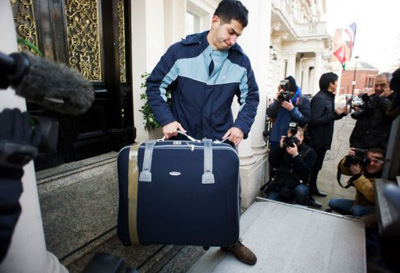 TEHRAN, Iran (AP) — Iranian diplomats expelled from London in retaliation for attacks on British compounds in Tehran arrived home Saturday, the official IRNA news agency reported, sealing Iran’s most serious diplomatic rift with the West in decades.
About 150 hard-liners waiting with flower necklaces had gathered at Tehran’s Mehrabad airport to give the roughly two dozen diplomats and their families a hero’s welcome. But the Iranian government, apparently opposed to any high-profile display that could worsen the fallout, took the diplomats off unseen from a backdoor, reflecting Iran’s own internal political rifts.
Tuesday’s storming of the British Embassy and residential complex — which the British government alleges was sanctioned by Tehran’s ruling elite — deepened Iran’s isolation, which has grown over the decade-long standoff with the West over its nuclear program.
Germany, France and the Netherlands have recalled their ambassadors, and Italy and Spain summoned Iranian envoys to condemn the attacks.
It amounted to the most serious diplomatic fallout with the West since the 1979 takeover of the U.S. Embassy after the Islamic Revolution, and some Iranian political figures have voiced doubts over whether anything can be gained from escalating the diplomatic battle.
The obstruction of Saturday’s welcome ceremony reflected the disagreements between hard-liners and the government of President Mahmoud Ahmadinejad, which opposed downgrading relations with Britain and condemned the attack on Britain’s embassy.
Iran’s relations with Britain have become increasingly strained in recent months, largely due to tensions over Tehran’s refusal to halt uranium enrichment, a key component of its nuclear program. The process is of deep concern internationally because it can be used to produce material for nuclear warheads in addition to reactor fuel. Iran insists its program is entirely peaceful.
Along with the United States and other nations in Europe, Britain has backed sanctions that have so far failed to push Iran to halt its enrichment program.
Hard-liners in Iran have said the embassy attack was an outpouring of the wrath of the Iranian people who believe Britain is a hostile country seeking to damage and weaken the Islamic Republic. Mohammad Mohammadian, a representative of Iran’s Supreme Leader Ayatollah Ali Khamenei, praised the attackers, saying they had targeted the “epicenter of sedition.”
Iran’s hard-line constitutional watchdog, the Guardian Council, approved a parliamentary bill into law requiring the Iranian government to downgrade relations with Britain. The government opposed it but said it would carry out the law.
The diplomatic freeze from Europe, including key trading partner Germany, further isolates Iran just weeks after a report by the U.N. nuclear watchdog agency that alleged Iran was making strides toward mastering critical elements for atomic weapons.
The current breakdown in relations with the West could embolden hard-liners who want a tougher stance against the International Atomic Energy Agency, which they accuse of being manipulated by the U.S. and allies.
Britain’s ambassador to Iran, Dominick Chilcott — now back in Britain — offered new details about the attacks, saying the experience had been “frightening.”
“We had no idea how it was going to end,” he said, describing how the mob trashed rooms, damaged furniture, scrawled graffiti and tore up a portrait of Queen Victoria, as staff took shelter in a secure area of the embassy.
“It felt like very spiteful, mindless vandalism, but it wasn’t quite mindless,” Chilcott said. “They removed anything that was electronic — mobile telephones, personal computers — anything that might give information about who you were talking to or what you were doing.”
At one point, the intruders started a fire inside the chancery building, forcing the staff to leave the safe area, climb down a fire escape and exit the building. A small number of police escorted them to a building on the edge of the compound and told them to lie low.
“We turned all the lights out and we sat in the dark and we could hear the noise of the intruders going on around us,” he said.
He said seven staff at a separate residential compound that was also attacked were seized and “quite roughly handled” by the invaders.
British Foreign Secretary William Hague has led the accusations that the rioters had a green light from Iranian authorities, including the powerful Revolutionary Guard. On Thursday, he said the attacks were “clearly premeditated” by high-ranking officials.
Iranian government officials said the storming of the embassy by angry protesters was unexpected and Iranian police intervened to protect the British diplomats and get the attackers out of the buildings.
The demonstrations had been organized by hard-line groups on university campuses and Islamic seminaries and included denunciations of the latest sanctions on Iran over its nuclear efforts.
Such major anti-Western rallies are rarely allowed to occur without official approval and often include state-backed forces including a paramilitary group known as the Basij, which is part of the vast security network controlled by the Revolutionary Guard.
Images broadcast around the world showed demonstrators tearing down Union Jack flags, brandishing a looted picture of Queen Elizabeth II and tossing out looted documents.
The deepening tensions with Britain and others may also trigger further rifts within Iran.
For months, Iran’s ruling system has ordered arrests and intimidation against political allies of President Ahmadinejad, who has sharply fallen from favor after challenging decisions by the head of the theocracy, Supreme Leader Ayatollah Ali Khamenei.
Ahmadinejad has remained silent since the attacks, but his supporters have raised questions about whether Iran’s interests are served by a diplomatic battle with the West.
Associated Press writers David Stringer, Jill Lawless and Cassandra Vinograd in London contributed to this report.


