


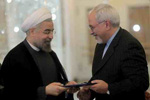
 Al-Arabiya: Rowhani and Zarif are active on Twitter although the Iranian authority still bans its citizens from using this site and other social networking websites in general. But this is no major detail for the Iranian regime to consider.
Al-Arabiya
By Diana Moukalled
Iranian president Hassan Rowhani, or perhaps employees of his, persist to post tweets on Twitter for himself and his foreign affairs minister, Mohamad Javad Zarif.
Rowhani and Zarif are active on Twitter although the Iranian authority still bans its citizens from using this site and other social networking websites in general. But this is no major detail for the Iranian regime to consider.
A veil of sensibility
He who reads the tweets of the “modern” president and of his foreign affairs minister will realize that the same terms are repeated: justice, peace, stability and a long list of the regime’s terms, tweeted by the two in English to address the West and not the people in Iran.
The “moderate” president and minister are aware that their smiles and expressions can attract more attention than their actions especially through a phase of Iranian-Western openness which makes concern over Iran’s violations less severe.
As a result, the fact that at least 80 people have been executed by the regime over the past two months has not been highlighted. Executions exceeded 500 last year. Perhaps one third of them happened following electing Rowhani for president last summer. This means that around 300 execution cases are linked to the era of the “moderate” president.
This year’s most famous execution case is the Iranian authorities’ hanging of Hashem Shaabani, an Arab-Iranian poet from Ahvaz, and of Hadi Rashedi. They were executed over accusations of “corruption, violating national security and waging war on God.”
Unlawful executions
Shaabani was executed amidst complete secrecy just like his trial – which was condemned by all international human rights organization because it lacked the minimum amount of transparency and justice. Televised confessions of the two were broadcast and it was clear that they were recorded under pressure.
In the confessions, Shaabani said he was member of a terrorist separatist group. But the truth is, apart from this interview, the Iranian judiciary did not present one single tangible piece of evidence that proves this allegation.
Hashem was a poet and a young Arab teacher who established a poetry magazine. He wrote texts criticizing the regime and its abuses against the Arab minority in Ahvaz and was therefore accused of waging war on God.
He was secretly executed at an unknown time. The paradox here is that Rowhani, the “moderate” president, visited the Ahvaz area only a short while before the execution was carried out and talked about the rights of the ethnic minorities.
Indeed, Iran is not the only country which is afraid of a poet and it’s not the only country whose regime is terrified by words and ideas.
But hanging Hashem Shaabani tells us a lot about Iran. The Iranian government’s attempt to show an image different than its image conveyed during Ahmadinejad’s days is still hypothetical so far.
When it comes to practice and not theory, the hideous image of Iran as a tyrannical regime still reigns true.
Recording Shaabani’s forces confessions on a video tape is a derogation of justice; a maneuver which now replaces the modern concept of a just, public and transparent trial.
Executing a poet is an expression that summarizes the Iranian regime.
Diana Moukalled is the Web Editor at the Lebanon-based Future Television and was the Production & Programming Manager with at the channel.


