


 Wall Street Journal: Iran’s nuclear program dominated last week’s meeting between U.S. President Barack Obama and Israeli Prime Minister Benjamin Netanyahu. A key challenge for both leaders: how to stop Iran’s rapid advance toward “critical capability.” Washington and its allies must insist that Tehran verifiably stop increasing the number and quality of its centrifuges.
The Wall Street Journal
OPINION EUROPE
By DAVID ALBRIGHT, MARK DUBOWITZ AND ORDE KITTRIE
Iran’s nuclear program dominated last week’s meeting between U.S. President Barack Obama and Israeli Prime Minister Benjamin Netanyahu. A key challenge for both leaders: how to stop Iran’s rapid advance toward “critical capability.”
Critical capability means the point at which Iran could dash to produce enough weapons-grade uranium or separated plutonium for one bomb so quickly that the International Atomic Energy Agency or a Western intelligence service would be unable to detect the dash until it is over.
Mr. Obama has implicitly threatened to use force, if necessary, to prevent Iran from “obtaining” nuclear weapons. But once Tehran is perched at critical capability, it could use the threat of an undetectable breakout to enjoy many of the strategic benefits of having a bomb without crossing Mr. Obama’s red line. Once Iran has produced sufficient fissile material—weapons-grade uranium or separated plutonium—it will be much more difficult for the West to stop Iran from completing the process of actually building nuclear weapons.
Producing fissile material is the most technically demanding step in building a nuclear bomb, and the hardest to hide. According to IAEA officials, Iran already knows enough to create the non-fissile parts of a basic nuclear bomb. With this knowledge, a country such as Iran could manufacture nuclear weapon components, or even assemble complete bombs, in small, secret facilities. That is one reason why U.S. intelligence was surprised by how quickly China, India, North Korea, Pakistan and the Soviet Union obtained nuclear weapons—and underestimated Iraq’s progress in 1990 and overestimated it in 2002.
How short would Iran’s fissile-material dash need to be so as to be undetectable? Currently, the IAEA inspects two Iranian enrichment facilities on average once a week, and a third facility every two weeks on average. With this rate of inspections, Iran would need to produce 25 kilograms of weapons-grade uranium (enough for one bomb) from its stockpiles of lower enriched uranium in less than one week. The window might be widened to two or three weeks if Tehran blocked one or two inspections on the pretext of an “accident” or a “protest.”
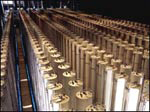
This brings us to the critical component for a fissile-material dash: the quality and quantity of Iran’s centrifuges. Tehran has in the last year installed about 5,000 additional IR-1 centrifuges, the biggest increase in years. It has also begun installing IR-2m centrifuges, which are reportedly three to five times as productive in enriching uranium as the currently standard IR-1 models. All of Iran’s centrifuge installation- and uranium enrichment-related activity violates multiple U.N. Security Council resolutions, which since 2006 have required that “Iran shall without further delay suspend . . . all enrichment-related and reprocessing activities.”
We estimate that Iran, on its current trajectory, will by mid-2014 be able to dash to fissile material in one to two weeks unless its production of 20%-enriched uranium is curtailed. If the number or efficiency of Iran’s centrifuges unexpectedly increases, or if Tehran has a secret operational enrichment site, Tehran could reach critical capability before mid-2014. The date could be delayed, however, if Iran encounters unexpected difficulties in centrifuge operation or can no longer import centrifuge equipment and materials from China and elsewhere.
At nuclear talks in Kazakhstan in February, Western negotiators reportedly focused on persuading Iran to curtail its production of 20%-enriched uranium and to export some of its existing stock. These goals are important but insufficient. As Iran increases the quality and quantity of its spinning centrifuges to the point of critical capability, a moratorium on 20%-enriched uranium will matter less and less. It will become easier for Tehran—after using some pretext to renege on a 20% moratorium—to rapidly make up for lost time in accumulating enough 20% enriched uranium that, if further enriched to weapons-grade (or about 90% enriched), would be enough for a bomb. Once Tehran had enough 20% material for a bomb, it could produce enough weapons-grade uranium for that bomb in a week or two.
Given Iran’s current course, the U.S. and its allies should immediately impose maximum pressure on Iran, including by intensifying economic sanctions and cracking down on Tehran’s illicit imports of centrifuge equipment and materials. In addition to curtailing Iran’s production and stockpile of 20%-enriched uranium, any interim deal must verifiably prohibit Iran from upgrading the type and increasing the number of its operational centrifuges. More frequent IAEA inspections at key Iranian sites are also essential.
Mr. Obama warned last fall that Iran could eventually achieve “breakout capacity, which means that we would not be able to intervene in time to stop their nuclear program.” If Iran achieves breakout capacity, the United States, by President Obama’s admission, would not have sufficient insight into Iran’s progress to intervene “in time” to prevent it from completing the process of obtaining nuclear weapons.
Washington and its allies must insist now that Iran verifiably stop increasing the number and quality of its centrifuges. Anything short of that will leave Iran far too close to an undetectable breakout capacity.
Mr. Albright is president of the Institute for Science and International Security. Mr. Dubowitz is executive director of the Foundation for Defense of Democracies. Mr. Kittrie is a law professor at Arizona State University.


