


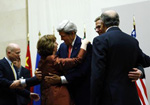
 UPI: 2013 saw six world powers negotiate a comprehensive deal with Iran to halt its nuclear program. Some hailed the deal a historic achievement, others, a historic mistake.
United Press International
By Margot Dudkevitch
2013 saw six world powers negotiate a comprehensive deal with Iran to halt its nuclear program.
The Nov. 24 interim agreement inked in Geneva, Switzerland, between Iran and the United States, France, Britain, Russia, China and Germany calls on the Islamic Republic to halt production of near-weapons-grade nuclear fuel in exchange for some relief from economic sanctions, amounting to some $7 billion. Some hailed the deal a historic achievement, others, a historic mistake.
The deal calls on Iran to halt construction of the heavy water nuclear facility in Arak, limit its uranium enrichment activities to 5 percent and dilute or convert its existing stockpiles of 20 percent enriched uranium. Iran also agreed to refrain from installing more sophisticated centrifuges and to allow U.N. inspectors daily access to nuclear facilities.
The measures are to remain in place for six months. During that period a permanent agreement is to be negotiated.
U.S. President Barack Obama called the interim deal an important step that will ensure Iran’s nuclear program is solely for peaceful purposes.
“For the first time in nearly a decade, we have halted the progress of the Iranian nuclear program, and key parts of the program will be rolled back,” he said in a statement shortly after the deal was signed.
U.S. Secretary of State John Kerry said the deal offers a real chance for a diplomatic solution to the longstanding nuclear crisis. He described the deal as a “hinge point in history.”
“One path could lead to an enduring resolution [of the] international community’s concerns about Iran’s nuclear program. The other path could lead to continued hostility and potentially to conflict,” he testified before Congress.
Kerry admitted profound differences with Iran have yet to be resolved. Nonetheless, he said the preliminary agreement is the “first step” that will “lead to what is our ultimate goal, which is a comprehensive agreement that will make the world safer.”
Israeli Prime Minister Binyamin Netanyahu slammed the interim deal, calling it “a historic mistake.” Israel is not obligated by the agreement and retains the right to defend itself against a regime that calls for Israel’s destruction, he said.
“For the first time the world’s leading powers have agreed to uranium enrichment in Iran while ignoring the U.N. Security Council decisions that they themselves led. Sanctions that required many years to put in place contain the best chance for a peaceful solution. These sanctions have been given up in exchange for cosmetic Iranian concessions that can be canceled in weeks,” Netanyahu said.
Prince Mohammed bin Nawaf bin Abdulaziz, the Saudi ambassador to Britain called the deal a “dangerous gamble.” The West’s policies on Iran risk the stability and security in the Middle East, he said.
In Tehran, Iranian President Hassan Rouhani warned the West against falsely interpreting the deal.
“If other countries attempt to bring up different interpretations of the deal, they will damage mutual trust and confidence building efforts made,” he said. Rouhani emphasized his country’s commitment to a peaceful nuclear program.
The ink had barely dried on the Geneva document when Tehran announced plans to construct two new nuclear plants with Russia’s help in Bushehr and insisted construction at the Arak heavy water facility would continue.
In mid-December, the U.S. Treasury announced it was sanctioning “more than a dozen companies and individuals” for helping Iran evade international sanctions. Tehran criticized the move describing it as “inappropriate and unconstructive.” Iranian Foreign Minister Javad Zarif said talks with the West would continue despite a decision to blacklist Iranian companies.
“We are pursuing negotiations seriously and of course we will give a well-considered purposeful, smart and proper reaction to any inappropriate and unconstructive move.”
At year’s end, it was unclear whether a permanent agreement could be achieved and military action remained an option.


