Home Blog Page 287

Retirees Continue Protests in 23 Cities Across Iran

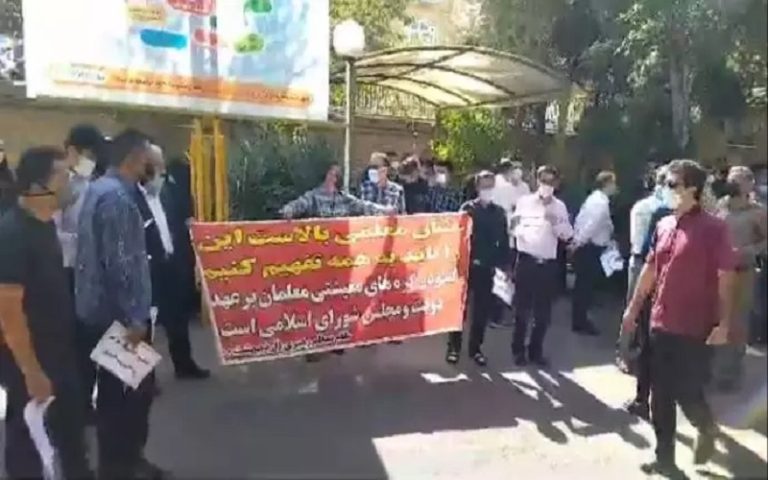
Retirees, pensioners, and welfare recipients affiliated with the Social Security Organization once again rallied and marched in 23 cities in 19 provinces across Iran on April 4. They protested officials’ failure to improve their living conditions, low salaries, and skyrocketing prices.

“In addition To Tehran, the retirees and pensioners staged protests in Arak, Ardabil, Isfahan, Ahvaz, Ilam, Khorramabad, Rasht, Sari, Sanandaj, Shiraz, Karaj, Kerman, Kermanshah, Gorgan, Qazvin, Mashhad, Yazd, Neyshabur, Shush, Shooshtar, and Abhar, outside the local social security offices,” stated the Iranian opposition coalition National Council of Resistance of Iran (NCRI).

In their countrywide protests, retirees vented their anger over officials’ deceitful policies and indifference toward their dilemmas. Enraged protesters also expressed their disappointment over both government factions, announcing that they would boycott the Presidential election scheduled for June.

“We have heard too many lies, we will no longer vote,” “Threats and crackdown are no longer effective,” “We have not seen any justice, we will no longer vote,” “Parliament, Government, stop deceiving the people,” “To overcome empty plates, we must take to the streets,” and “Until we obtain our rights, we will be here every day,” retirees chanted.

In recent months, retirees and pensioners have time and again staged rallies and marches in various provinces. These protests have gradually grown into a countrywide movement, which has swept more and more cities. Furthermore, despite officials’ promises and other tricks, such rallies increase with each passing week.

Given the government’s mismanagement and corruption, Iran’s economy has been placed on the verge of collapse. In such circumstances, vulnerable classes of society like retirees and pensioners face enormous dilemmas. They face a deteriorating rate in their purchasing power, and their food baskets are constantly shrinking.

On the other hand, the government does not care about these impoverished people’s hardship and has left them in utter poverty and misery, according to Iran experts. According to state-run media, the majority of Iran’s population live below the poverty line. However, in reality, many people suffer from poor nutrition.

“Pensioners receive on average 25 million rials per month while the poverty line in some parts of Iran has reached 100 million rials in the past year. Along with pensioners, workers are also suffering from the regime’s destructive policies and its refusal to increase the minimum wage based on inflation and price rises,” noted the Iranian opposition People’s Mojahedin Organization of Iran (PMOI/MEK).

In this status quo and while the country has plunged into the fourth wave of the coronavirus outbreak, retirees’ dilemmas have been doubled. Nonetheless, these people prefer to come to the streets and struggle for their inherent rights rather than remaining silent over the government’s plundering policies. This issue shows public distrust in the entire ruling system as citizens have been disappointed to follow their fundamental grievances through governmental apparatuses.

“Today, Iran’s honorable pensioners and retires once again held their protests and uprising across the country with chants which boycotted the mullahs’ election charade. They thus echoed the voice of all the people of Iran who seek to gain back their rights usurped by the mullahs’ corrupt regime,” said NCRI President-elect Maryam Rajavi.

“The clerical regime has plundered the Iranian people’s national wealth and assets. They squander the product of Iran’s toiling workers on warmongering and belligerence, nuclear and missile programs, domestic repression and terrorism abroad, just to preserve the regime’s rule,” she added, highlighting, “The protesters are right when they cry out: We will no longer vote, because we did not see any justice, but heard many lies.”

Iran Hopeless About Appeasement

The positions of Iranian officials on the 2015 nuclear deal with world powers, known officially as the Joint Comprehensive Plan of Action (JCPOA), are contradictory.

“We have no urgency for the United States to return to the JCPOA. It is not our matter whether the US returns to the JCPOA or not. What our rational demand is, is the lifting of sanctions,” Iran’s Supreme Leader Ali Khamenei stated. (Khamenei.ir, January 8, 2021)

Following Khamenei, key elements of his faction like Ali Akbar Valayati and Saeed Jalili, referred to his comments about the JCPOA and the negotiations that the regime is not in hurry for the US to return to the JCPOA.

Valayati said: “We are not in hurry for a US return. But if it wants return, it has conditions, which the most important is the that it removes the sanctions.” (Khamenei.ir, January 12, 2021)

Instead, the regime’s president Hassan Rouhani and his faction are counting daily for the return of the US to the JCPOA. Attacking the interference of the rival faction, Rouhani said: “Delay in lifting the sanctions is betrayal. If any faction, individual or group delays the end of sanctions for an hour for any reason, it is treason. Of course, today the reason for this is only the 2021 elections. For whatever reason, anyone who wants to delay the end of the sanctions is a great betrayal of the history of the Iranian nation, and this eternal disgrace will remain for that faction and individual.” (president.ir, March 17, 2021)

Then days after the beginning of the Persian calendar’s new year Rouhani pleaded with the US and said: “If they lift the sanctions, it will become clear to us that this is the right thing to do. We will return to all our obligations.” (State TV, news channel, March 24, 2021)

Sad about the US decisions and the lost hope for the appeasement policy the state-run TV channel One on March 23 said: “Biden had asked Trump to reduce sanctions because of the coronavirus outbreak, but two months after he took the White House, he has taken no action.”

And about the US’s return to the JCPOA a government expert in an interview with the news channel said: “I do not see the future perspective to compensate for the mistakes. It has been about two months and a week that Mr. Biden has been following in Mr. Trump’s footsteps.” (state TV News Channel, March 24, 2021)

Fearing the continue of the sanctions and its consequences Ali Motahari warned: “We should not obstruct the lifting of sanctions and the revival of the JCPOA, we should not create hardship for the people in the name of revolution.” (State-run daily Aftab, March 23, 2021)

There are many other sources and people who have the same concern about the regime’s situation and its future especially in the field of the JCPOA and negotiations.

State-run daily Aftab on March 27, 2021 wrote: “The window of opportunity for the revival of US-Iranian diplomacy will close soon.”

The Arman daily on the same day saw the “negotiations” as the “last hope” and “last solution”, and said that, “Iran must bring the issue of JCPOA to a logical conclusion” because, “the fact that events have taken place in the country in recent years is widening the gap between the people and the government, and this gap is deepening day by day” and, “another point is that the conditions of possible future negotiations have changed since the JCPOA in 2015, and these changes require new measures. In the current situation, the situation of Iran’s influence has changed compared to the past in areas such as Iraq, Lebanon and Syria, and the situation is not the same as in the past.”

And Sadegh Zibakalam, one of the regime’s insiders, in an interview with the RFI radio on March 24, 2021 said: “What will pull the country out of the quagmire will be the 2021 JCPOA of the government with the United States. Of course, they will say in the advertisements that this 2021 JCPOA, this heroic flexibility of 2021 is not like the JCPOA of 2015 in any way.”

What these contradictions in the comments of the regime’s elements and state media show as a conclusion is the deadlock of the regime, having no way out of its crisis even if the US returns to the JCPOA.

Iranian Supreme Leader’s “Definitive” Nuclear Policy is Mainly Bluster

Iran’s Supreme Leader Ali Khamenei delivered his annual Nowruz speech just over a week ago. Although it was uniquely broad in scope, the actual substance of the speech was hardly distinguishable from any other major address by a leading figure in the theocratic regime.

It was largely an exercise in propaganda, peppered with boastful and often ridiculous claims designed to present an image of unbridled strength for the Islamic Republic.

Unsurprisingly, some of the relevant statements were more specifically aimed at portraying the regime as being so politically and economically resilient that it can stand toe-to-toe against the United States and force the world’s leading superpower to back down on issues that include the Iranian nuclear program and the so-called Joint Comprehensive Plan of Action.

The supreme leader reasserted that his regime had established its “definitive policy” with regard to that 2015 Iran nuclear deal and would neither surrender nor compromise in the face of persistent U.S. sanctions.

Experts in foreign affairs generally recognized that Iranian officials were looking to last January’s Presidential transition in Washington as an opportunity for a return to the status quo as it existed before then-President Donald Trump pulled out of the nuclear deal and initiated a policy of “maximum pressure.”

But his successor, Joe Biden, has so far shown little interest in rushing to suspend the sanctions that were re-implemented or newly implemented after May 2018.

On the campaign trail, Biden had signaled that he would try to return to the deal, and he has technically retained that position since taking office. But the two sides remain at an impasse over the question of who acts first.

As Khamenei reiterated in his speech, Tehran is insisting that the U.S. remove all sanctions first, before Iranian authorities begin reversing any of the myriad violations of the deal that they made at a time when the five other signatories were struggling to continue enforcing it.

Meanwhile, the White House correctly sees that there is no reason to provide Iran with additional, unearned concessions, as the regime is in no position to make demands.

US Deputy Secretary of State Wendy Sherman, formerly a major player in the negotiations that led to the nuclear deal, explained this situation in her confirmation hearing before the Senate Foreign Relations Committee, about two and a half weeks before Khamenei delivered his Nowruz speech.

“The facts on the ground have changed, the geopolitics of the region has changed, and the way forward must similarly change,” she said after underscoring “the threat that Iran poses to our interests and those of our allies.”

Read More:

Tehran Expresses Its Disappointment About U.S. Approach

Khamenei cited Sherman’s remarks but ignored their context. “Conditions have changed,” he declared, “but they changed in favor of Iran, not the U.S. So if anything, the JCPOA must change in favor of Iran.”

Of course, this is exactly what he and other leading Iranian officials are proposing when they insist upon a full-scale return to sanctions relief, sans consequences or any real acknowledgment of the fact that Tehran has recently ramped up its nuclear activity to a degree and with a pace that raises serious questions about the agreement’s prior value.

Those advancements came as a surprise to many observers, given that the JCPOA had been sold to skeptical lawmakers as supposedly lengthening the regime’s “breakout” time for a nuclear weapon to well over a year.

Current estimates put the regime just a few months away from such a weapon, at best. Since halting all compliance with the JCPOA at the beginning of this year, uranium enrichment facilities in Iran have started running cascades of second and third-generation centrifuges and have readied even more advanced machines for still faster production.

The country has also begun work on uranium metal, a key component in the core of a nuclear weapon, and has ceased implementation of the Additional Protocol to the Nuclear Nonproliferation Treaty, making it doubtful that international inspectors will be allowed to remain in the country for much longer.

This all sounds rather alarming, and it is. But it would be wrong to respond to the underlying threat by giving the Islamic Republic what it wants, now that there is ample evidence to suggest that the regime would just exploit the new concessions in order to further weaken an arrangement that was already far less beneficial to global security than had been claimed.

The foregoing violations confirm frequent criticisms of the JCPOA, namely that Iran would continue making clandestine advancements in areas not covered by the agreement or the inspections regime, and then would rush to nuclear breakout once the restrictions on enrichment and stockpiling either expired or were abandoned.

Read More:

Tehran Jeopardizes Global and Regional Peace with Unlawful Enrichment

Some Iranian officials have all be acknowledged that this was their plan all along. Ali Akbar Salehi, the head of the Atomic Energy Organization of Iran, admitted to state media more than two years ago that authorities had deceived UN nuclear monitors into believing that the Islamic Republic had fully complied with a provision of the JCPOA requiring that the core of a heavy water plant in Arak be deactivated, cutting off the regime’s plutonium pathway to a nuclear weapon.

Later in 2019, Salehi indicated that this was not the only instance of deception and that the regime had also put “countermeasures” in place to prevent significant or long-lasting effects from restrictions on uranium enrichment.

If anyone advocates for appeasing Tehran in the wake of Khamenei’s “definitive” rejection of further negotiations, they are ignoring the real nature of the threat. To reverse the maximum pressure strategy at this time would be to reward Iran for its deceptions and violations, and to give away the very leverage that the regime is so plainly desperate to remove.

Contrary to the supreme leader’s rhetoric, recent changes to the geopolitical situation are proof of Tehran’s vulnerability, not its strength. The regime is perhaps under more pressure from both at home and abroad than it ever has been.

Between December 2017 and January 2020, authorities were faced with three nationwide anti-government uprisings, and as the Iranian Resistance leader Maryam Rajavi explained in her own Nowruz, speech, the “flame” of those movements has been “kept alight” throughout the coronavirus pandemic, and now seems to be contributing to major protests in areas like the border province of Sistan and Baluchistan.

Read More:

Iran: Officials Murder Baluch Fuel Porters and Protesters in Saravan

Meanwhile, news of an Iranian terror plot against a Washington military base has made it all the more clear that the regime is desperate to project strength at any cost, for fear of the growing challenges to its grip on power.

That plot may bring renewed attention to earlier threats including the 2018 attempt at bombing an Iranian expatriate rally in Paris, which led to a 20-year sentence for a high-ranking Iranian diplomat.

Such stories reinforce the need for greater isolation of the Iranian regime, which is incompatible with recommendations coming from those who prioritize salvaging the JCPOA above all else.

Those recommendations should be taken no more seriously than Khamenei’s portrayal of the Islamic Republic as a country on the verge of defeating the United States. The reality is that his regime is on the verge of collapse and only pretends otherwise in hopes of saving itself.

Iran’s Government Scores 150 in Discrimination Against Women

In the newly-released Global Gender Gap Report 2021 by the World Economic Forum, Iran under the rule of the mullahs is ranked 150 in terms of gender gap.

The report, which was released on March 30, 2021, points out that Iran has fallen two other steps over the past year. Iran in 2006 was ranked 108, but after 15 years, it has fallen 42 further steps. Out of 19 countries of the Middle East and North Africa, Iran has the rank of 16.

According to the World Economic Forum report, Iran has a disastrous situation in all areas. If someone does not know the wealth and opportunities of Iran, they might think that this is one of the poorest countries in the world, which is falling year after year in all Indicators of health and gender equality.

The report added: “…On the opposite end of the spectrum, the countries with the largest economic gender gaps are Iran (just 37.5% of the gender gap closed so far).”

The other statistical table of this report indicate that Iran ranked 119 in terms of Educational Attainment, 129 in terms of Health and Survival ranked, and 151 in terms of Political Empowerment.

Global rank of Iran in terms of gender gap

The report highlights the low level of women’s labor force participation which according to this report is a driver of lack of economic participation. While it said the Middle East’s average women’s participation is 31 percent, it said that seven countries including Iran have the lowest rates in the world with 20 percent or less of women participation in the labor market.

Pointing to another important factor of women’s situation this report said: “Another important factor that limits economic opportunities of women in the region is lack of access to financial assets, including bank accounts. Combined with low presence in the workplace, this drives stark income differences between men and women. Six of the index’s 10 lowest-ranked countries in terms of income gender gaps are in this region. In Saudi Arabia, for instance, a woman’s income is on average only 24% that of a man, and in Egypt, 22%; in Algeria, 19%; in Iran, 18%; in Iraq, 12%; and in Yemen, 7%. Even in Israel, women’s income is only 61% of that of a man.”

Iran’s score card
Iran’s score card

About the women’s political participation in Iran the report said: “With the exception of the United Arab Emirates, where there are as many women as men in the parliament, women make up just 18.3% of parliamentarians across the region, and in five countries women represent 6% or less of lower-house members: Yemen (0.3%), Kuwait (1.5%), Oman (2.3%), Lebanon (4.7%) and Iran (5.6%).”

Iran: Water in Karaj and 12 Metropolises Will Be Rationed

For years, water management in Iran has become one of the main challenges that the government faces, and the population is suffering from it.

Water scarcity is the result of two mechanisms: physical water scarcity and economic water scarcity, where physical water scarcity is a result of inadequate natural water resources to supply a region’s demand, and economic water scarcity is a result of poor management of the sufficient available water resources.

But in Iran the main cause of water scarcity is due to the prioritization of economic development. The main economic entities are in the hands of the Revolutionary Guards (IRGC), and by its wasteful dam constructions mainly with the goal of military use, it is wasting the water resources.

In any country, based on a proper plan, according to natural resources such as water, population and capabilities, rational policymaking should be formulated and implemented in national development plans. But in Iran this has not received enough attention.

For example, to address a country’s water challenges, these solutions are included, ‘education and awareness’, ‘use of new technologies’, ‘wastewater reuse’, ‘upgrading irrigation systems to prevent water losses in agriculture’, ‘rationalizing water prices’, ‘use of efficient water desalination systems’, ‘use of rainwater’, ‘attracting public participation and inter-organizational coordination’, ‘review of policies and regulations’, and ‘integrated management and attention to the ecosystem.’

But none of these have been implemented by Iran’s government over the past 40 years. And every year increasingly the country is facing a severe lack of water.

Water rationing in Karaj has begun as the first critical metropolis. Shahin Pak Rouh, Deputy Minister of Energy, said:  “In 2021, more than 12 metropolises are faced with a water supply crisis. The metropolis of Arak, Isfahan, Bandar Abbas, Tehran, Shiraz, Qazvin, Qom, Karaj, Kerman, Mashhad, Hamedan, and Yazd are facing with a water supply crisis in summer, from which water rationing in Karaj began as the first critical metropolis.”

He claimed: “This action is looking for drought problems, reduced rainfall and dehydration in the country.” He introduced the people as the main culprits and added: “If people don’t stop over-consumption and fail to save at least 10 percent of drinking water, with an intensification of heat the scope of problems will increase.”

Mohammad Reza Janbaz, director of water and sewage, said that, it is expected that the number of cities suffering in the summer of 2021 increases compared to the previous year. Last year, the number of cities suffered from water crisis reached 225 cities.”

After 42 years, the Iranian government is still unable to provide potable water resources for people. Every year, people in the heat season are faced with water rationing.

Iranians Consume Less Red Meat Than Anywhere Else

In tandem with the rise in red meat prices in Iran in recent years, Iranian families have been forced to consume less of it. According to a report provided by Tehran’s Chamber of Commerce, Industry, Mine, and Agriculture, per capita annual red meat consumption in Iran was between 10 to 12 kilograms in 2013. This number reached 8 kilograms in 2020, according to the chamber’s latest report.

This issue would be more painful when we compare this amount with other countries. According to the United Nations Food and Agriculture Organization (FAO), red meat consumption per capita in Ghana and Tanzania is 9 and 10 kilograms, respectively. This number reaches 14.5 kilograms in the war-torn country of Yemen. Also, the Singaporeans, Germans, and French annually consumed around 26, 45.7, and 57.7 kilograms of red meat in 2019.

The Tragedy Is not Limited to Red Meat Consumption

This decline in meat consumption is not limited to red meat alone, but Iranian families consume fish 10 kilograms less than the global average. Instead, the people resorted to consuming white meat. In November 2020, Eghtesad Online website reported that “during the past two years, chicken consumption per capita has grown from 20 to 30 kilograms.”

Other statistics prove the decrease in red meat consumption and the growth in chicken meat consumption. For instance, in June 2019, the chief of livestock and poultry stats bureau in Iran’s Statistic Center acknowledged that “chicken consumption per capita had increased from 17.6 kilograms in 2011 to more than 21 kilograms in 2017.”

Furthermore, the price of both red meat and chicken meat has doubled in recent years. However, there is still a flagrant distinction between prices. For example, the chicken price has reached from 115,000 to 230,000 rials [$0.46-0.92] per kilo, while the red meat price increased from 1 to 2 million rials [$4-8] per kilo.

During recent years, Iranian citizens have experienced unprecedented financial problems. Many people like workers, employees, and even nurses and teachers have yet to receive their salaries for months while no day goes by without news about officials’ corruption and embezzlement cases. In such circumstances, many citizens, particularly low-income families, have resorted to consuming chicken meat rather than red meat.

While this is not the whole story, but it is a stark view of Iran’s society. Today, many people cannot provide essential foodstuff for their families, and they spend hours in crowded and long queues for items such as edible oil, bread, rice amidst the coronavirus outbreak.

Read More:

State-Backed Mafia Removes Red Meat From Iranians’ Food Basket

Economic Dilemmas Shrink Iranians’ Food Basket

Economic dilemmas have driven low-income citizens to consume low-price meat and foodstuff; however, several million people whose breadwinners lost their careers during the past year suffer from unimaginable hardship. According to official stats, at least 600,000 workers and employees lost their job in the past year.

Recently, officials announced more than 90 percent of working families are below the poverty line. However, Iranian workers suffer from systematic discrimination, meaning the minimum monthly wage approved by the Parliament (Majlis) is 26.55 million rials [$106.20] while the poverty line has reached 100-130 million rials [$400-520].

In fact, it is forecasted that the current growing rate of prices, especially in foodstuff prices, has led the majority of Iran’s society to poor nutrition. Given the $400 poverty line and workers’ $106 monthly wage, Iranians have no solution except shrinking their food baskets, which may spark social protests in the upcoming months due to expanding public distrust and hatred against the government.

Iran Attempts To Block Internet To Stop Protests

The Iranian officials have  increased their efforts to censor internet content and block social media in order to stop people from learning about protests or organise future ones, as the situation in Iran becomes more explosive.

State Security Forces’ Special Forces unit commander Hassan Karami said on Monday that the regime’s enemies are using the internet to “infiltrate” Iranian culture, while Tehran prosecutor, Ali Alghasi Mehr, had previously expressed fear over how protesters were using social media channels to organise more effectively.

On March 25, Golestan province’s IRGC commander Ali Malek Shahkoohi  said: “The [regime’s] sworn opponents and enemies tried to divide and create insecurity in the province through social networks and cyberspace and their internal agents by abusing the Gonbad incident.”

This came shortly after a major protest rally in Gonbad Kavus, where local residents clashed with police after the judiciary’s refusal to charge a security agent accused of raping two girls, aged seven and eight.

Supreme Leader Ali Khamenei used his New Year address on March 21 to call for increased controls on social media, also saying that “the enemy” is using the internet to “discourage the people”. Khamenei’s speech led Revolutionary Guards (IRGC) commander Hossein Salami to say that the IRGC will take control of the internet.

However, the Iranian Minister of Information and Communications Technology Mohammad-Javad Azari Jahromi warned that blocking sites isn’t feasible thanks to “advanced encryption and satellite tools”. Azari Jahromi, a long-time intelligence officer who helped establish a technical infrastructure to identify dissidents from online posts, instituted a major internet blackout during the November 2019 protests. His acknowledgement that the government cannot control the internet is telling.

The Iranian opposition wrote: “There are two reasons for the regime’s deadlock in controlling online activities. First is the huge explosive potential of Iran’s society. The population, especially the youth, are fed up with the tyranny and corruption of the regime. They use every possibility to organize protests and.. have always found ways to circumvent censorship and have their voices heard. Second is technological advances that are making it harder and eventually impossible to block access to the internet and social media. Satellite internet technology is becoming more prevalent and… more resilient against mass signal filtering techniques that the regime uses to block access to satellite channels.”

Europe Should Not Ease up on the Iran Deal

Iran has taken advantage of Western powers every time they pursued appeasement and used terrorism and blackmail to get out of every single international and regional crisis they faced.

Some examples of this include:

  • Bombing the US Marine barracks in Beirut
  • Blowing up the Jewish Community Centre in Buenos Aires
  • Taking hundreds of hostages from around the world
  • Launching hundreds of missiles into neighbouring countries
  • Hijacking several ships and tankers
  • Assassinating tens of thousands of political dissidents at home and abroad
  • Threatening European diplomats with the deaths of their soldiers in Iraq unless the Iranian nuclear program was allowed to continue

This was part of what the Iranian nuclear deal, formally known as the Joint Comprehensive Plan of Action (JCPOA), was supposed to deal with, but instead what we got is a watered-down agreement that only delayed Iran’s ability to legally pursue nuclear weapons for a few years.

Of course, mullahs’ apologists ignore Iran’s malign actions and dismiss the bi-partisan consensus that they need an agreement to address all these issues. They claim that the government can right itself if offered sanctions relief, but ignore that the same system had two years of that from 2016 to 2018 and they failed to change course or even actually abide by the JCPOA as evidenced by officials’ comments and International Atomic Energy Agency (IAEA) findings.

And that’s just the nuclear issue. During that time, the Iranian government continued its destabilising activities in Iraq, Syria, Lebanon, and Yemen, as well as trying to bomb a 2018 Free Iran gathering in Paris attended by 100,000 people using a senior Iranian diplomat.

The National Council of Resistance of Iran (NCRI) wrote: “There’s hardly any doubt that six UN Security Council resolutions brought the regime to its knees, forcing it to come to the negotiating table reluctantly. But the opportunity to put an end to the regime’s nuclear ambition was lost because of the feeble and misguided approach by the 5+1. The West must not fall for the mullahs’ posturing and blackmail now, particularly since the regime is reeling under the weight of the crippling sanctions and an increasingly furious and enraged population that, like a powder keg is ready to explode.”

They advised that the mullahs are at their weakest point now and that the West should stay the course, continue economic sanctions and pursue diplomatic isolation, to obtain a real change in Iran.

Iran-Backed Cartel Controls Iraqi Borders

Since the U.S. invasion to Iraq in March 2003, Iranian authorities seized the opportunity to add this country to their territory. In this respect, they silently conquered all critical elements of power through their proxies and militias.

Today, experts say Iran-backed militias, parties, and officials are the main barrier in front of the Iraqi people to make a progressive and prosperous country. Not only did these obedient elements apply Tehran’s political and economic sovereignty in Iraq but also put the fate of the country and next generations in murky conditions.

“Along Iraq’s borders, a corrupt customs-evasion cartel is diverting billions of dollars away from state coffers to line the pockets of armed groups, political parties and crooked officials,” France24 reported on March 29.

The French website obtained its detailed report through a six-month investigation moderated by AFP staff. In their investigations, AFP staff interviewed customs workers, government officials, port workers and importers, and ordinary people, shedding light on the real aspect of Iran’s influence in Iraq. Due to threats to their lives, many interviewees urged to remain anonymous.

“Worse than a jungle. In a jungle, at least animals eat and get full. These guys are never satisfied,” said an Iraqi customs worker to AFP.

Iraq suffers from enormous economic dilemmas arose from slow bureaucracy, fractious politics, and a limited non-oil industry. However, the country is subjected to an unannounced occupation by its eastern neighbor Iran via its proxies, which have derived unbridled corruption from the ayatollahs.

Also, customs provide one of the few sources of state revenues, and to keep disparate groups and tribes happy, many of them close to Iran, entry points are divvied up among them and federal duties largely supplanted by bribes.

“There’s a kind of collusion between officials, political parties, gangs and corrupt businessmen,” Iraq’s Finance Minister Ali Allawi told AFP.

Back in October 2019, in an exclusive report, the Iranian opposition coalition National Council of Resistance of Iran (NCRI) revealed the role of Setad Bazsazi Atabat Aliyat [Holy Shrines’ Reconstruction Headquarters] as a front organization of the Islamic Revolutionary Guard Corps-Quds Force (IRGC-QF) for ensuring Tehran’s malign meddling in Iraq and Syria.

“The Iranian regime uses humanitarian or charity organizations and institutions, in addition to its official organizations such as embassies and consulates, as a cover for the terrorist Quds Force to intervene in neighboring countries. The mullahs have systematically used these organizations to secretly occupy Iraq in particular,” NCRI wrote.

In March 2020, the United States Treasury Department designated several entities and individuals linked to the headquarters due to their involvement in terrorism.

“Among other malign activities, these entities and individuals perpetrated or supported: smuggling through the Iraqi port of Umm Qasr; money laundering through Iraqi front companies; selling Iranian oil to the Syrian regime; smuggling weapons to Iraq and Yemen; promoting propaganda efforts in Iraq on behalf of the IRGC-QF and its terrorist militias; intimidating Iraqi politicians; and using funds and public donations made to an ostensibly religious institution to supplement IRGC-QF budgets,” the U.S. Treasury Department’s statement read.

These ‘construction activities’ are the flipside of the Iranian government’s apparent influence in Iraq and other countries. In fact, the ayatollahs have extended their web across these states, particularly Iraq, and won control of almost all sensitive sectors.

During their protests that have lasted more than a year, Iraqi protesters constantly call for an end to the activities of paramilitary gangs affiliated with Iran and expelling all Iranian agents from their country. For instance, Iraqi protesters have called on the government to disarm Iran-backed militias, which would be a pivotal event and herald a new era in this region.

Iran Official Admits to Widespread Corruption

A former Iranian official admitted on Saturday to systematic economic corruption by the mullahs.

Azar Mansouri, a member of former president Mohammad Khatami’s Advisory Board, said: “Giving names to years and disregarding the true requirements has only given these nomenclatures publicity purposes and sometimes yielded reverse results. And the year 1400 is no exception to this rule.”

This came just days after Supreme Leader Ali Khamenei declared in his New Year speech that this would be the year for supporting domestic production and removing barriers, claiming that last year saw a “production leap”, even though the Iranian people saw no benefit. This speech also centred on his refusal to limit nuclear activities or improve relations with the global community, which are vital to ensuring the lifting of sanctions.

Mansouri said: “It is impossible to talk about production leap while the sanctions have maintained their impact. No country can achieve a prosperous economy with these sanctions. We should look at the sanction relief project as a national goal, not a factional one, and we must use all our diplomatic capacity to achieve it.”

Of course, some officials blame the country’s economic issues on sanctions, but more are saying that government corruption caused the problem.

On March 6, Expediency Council head Mohsen Rezaii said: “The economic mismanagement of the country must end. Since 2013 [the beginning of Hassan Rouhani’s presidency] until now, the people’s purchase power has decreased considerably. An important part of the problems is not due to sanctions but are due to management issues. Negligence has resulted in the devaluation of the country’s currency against foreign currencies. And you can see the conditions of the stock market. Economic managers claim that the people’s lives are spinning just as the centrifuges are. Hearing such things in these conditions is very disturbing.”

But Mansouri also admitted to the systematic and institutional corruption that led the mullahs’ to privatise the economy and created the biggest obstacle to production. She called on the authorities to end its monopoly of allowing its affiliates to buy state companies at low prices.

Then, she spoke about Iran’s refusal to pass anti-money laundering (AML) and counter-terrorism financing (CTF) bills to bring them in line with the Financial Action Task Force (FATF) standards.

Mansouri said, “By delaying the FATF bills, we have created a barrier to financial and banking transactions. This has even caused us to lose the markets of other countries in the region.”

She called for reforms to reduce corruption and improve the economy for all Iranians.