


Iran Focus
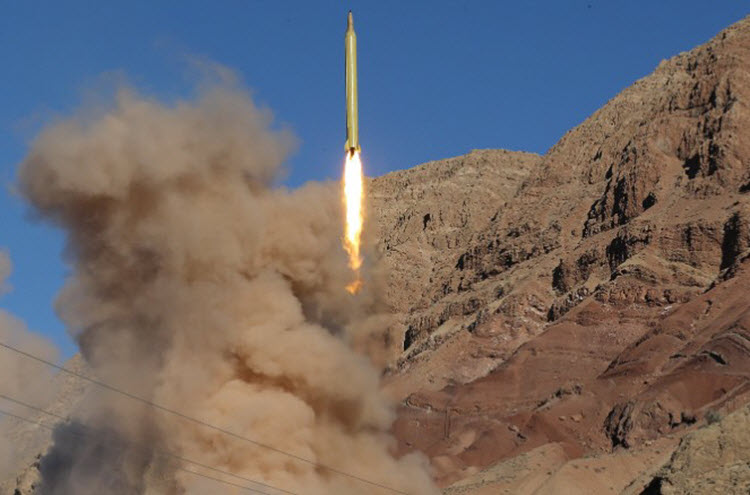
London, 14 May – In a written testimony by Daniel Coats, US Director of National Intelligence, for the Senate Select Committee on Intelligence on Thursday, he described the growing threat of Iran’s missile program. “Iran’s ballistic missiles are inherently capable of delivering WMD [weapons of mass destruction], and Tehran already has the largest inventory of ballistic missiles in the Middle East,” he wrote, adding, “We judge that Tehran would choose ballistic missiles as its preferred method of delivering nuclear weapons, if it builds them.” Coats also noted, “Iran continues to be the foremost state sponsor of terrorism.”
Iranian leaders announced earlier this week, that two “home-made” satellites are set to be launched in the next few months. Officials are are concerned that they will be used as cover for continued work on missile technology.
In his testimony, Coats wrote, “Tehran’s desire to deter the United States might drive it to field an intercontinental ballistic missile (ICBM). Progress on Iran’s space program could shorten a pathway to an ICBM because space launch vehicles use similar technologies.”
The Joint Comprehensive Plan of Action (JCPOA) was implemented in January 2016. This agreement between Iran and the US, the EU and other world leaders was meant to ensure that Iran’s nuclear program would be peaceful.
Although Supreme Leader Ali Khamenei claims “conditional support” for the deal, he remains “highly distrustful of US intentions,” Coats pointed out.
Technically, the testing of these missiles is not a breach of JCPOA, but US President Trump called it “against the spirit of the agreement”. One portion of the resolution contains language that is considered ambiguous, as it states that Iran is “called upon” not to create or test these types of missiles. Still, it does not explicitly forbid Iran to do so.
“Iran continues to develop a range of new military capabilities to monitor and target US and allied military assets in the region,” Coats stated. “Tehran continues to leverage cyber espionage, propaganda, and attacks to support its security priorities, influence events and foreign perceptions, and counter threats -including against US allies in the region.”
It’s estimated that the amount of time it would take for Iran to produce enough fissile material for a nuclear weapon would be from a just few months or up to a year.
A parade held in Tehran for National Army Day last month, showcased the country’s wealth of missiles, tanks, armored vehicles, fighter jets and radar systems.
As recently as May 3, the Iranian military conducted a missile test from a submarine in the Strait of Hormuz. However, it’s reported that the test failed.
“Iran continues to develop a range of new military capabilities to monitor and target US and allied military assets in the region, including armed UAVs [drones], ballistic missiles, advanced naval mines, unmanned explosive boats, submarines and advanced torpedoes, and anti-ship and land-attack cruise missiles,” Coats’s testimony said.


