Home Blog Page 325

Iranian Prison Guards’ Unprovoked Attack on Political Prisoners

0
Iran - Urmia Central Prison
Iran – Urmia Central Prison

By Pooya Stone

Over 20 guards raided the political prisoners’ ward in Urmia Central Prison on Tuesday, attacking inmates and looting their belongings, under the guise of a “routine inspection”, shortly after the prisoners had protested the dire living conditions, including constant water and power outages.

The attack began at 1 pm local time and continued for three hours, with inmates doing their best to defend themselves and stand up to the heavily armed guards (six prison guards and 15 anti-riot guards) who were led by prison warden Sohrabi, the prison’s financial deputy Nouri, inspections officer Azar-Nia, and someone called Mohammadi.

Nouri and prison security chief Karbalaie planned to place political prisoner Ahmad Tamuie in solitary confinement but other prisoners reacted quickly and stopped them.

Many political prisoners were injured in the attack, while there was significant damage to the ward’s doors and windows, and it was reported that after the attack, anti-riot guards remained outside the prison, ready to attack again at the first sign of unrest.

One informed source said that all 48 prisoners held on this ward protested the attack by launching a hunger strike and that many of the prisoners are in danger of losing their lives.

The Iranian Resistance said: “Supreme Leader Ali Khamenei and judiciary chief Ebrahim Raisi are responsible for the health and safety of political prisoners across Iran. The Iranian opposition National Council of Resistance of Iran (NCRI) is calling on the United Nations and all international human rights organizations to take swift action to save the lives of political prisoners in Iran, send an international fact-finding mission to visit Iran’s prisons, and meet with the inmates, especially political prisoners.”

This call has been made by the Iranian Resistance, particularly NCRI President-elect Maryam Rajavi, on multiple occasions, increasingly since the start of the coronavirus pandemic.

Since the threat of the coronavirus became unmistakably clear in March, the regime has failed to take the appropriate action to protect any of its people, let alone prisoners. The mullahs refused to allow non-violent prisoners furlough, to allow for social distancing among remaining inmates, and allow others to be at home with their families. They have even denied, as is typical of the regime, sanitary items, such as soap and bleach, to prisoners and prevented them from seeking adequate medical care. They are using the pandemic to thin the herd of political prisoners and this must be stopped.

Read More:

Political Prisoners Attacked in Iran’s Qarchak Prison


Female Political Prisoners Suffering in Iran

Simultaneously with the government's misogynistic measures against Iranian women, many female political prisoners, human rights defenders, and social activists suffer intolerable suffering in prisons
Simultaneously with the government’s misogynistic measures against Iranian women, many female political prisoners, human rights defenders, and social activists bear intolerable suffering in prisons

By Jubin Katiraie

The health of three Iranian female political prisoners – Nasrin Sotoudeh, Fatemeh Mosanna, and Zeinab Jalalian – held in solitary confinement in Evin and Kerman prisons is said to deteriorating and there is much concern about their lives.

On September 7, Mosanna was taken to Taleghani Hospital, where she was given an endoscopy and colonoscopy after suffering severe stomachache, diarrhea, and nausea, before being returned to Evin prison. She was not given proper medical care and the prison doctor only visited her a couple of times to inject serum.

On August 31, reports from Evin Prison said that Sotoudeh, then on the 21st day of her hunger strike, wasn’t feeling well, but refused to take the serum. As of writing, she is still on the hunger strike.

Jalalian, a Kurdish political prisoner, who is being held without trial, recently spoke with her family about the horrendous conditions and explained that she could only be transferred if she paid the costs. She’d previously contracted the coronavirus in Qarchak Prison and went on hunger strike to protest being moved from Khoy Prison, which is nearer her family.

Meanwhile, political prisoner Sakineh Parvaneh, who is sentenced to five years and regularly subjected to abuse by Evin Prison officials, has been on the hunger strike since September 5.

Political Prisoners Attacked in Iran’s Qarchak Prison

Civil activist Azam Shirafkan was sentenced to 6.5 years in prison; five years for “assembly and collusion through inciting people to disrupt national security” and 1.5 years for “propaganda against the state”. The mother of one from Alborz Province is being imprisoned for protesting.

Nurse Roghieh Ghadimi Nouran has been detained in Bushehr Prison without trial for 20 days now, after being arrested at the request of the Health Network and the Governorate of Tangestan.

The volunteer treating Covid-19 patients suffers from cancer and diabetes, so her life is in danger whilst in prison.

Political prisoner Elham Khamseh was forcibly moved to Aminabad Mental Hospital (Razi) on Saturday before being returned to Evin Prison the next day.

The National Council of Resistance of Iran (NCRI) Women’s Committee wrote: “Accusing political prisoners of mental disorder and relocating them to a mental hospital is commonly practiced by the clerical regime to intimidate and increase pressure on political opponents and their families. The dual-national prisoner Nazanin Zaghari, student activist Soha Mortezaii, and Kurdish political prisoner Sakineh Parvaneh have been among those who were either taken to a mental hospital or were intimidated with the threat to do so.”

Iran Sacks Female Wushu Champion for Protesting

Iranian Authorities Confiscate the Late Mostafa Salehi’s Home and Properties

0
Iranian authorities try to silence upcoming protests by applying inhuman pressures on Mostafa Salehi’s family

By Pooya Stone

On September 12, Iranian authorities summoned the late Mostafa Salehi’s family to the Najafabad Court and threatened his widow and orphans with the seizure of their garden and home. They announced that these properties would be confiscated if they do not pay 5 billion rials (about US $21,700) as soon as possible.

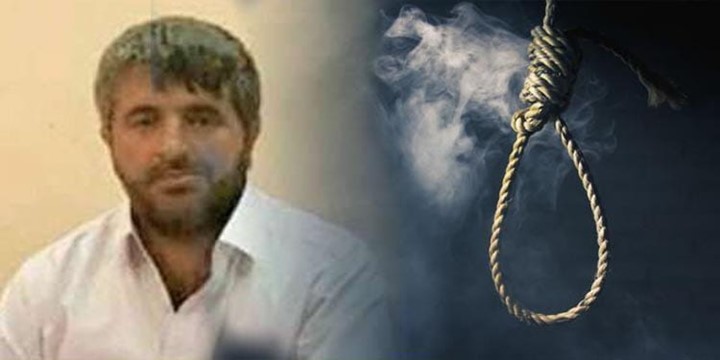
Mostafa Salehi was executed on August 5 for taking part in the anti-government Iran protests of 2018.

In late August, Iran’s judiciary had ordered Mostafa Salehi’s wife to pay 4.25 billion rials (about $18,450) as “Blood Money.” However, on September 9 and 10, authorities summoned this grieving family to the Isfahan Revolutionary Court and announced that the “Blood Money” had increased to 5 billion rials.

In response, this family complained, saying that Mostafa was killed despite being innocent of any crime and that his children had become orphans. However, the judge and court employees insulted this grieving family with obscene and vulgar language. They also threatened this poor family that their home, garden, and properties would be confiscated if they do not pay 5 billion rials.

The blood money has been estimated based on injuries, including each scratch and even bruise. However, Mostafa had rejected all allegations during the proceeding period and complained against false accusations.

All the while, Mostafa Salehi was frequently subjected to excessive and harrowing torture in custody, which had never been prosecuted. Notably, the judge had sentenced him based on torture-tainted confessions. However, it seems that Iranian authorities intend to retaliate from Mostafa’s family in addition to hanging him on August 5.

Iran Issues More Execution Sentences

A Glance at What Interrogators Exercised Against Mostafa Salehi

According to a familiar source with the case, Bahrami and Arab interrogated Mostafa. They are intelligence officers and responsible for torture and other ill-treatment against this late protester.

They had reconstructed the “crime” for Mostafa Salehi. Then Bahrami gave him a gun and made a film. However, when Mostafa rejected their fake scenario, they suggested that he make a televised confession and admit to shooting. If he did so, they promised not to have anything to do with him.

Mostafa Salehi told Bahrami that I did nothing, and I will never admit to anything. You boast that you are security agents, therefore, find the murderer.

Afterward, Bahrami slapped in the face of Mostafa twice and said, “I must execute you at all costs. I made an honored word to superiors to hang one person from Kahrizsang city, Mostafa’s hometown.

“Mostafa Salehi was prohibited from speaking at the court. They had told him, ‘just shut up.’ The judge Morad Ali Najafpour only noted what Bahrami and Arab were saying. Afterward, they beat Mostafa to sign the proceeding accord,” the source said.

“Also, there were some wrenches, welding machine, and a few electric scrapped appliances in a warehouse at Mostafa’s home. The state security forces of Goldasht district seized all of them after arresting Mostafa Salehi.

“Later, when his family referred to Goldasht police station, the chief of station refused to hand over them, saying, ‘These appliances were our forces’ share and do not look for them.’ In fact, they had divided the tools that valued $800 between themselves,” the source added.

In reality, Iranian authorities pursue to send a message to the outrage society that laid in an ambush to use any opportunity to release its fury against the entire ruling system like November 2019. However, the ayatollahs are practically fueling the people’s rage and expanding the current gap between their rule and citizens, putting further anti-establishment protests and uprisings on the horizon.

Iran: Human Rights Situation for August 2020

Political Prisoners Attacked in Iran’s Qarchak Prison

0
Iran’s Qarchak Prison

By Jubin Katiraie

Two female political prisoners in Qarchak Prison were attacked on Monday by hired goons brandishing boiling water.

Forough Taghipour and Parastoo Mo’ini, who are currently held in Ward 6, would have been scalded or worse by two women hired by the Qarchak Prison warden Mehdi Mohammadi, had it not been for the other selfless inmates who rushed to their aid and ended up getting burned themselves.

The two women hired by the warden have been named as Zeinab Ghanbarnejad (a.k.a. Zeinab Saratani) and Narges Amir Ali.

Mo’ini and her mother Zahra Safaei were previously threatened and harassed multiple times over the past few weeks by the ordinary prisoners of Qarchak Prison, who were hired by the warden.

The reason is that Iranian authorities are currently doing whatever they can to harm (or even kill) political prisoners and detained protesters with the hopes of intimidating the Iranian people and discouraging them from taking part in future protests against the regime.

The regime is incredibly weak, so it fears the rightful backlash for outright executing political prisoners as they did in the past. Instead, if they can’t pin a bogus murder charge on them and execute them for that, as happened to Mostafa Salehi on August 5, and wrestling champion Navid Afkari on September 12, they will kill them through other means:

  • denial of medical treatment
  • unhygienic environment, especially during the coronavirus pandemic
  • refusing furlough to non-violent offenders during the pandemic
  • sending dangerous criminals to attack and kill them

Following Afkari’s execution, prison authorities threatened to kill all of those held on  Ward 5 of the Great Tehran Penitentiary – mainly protesters arrested in the November 2019 uprising – because of the international outrage campaign that sprung up after Afkari’s sentencing was not enough to save him.

The Women’s Committee of the National Council of Resistance of Iran (NCRI) has reiterated a call by the Iranian Resistance for international human rights groups and advocates to take urgent action to save political prisoners in Iran.

They wrote: “The lives of political prisoners, particularly the female political prisoners in Qarchak Prison Zahra Safaei, Parastoo Mo’ini and Forough Taghipour, are in danger, demanding urgent intervention to secure their immediate release.”

The Iranian Resistance has previously called for an international delegation to visit Iran’s prisons to see the conditions for themselves and meet with prisoners, particularly political prisoners, to prevent another bloodshed.

Read More:

Amnesty International: Iran Uses Torture as Punishment

More Protests Across Iran

Haft Tappeh workers and retirees of Ahvaz
Iran protests: Haft Tappeh workers and retirees of Ahvaz

By Pooya Stone

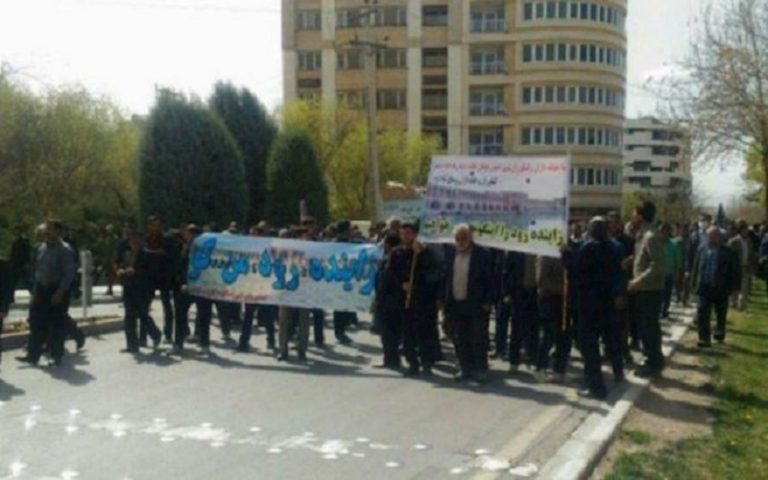
There were several new protests across Iran over the past few days, from all different sectors of society, including college students, factory workers, patients with a rare disease and their families, and border porters.

On Monday, two Qazvin Counter Manufacturing Factory workers’ representatives were arrested after a protest the previous day, held in front of the Qazvin courthouse.

The Qazvin Counter Factory workers have, most recently, been on strike over their insufficient living conditions since August 20. However, they have been protesting regularly to demand the payment of their wages and have been raising concerns about the competence of factory officials since March.

Also on Monday, the Revolutionary Guards Corps (IRGC) shot and killed a kolbar (border porter) on Monday at the Oshnavieh border, western Iran. A report stated that Salahaddin Issazadeh, the kolbar, was tortured before being shot in the head at point-blank range.

There were further reports that IRGC members shot and wounded two more porters in the border areas of Baneh and Nosud.

It is likely that this will lead to protests from porters, as it has done in the past. Porters are frequently targeted by the IRGC who see them as threats to their smuggling operations.

Tehran University students held a protest rally in the capital on Sunday, at the start of the new school year, protesting the dire social and economic conditions, which were caused by the mullahs’ corruption and exacerbated by the coronavirus pandemic that the regime has failed to control.

It was also reported that other college students were protesting in Tabriz.

Also on Sunday, Mucopolysaccharidosis type I (MPS I) patients gathered with their families outside the Food and Drug Administration building in Tehran to protest being denied access to medicine.

One mother at the protest said: “My son has taken medicine for about six years. However, we no longer receive his medication for about two years now and we were finally told that my child would have to be tested to confirm his illness. Now, after two years, they still have not given us the result. This is while, in addition to the approval of my child’s doctor, he even has clinical signs of this illness.”

Patients are facing difficulty even getting hold of this much-needed medicine because the regime refuses to allocate money to healthcare, even though there’s always plenty of money for terrorism and warmongering, which has led to patients’ illnesses getting worse.

Read More:

Iran: A Society That ‘Will Undergo Major Changes’

Tehran Efforts to Defend Navid Afkari’s Execution in a Ridiculous Manner

0
In response to domestic and international condemnations of Navid Afkari's execution, Iranian authorities desperately try to justify their crime
In response to domestic and international condemnations of Navid Afkari’s execution, Iranian authorities desperately try to justify their crime

By Jubin Katiraie

Many facts about the execution of Iranian wrestling champion Navid Afkari indicate the authorities’ decision to execute him was due to the government’s need to frighten the people and prevent any further protests.

To see a few of the contradictions in the case of Navid and his brothers, one should read the latest revelation of VOA, which according to one of Navid’s relatives, exposed that Navid and his other two brothers which are now in custody are innocent. And the government has convicted him by trumped-up charges.

But this is not the case of this article. This article by collecting some of the reactions of the Iranian media outlets will show that this ridiculous reaction by the government is evidence enough and there is no need to prove that these three brothers are innocent.

Just concentrate on Tehran’s contradictions and officials’ desperate effort to defend themselves.

The state-run FARS news agency on 14 September: “Jafar Ghaderi, a representative of the people of Shiraz in the Islamic Parliament, in an interview with a parliamentary reporter of Fars News Agency, referring to the execution of the sentence of Navid Afkari, a young man who was retaliated to a premeditated murder: “This case went through its normal course and eventually led to the execution of the killer.”

“He then added: When a person allows himself to kill another person for no reason, the victim’s family and society expect the judiciary to administer justice and not be influenced by blackmail and pressure from the domestic and foreign media. If these blackmails and pressures of the media are to be decisive, nothing will be left.

“In the end, Ghaderi said: ‘The work of the judiciary in retaliation promised a logical and reasonable work and there is no objection to it.” (FARS 14 September)

And Aftab news wrote: “Ruhollah Nejabat said in his speech in the open session of the parliament yesterday: If justice is not subject to historical social justice, it is blind. What does the weakening of religious sovereignty have to do with investigative justice? Everyone’s words and deeds should be in order to strengthen the Islamic system. If the Islamic system is weakened, an unforgivable sin has occurred. The kind of justice that is based on the values ​​of Islam and the opinion of the Imams and the Supreme Leader will be desirable. Whatever the other behaviors, are not investigative justice and are not desirable. Why is it that, due to the complex propaganda of the enemy, all the actions of the Islamic Republic are considered null and void?”

And Sepehr daily on 14 September wrote: “In the meantime, of course, the strength of the judiciary also encouraged the oppressed and the lovers of the revolution. The toughness that showed he did not get caught up in the clichés and trends of Twitter and did justice at all costs. And justice, which, of course, must be continued, because the enemies of the system and their internal followers will never stop supporting their mercenaries and other criminals (such as the perpetrators of the November 2019 edition) who are in the custody of the judiciary, and this case requires the permanent strength of the judiciary.” (Sepehr daily, 14 September)

Iran Acts with Impunity in Executing Navid Afkari

And at least one of the government-link main media Mashregh news referring to a video, with the title, ‘A number of Navid Afkaris going at it!’ wrote: “If the murderers and rioters were not going to be executed at any media pressure, now they were all walking around the city with impunity and freedom in any case, and this scene was the least we saw. (Referring to the included video.) (Mashregh news 14 September)

At a meeting of the Supreme Judicial Council, Ibrahim Raisi, the head of the judiciary, expressed his fear at the wave of disgust with the execution of Navid, calling it exaggerations.

“Referring to the legal process in handling cases and complaints and legal guarantees for the administration of justice for litigants, the head of the judiciary said that committed judges handle cases based on these judicial procedures and exaggerations should not and cannot affect the judge’s opinion.

“The head of the judiciary also thanked the prosecutor for distinguishing between political crimes and security crimes, and he called on the courts and tribunals to take action to enforce the law and the ordered circulars on political crime. At this hearing, the Tehran prosecutor said that five defendants had been indicted as political offenses and sent to the criminal court. (State-TV channel one, 14 September)

Iran: August Marked by Hundreds of Protests

A group of people hold a gathering and raise a banner reading "End the poverty, corruption, discrimination, and injustice."
A group of people hold a gathering and raise a banner reading “End the poverty, corruption, discrimination, and injustice.”

By Pooya Stone

During the month of August, there were at least 331 protests held in 82 cities across the country, averaging around eight per day.

The majority of the protests were people expressing their anger at the economic difficulties they have been left with. Many of the protests were planned and lasted several days.

Oil and gas workers, as well as petrochemical workers, have been holding protests because of their overdue salaries and benefits, the lack of job security they have because of temporary contracts, and the difficult and dangerous working conditions that they are subjected to.

Employers have tried to stop the strike by making false promises but the workers have vowed to remain on strike until their demands have been responded to in full.

Industrial workers in dozens of cities also held protests. Many were calling for the payment of their overdue salaries including workers at the Haft Tappeh Sugarcane Company in the city of Shush in south-western Iran who continued to strike for the whole month.

Retired workers also took to the streets to draw attention to the very low pensions that they receive which are often paid late. Their situation has degraded over the past few years because of increasing prices, inflation and a dire economy that is making their lives very difficult. Pensioners gathered in 14 cities, including the capital Tehran as well as Ilam, Mashhad, Isfahan, Tabriz, and Ahvaz.

Retirees of Social Security Organization continue their rallies protesting officials' inattention to their dire living conditions
Retirees of Social Security Organization continue their rallies protesting officials’ inattention to their dire living conditions

Teachers in several cities also protested for a number of reasons including low wages, their employment status and the government’s neglect to ensure that they are given formal working contracts from the Ministry of Education.

University students have been very active during the month of August. Traditionally students have played major roles in protests – not just in Iran but around the entire world. They are the new generation that will be most affected by certain situations and they have a huge motivation to bring great change.

During August, students in Isfahan protested about the bad treatment they have been subjected to by officials of the university. In Rasht, medical students also gathered because of their pre-internship exams.

Other sectors were also protesting last month, including farmers, defrauded creditors, families of people killed when the Revolutionary Guard (IRGC) shot down the Ukrainian flight at the beginning of the year, medical workers, families of political prisoners, and many more.

Deliberate Lies Raise Iranians’ Wrath Against Rulers

Nurses, doctors and many other medical workers such as midwives, caregivers, and so on, were protesting in a number of cities. Many of them were demanding the payment of their overdue wages. Nurses were also protesting against the very low wages that they receive and are calling for more respect for their profession. Emergency doctors were also calling for their wages to be reviewed.

The frequency of protests in Iran is increasing compared to a few years ago and the people’s anger is palpable. During the previous month, there were 237 recorded protests, so from one month to the next, there has been a huge rise in the number of people speaking out against the ruling system.

Iran Destroys Mass Graves of Political Prisoners to Hide Evidence

0
As the world focuses on human rights violations in Iran, the government tries to hide the relevant evidence to the massacre of tens of thousands of political prisoners in the summer of 1988

By Jubin Katiraie

The Iranian government has recently destroyed a mass grave in Ahvaz, where many victims of the 1988 massacre were buried, and plan to build a road over the area in a clear attempt to destroy evidence of this crime against humanity.

Mojahedin-e Khalq (MEK/PMOI) supporters in Ahvaz and Khuzestan province have presented a documentary report about the destruction, with a local truck driver confirming after three days of investigations that MEK members killed in the 1988 massacre are buried at the site.

Urgent Action Needed to Save the Lives of Political Prisoners

Meanwhile, officials are using the guise of infrastructure improvements to cover up their desecration of these graves and hide their involvement in the massacre.

There are dozens of mass graves containing the remains of political prisoners in Iran; most of these dating from the period 1981-1988. All of the graves are located in remote areas, with no names registered or gravestones marking the site.

Over the past 40 years, the mullahs have repeatedly tried to (and in some cases managed to) destroy these mass graves that link them to the genocide of their people as these should, if the world worked the way it was supposed to, be used as evidence in their trial at The Hague. The idea is to make people forget what happened in Iran’s prisons in the 1980s, particularly in 1988 when 30,000 political prisoners were killed in one summer.

Most of the time, this destruction of evidence is covered up with building work with the hopes that the international community won’t look too closely at roads being constructed in remote areas. Not that they’d have to look that far to see the problem. Two of the sites had cement poured over them in large square shapes, which should have raised suspicions, and other mass graves were covered in rubbish to further insult the victims and discourage the families from visiting.

Iran constructs a boulevard on the grave of political prisoners who were massacred in 1988

In May 2017, the government previously tried to build a boulevard over other mass graves in Ahvaz, something that was halted following an outcry by the families and an investigation by the Iranian Opposition. Just one month later, authorities promised not to interfere with the graves when building the road, but by June 2018, the government was at it again and razed one mass grave in less than 24 hours, destroying the grave markers left by relatives with large machinery.

Ahvaz is a particularly important site for mass graves because it’s where the first group of executed political prisoners was buried in 1981, followed by many more groups over the years; something made painfully obvious by satellite images.

Iran Issues More Execution Sentences

At least 39 School Students Contracted Coronavirus, One Died in Iran

0
The reopening of schools in Iran has resulted in the infection of 39 students with the coronavirus and one death so far

By Jubin Katiraie

On September 12, Iranian media outlets reported 39 school students had been infected with the novel coronavirus in a town in Lorestan province. Also, on September 13, Asr-e Iran daily acknowledged that the death of an eight-year-old student of the Covid-19 had caused concern among parents in Gotvand county in Khuzestan province.

Afshin Torkarani, acting governor of Selseleh town in the Delfan region, announced that these students were educating in different grades. “From September 5 to yesterday [September 11], 39 students in different educating-grades contracted the novel coronavirus,” Lorestan’s official telegram channel quoted him as saying.

According to reports, only during September 10 and 11, at least 18 students were infected with the virus in this area. Given this event, Torkarani announced that all schools in Alashtar and Firuzabad counties would shut down until October 10.

Locals say the rest of the patients were among students of primary schools. However, the acting governor realized that the infected students are between 7-17 years old. He affirmed that all of them were those who attended in-person schools.

Furthermore, in recent weeks, Lorestan province experience critical conditions. Seyyed Mousa Khademi, the provincial governor, recently said, “Regrettably, Lorestan province is among provinces that had a leap in the number of new hospitalized patients.”

He also laid the blame on the people and added that the people probably neglected in obeyance of guidelines, and today, we witness these cases. According to Iranian opposition Mojahedin-e Khalq (MEK), as of September 12, over 4050 people have lost their lives to the Covid-19 in Lorestan. Notably, the Iranian government refuses to acknowledge the number of coronavirus victims divided by province.

In recent months, the Iranian government’s odd function show there is no will among authorities to contain the contagion. In this respect, on July 22, Amangholich Shadmehr, member of the Parliament (Majlis) from Gonbad Kavus in Golestan province, slammed the government’s incompetence decisions.

“Officials are blaming everything on the people. They should be reporting on what they have done and are doing?… The people do not even have the power to purchase face masks. [Officials] should get a hold of themselves! It is as if they have sworn to kill all the people,” he said in a Majlis public session.

Earlier, Deputy Health Minister Iraj Harirchi had admitted that the lifting of restrictions and reopening of crowded centers and sites sank the country to more health catastrophe. “Lifting restrictions resulted in 200 deaths in the span of the last 24 hours. If comprehensive measures are not taken, rest assured our circumstances will deteriorate further,” he said on July 8.

Furthermore, many health officials had lately issued warnings about the reopening of schools and education centers. “With the reopening of schools and other education centers, and an increase in traffic in the city of Tehran, there is a possibility of a rapid spread of coronavirus among families,” Entekhab daily quoted Alireza Zali, the head of Tehran Covid-19 Task Force, on September 1.

Also, a member of the National Coronavirus Task Force, Minoo Mohraz, described schools as “the most dangerous place to transfer” the novel coronavirus. “Even if individuals wearing masks are together in closed environments for a long time, there is a possibility of the illness being transferred to others,” she explained in an interview with Asr-e Iran daily on September 2.

However, President Hassan Rouhani and his education minister Mohsen Haj Mirzaei were insisting on the reopening of in-person schools, which would be ended at the expense of millions’ lives and health of students, teachers, and parents.

This hasty and irresponsible decision caused severe objections among media outlets and health officials. For instance, in an interview with Resalat daily on September 7, a medication strategist Siamak Afazeli described schools’ reopening as a “genocide.”

Also, Anush Barzigar, head of the Gilan Province Medical Apparatus, highlighted the administration’s responsibility for children’s health. “In our viewpoint, those who reopened schools will be responsible for the death of even one student or teacher, and this is an unforgivable mistake,” he said.

A member of Tehran City Council, Shahrbanu Amani, also criticized the reopening of schools. “With 14.7 million students across the country and 2 million going to classes in Tehran, there’s concern that even if one percent of this population contracts coronavirus, we will be faced with a human catastrophe,” she told Arman-e Meli daily on September 13.

Amani also blamed Rouhani for not attending the inauguration ceremonies of schools and universities while he was promoting the reopening of schools and silencing any opposition voices by attributing speakers to foreign “enemies.” “The president didn’t have any plans to attend any of the schools physically and he declared yesterday that he would be attending the inauguration ceremony of universities virtually, and this shows how bad the situation is in Tehran,” she added.

Why Iran Reopens Schools Despite the Coronavirus Risk?

In reality, this is merely the beginning of the story. The hazardous impact of crowded mourning ceremonies, holding college entrance exams without providing essential hygienic protocols, and reopening schools will emerge in upcoming months. Remarkably, the country will be plunged into more disaster due to the contagion of seasonal flu in fall and winter.

“Rushing into reopening schools and sending kids into classrooms as we saw, not having a supervising system and failing to provide necessary training to the teachers will increase the dilemmas ten-fold. The problem is that in late September, in addition to Covid-19, we will also be witnessing flu and cold epidemics,” said Massoud Mardani, a member of the National Covid-19 Task Force, on September 10.

Corruption in Iran Exposed Again 

0
Iranian authorities are severely concerned that the unbridled corruption ignites a new round of anti-establishment protests

By Pooya Stone

Institutionalized systematic corruption in the Iranian government has increased the economic pressure on people to an unthinkable amount and officials fear that economic grievances could lead to protests like those seen in November 2019. 

On Wednesday, the Iranian Parliament showed how the ever-present threat of protests caused by hatred of the ayatollahs has increased infighting among Iranian politicians, which even caused them to admit that the government’s mismanagement and corruption created the economic crisis in Iran that they have long tried to blame on sanctions. 

Torbat-e Jam MP Jalil Rahimi Jahanabadi said: “We could clearly see that the country’s problem is having shadow decision-makers. Ministries are not controlled by ministers but rather by mafias in their entourage. Within the last 100 days that we assumed office (as lawmakers), the price of rice has increased four times, the price of cars has increased threefold. The national currency values have decreased by 300 per cent. Meanwhile, the villagers’ insurance renewal fee has jumped from 600,000 rials to 7,000,000 rials, what have you done?” 

Iran’s IKCO Raises Price of Eight Automobiles

The Seday-e Eslahat newspaper wrote the following the day that the currency value is declining and that those in power should be made to explain what they have done to damage the country’s economy. 

Through this, we can clearly see that the Iranian people’s unprecedented poverty is down to the absolute power of mafia gangs who control the sale of everything from food to fuel and thus demand an extraordinary markup, which is then used to fund the government’s domestic oppression and warmongering. 

Case-in-point, the testing of new ballistic missiles during a global pandemic or the acknowledgement by former MP Heshmatollah Falahatpisheh that the government has spent $20-30 billion propping up Syrian dictator Bashar Assad. 

The National Council of Resistance of Iran (NCRI) had published seven articles recently about the government’s systematic corruption, where they determine that the Revolutionary Guards (IRGC) is holding “Iran’s economic channels hostage and even on the occasions that corrupt officials were replaced – as was the case for the judiciary’s Akbar Tabari-Pour – it does not end the corruption. Rather like the hydra, cutting off one head causes two more to grow. 

The NCRI wrote: “The regime’s institutionalized corruption and plundering of the national wealth for funding terrorism have triggered two major Iran protests in 2018 and 2019 which rattled the regime’s foundations. The possibility of another uprising starting because of the economic and social pressure on people has terrified the entire regime.