Over 7,000 Iranian Underage Girls Married Off

0
During the past three months, more than 7,000 girls under the age of 14 were recorded as married, according to the Iran Statistics Centre’s quarterly report. In this report, published on November 30, it was stated that 7,323 girls aged 10 to 14 are registered as married, with one girl married before she turned 10. It further stated that some 130,000 girls under 14 were married between 2016 and 2019, which works out at roughly 43,300 marriages involving underage girls each year. According to a member of the Cultural Association in Support of Working Children Mohammad Bonyazadeh, the number of child wives in Iran was nearly one million in July 2010. “Official sources put the number of child spouses in the country at between 900,000 to 950,000. This violates the international Convention on the Rights of the Child,” the semi-official ILNA news agency quoted him as saying on July 1. This does not take into account unregistered marriages and should be considered a minimum due to the government’s secrecy over statistics that make them look bad. Child marriage, which should also include the thousands of Iranian girls aged 14-18 who are married off each year, causes lasting physical and psychological harm to the minors involved, especially those who become pregnant while underage. Here, we will list just a few:
  • depression and suicide attempts
  • divorce
  • education deprivation
  • early pregnancy-related injuries and deaths
  • poverty continuation
Iranian Deputy Minister of Sports and Youth Mohammad Mehditandgouyan has said that the government has seen an increased number of underage girls applying for marriage loans.
Another Veil of Crime Against Iranian Children
“In recent years, two-thirds of the loan requestees have been underage girls, and this is at times associated with forced marriages,” he said. While the head of the Women and Family Affairs Department in Markazi province, Zahra Kasayipour, said that in the past six months alone 109 girls aged 14 or under were registered as married, with another 109 underage girls becoming pregnant. She went on to say that 1,157 girls under 18 became pregnant from 2017 to 2019, with 1,055 girls under 15 becoming pregnant from 2016 to 2019. The Statistic Centre also reports that between 2011 and 2015, there were 95,000 divorces involving women under 19, with 5,760 of them related to marriages involving someone aged 14 or younger. Child rights activists, worried about increasing rates of marriage for underage girls, highlighted that this will harm the future health of Iranian society and showcases widespread disaster. The marriage age of 15 for girls is decided by the average “sexual maturity”, although it should be noted that this just means that menstruation has begun. It does not take into account the kind of physical or emotional maturity required to consent to marriage, the kind that only comes from being allowed to finish your childhood in school and surrounded by your peers and not from being married off to a much older man.
Iranian Education Ministry Joined the Mafia

The Vicious Circle of Budget Structure Reforms in Iran

Iran’s state-run outlets acknowledge that one of the ongoing disputes in the media is about the budget structure and its reforms. Bijan Abdi one of the governmental economists criticizing the present situation said: “What was done in the government and the management and planning organization to reform and clarify the budget was a series of words that were of no use to anyone. Words that one thinks are mostly sham, and by presenting forty, fifty pages, they got rid of with useless words. “The serious problems we had in the budgets of the last two years in the last two governments were that in practice the government did not believe in planning and did not do the rights things, what the parliament approved, while the deviation of the government from the approved budgets and programs is so great, that the lack of a plan for the government does not make much difference,” Radar-e-Eghtesadi website wrote on November 23. The poor economic situation which of course is intensified by Iran’s global isolation and sanctions, but has other main reasons which are raised from the heart of Iran’s devastated economy, which is caused by the government’s corrupt policies, and has nothing to do with the sanctions and the government’s external conflicts. Even government experts see sanctions as a secondary issue that has a dual effect when it comes to a corrupt and undisciplined economy like Iran’s. “Reference to this budget document and review of its various clauses clearly shows that from beginning to end it is full of small and big problems, each of which is the source of one of the most important problems in the economy and of course people’s daily lives. In a way, it is sometimes surprising why these issues exist in the country’s budget but have not been corrected over the years,” Farhikhtegan website wrote on October 15. Of all the debates over reforming the budget of the Hassan Rouhani government, it is enough to mention the issue of state-owned companies, which account for about two-thirds to 75 percent of the total budget for 2020. This is a number equal to three times the country’s general budget.
A Look at Iran’s 2020-2021 Budget
It may be hard to believe that no one in this country knows how the budget lines and details of the allocations and audits of state-owned companies are done and where the documents are. How much did the members of the Parliament examine these documents and carefully evaluate their figures? How much tax do state-owned companies pay? “All three of these questions can be answered with a well-known and now termed phrase in the country, ‘almost none’, you may ask what does this phrase mean? “We say this means that the least transparency, the least oversight, and the lowest tax payments are for the largest part of the budget. The referral to the MPs was followed by only one answer, ‘Basically, the MPs do not have the opportunity to review these sections! If you hear it, you must be surprised, ‘The share of collections that account for 75 percent of the country’s budget is only 3.5 percent of the tax paid,” Farhikhtegan added.

Hiding the Budget Deficit

Whether in the case of state-owned companies or in other cases, the first principle for correcting anything is transparency and revealing all the underlying facts and details. The first step in reforming the budget structure is that the government does not hide its budget deficit. Haji Babaei, head of the parliament’s program and budget commission, said: “In order to reform the budget structure, resources and expenditures must be transparent, and everyone who receives money from the budget must have an ID.” Meysam Pilehforoush, a government economist, also said: “The specification of the non-oil budget deficit is a summary of all the research institutes that have never been heard before. “Interestingly, some of those currently in charge taught these things at the university themselves, but when asked why they do not do what they taught in the classroom, they say that these reforms have not been done yet and why should we bother? The future generation will be working hard for fundamental reforms!” Mehr News Agency reported on  November 22, 2020. It has been said many times that, ironically, sanctions and the isolation of Iran from the international system are a favorable situation for realizing the slogan of independence and self-sufficiency. But even the speakers of these slogans do not believe these words. The state-run media also says about these slogans and their speakers: “The country’s budget is oil-based and has had major structural problems in recent years, but governments have refrained from reforming it to provide easy revenue from crude oil sales. “In recent years, especially in 2019 and 2020, when oil revenues declined, policymakers were expected to inevitably move towards structural budget reforms, but unfortunately, each year, the government presented the parliament with excuses, formal and unbalanced budgets, and passed a resolution with unsustainable revenue sources. And harm the economy. “But the interesting thing is that Mohammad Baqer Nobakht, the head of the Program and Budget Organization, not only believes that dependence on oil has been eliminated and this year’s budget bill was submitted to the parliament with structural reforms (of last year), but instead of accepting the mistakes and shortcomings of the government in this regard, he throws the ball in the parliament court and believes that the reform of the structure should start from the parliament,” Mehr reported on November 15. The futility and emptiness of the slogan of budget reform have been proven one by one during the decades. To the extent that government experts and policymakers have acknowledged this.
Budget Settlement Reveals Systematic Corruption in Iran
Hadi Sobhanian, Deputy Director of Economic Research at the Research Center of the Parliament, said that we are stuck in a vicious circle of structural reforms: “A serious critique of the policy-making and implementation system in the country is ‘losing opportunities.’ When the policymaking system does not work in time, it is empty-handed when it needs to be ready. “Given the dependence of government revenues on oil when the situation is normal, governments have no will or determination to move towards structural reforms. They make a living with the same oil money and do not reform the existing structures because the beneficiaries of the status quo resist the reforms. “When we move to emergencies such as sanctions or events such as oil price hikes or the outbreak of the coronavirus, the reform options that were normally on the government’s table are removed from the table, arguing that the country is in a special situation. This approach has left the country in a vicious circle of structural reform,” Mehr reported on April 21.

One Meter of Housing, Equivalent to One Year of an Iranian Worker’s Wage

0
After much debate and conflict, finally, on April 9, the Supreme Labor Council approved the minimum wages of Iran’s workers without their representatives having a say. And after the many protests in recent months, the Department of Labor stepped back and accepted to increase the income of the workers by 26 percent. Eventually, the income of a worker’s family with one child reached 27.18 million rials [$105].

The Average Price of a House in Tehran is 270 Million Rials

The Central Bank also published a report on the developments in the capital’s housing market in November of this year. The report states: “The average purchase and sale price of one square meter of residential unit traded through real estate agencies in Tehran was 271.9 million rials [$1045], which compared to the previous month and the same month last year shows an increase of 1.8 and 118.2 percent, respectively,” Kasb-o-Kar daily wrote on November 26. Aside from the above-mentioned news, one can guess the possibility of housing purchase by workers and other poor sections of society. That is, of course, if they are not among the millions of workers and toilers who are unemployed and have no salary. One of these countless needs is the cost of medicine and treatment during the coronavirus pandemic.
Iran: Mismanagement and Coronavirus Trigger New Housing Crisis

One-meter House per Year, the Yearly Salary of the Workers

In September of this year, a member of the Parliament revealed: “If a worker saves all his wages during the year and just breathes, he can buy one meter of a house in a year. Where are the oppressed in government decisions?” Alefba daily wrote on September 1. At that time, according to the Central Bank, the average price per square meter of a residential unit was 230 million rials [$885]. A month later, the price of a house increased again and reached an average of 242 million rials [$930] per square meter. This meant that the price per square meter of housing in September 2020 has increased by about 91 percent compared to September 2019. Now with this significant price increase, how many years should people wait to buy a house? With a simple calculation, we can say that if the minimum wage of workers is about 27 million rials and the total yearly income of workers is 312 million rials [$1200]. Assuming a worker saves his entire annual salary, he can only buy 1.2 meters of housing. Therefore, assuming that housing prices and minimum wages remain the same, a worker must save 46 years of his full salary to be able to buy a 60-meter house at a price of about 14.52 billion rials [$55,846]. For a long time, the ill-considered plans of the governments in Iran—from Ahmadinejad to Rouhani—to provide housing have made the insufficient facilities and capital used for construction unusable in practice, and housing has been built in places and situations that has become a public problem. One of the examples is the “Maskan Mehr” project, which has wasted many of the national resourses and cannot be reversed. In this regard, a member of the Alborz State Labor Council said: “Land should be allocated in a place where there are basic facilities for living. Why should we build a house on the top of a mountain or give land where there are no roads, water, gas and electricity that takes years to resolve?” ISNA news agency wrote on November 28. “If we are looking to build social housing and we want members of society to become homeowners, we must reform the infrastructure of housing construction and provide free land and cheap loans so that people can afford housing,” ISNA added He said that building a house requires money and workers are not able to build with low wages, and added that no worker can buy a house with 28 million rials [$107], even on the outskirts of cities, let alone build a house. The rents paid by workers consume more than half of their wages and earnings, and in many cases, they cannot afford to pay for living costs.
Connex Sleepers, the Other Face of Marginalization in Iran
In connection with this issue of housing, banks could provide the cost of housing construction in the form of appropriate facilities, while we see that these facilities have changed direction in the service of brokers and transactions outside of bank duties. According to statistics reported by Fars News Agency on November 27: “The share of the housing sector in bank lending facilities has decreased from 17 percent in 2011 to 7 percent in 2019, and only 3 percent of it is allocated to housing construction. While ignoring this major share, banks have spent their facilities on early repayment of loans to the unproductive sector of the economy.” Due to the change in the form and nature of economic activities in Iran and the move to increase unproductive activities, the banking system in Iran tends to pay short-term facilities and housing facilities are not suitable for bank due to its long repayment period. Bank lending facilities are generally allocated to quick-return facilities, which are mainly used in unproductive but profitable sectors such as trading and importing luxury goods and buying and selling land, etc. In this regard, Hossein Raghfar, an economist, said about the impact of the way banks provide facilities: “In the current situation, most of the bank facilities are allocated to quick-return activities, and create the ground for increasing inflation,” Ayyar online website wrote on November 28. Let us hear the unfinished talk about the deplorable situation of house preparation from the Deputy Speaker of Parliament, who says: “We currently have 2.5 million luxury homes nationwide, while some are homeless and unable to afford them. 1.5 billion rials [$5770] per square meter to buy a house in Tehran is not wise. The government wasted six years of its life on housing,” Jahan News website wrote on November 26.
Homeless Citizens and Iran’s Housing Mafia

Tehran’s Hostage-Taker State Presses EU to Release Terrorists

0
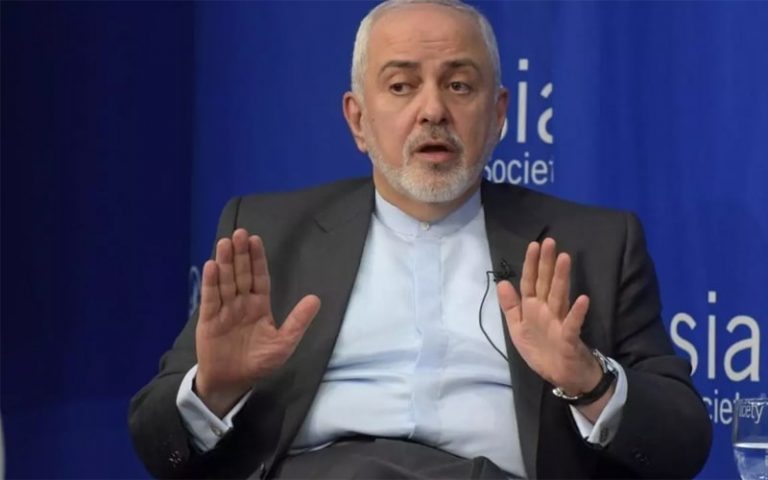
On Thursday, Iranian Foreign Minister Mohammad Javad Zarif once again professed his country’s readiness for prisoner exchanges involving Western nationals who have been taken hostage in the Islamic Republic in recent years. Zarif naturally did not acknowledge those individuals’ status as hostages, but with few exceptions, the Iranian judiciary and Iranian state media have failed to substantiate the allegations of espionage or other, vaguer national security crimes that have been used to justify their sentences. The foreign minister’s commentary on this subject was apparently prompted by recent news that a British-Australian academic, Kylie Moore-Gilbert, had been released from Iranian custody after serving more than two years of a 10-year sentence. The surprise commutation of that sentence coincided with the release of three Iranian nationals from prison in Thailand, where they had been implicated in a 2012 bomb plot that unsuccessfully sought to target Israeli diplomats. The apparent prisoner exchange is significant for multiple reasons. It may have implications for other Western nationals who remain as hostages to the Iranian regime, and it may also connect one or more of their cases to those of other alleged Iranian terrorists. If Tehran specifically used Moore-Gilbert in order to seek the release of individuals who were involved in an Iranian bomb plot, then it is quite possible that it was motivated in part by the concurrent start of a terror case in Belgium which involves similar state-sponsored terrorism. In June 2018, an Iranian diplomat and three accomplices attempted to set off explosives at a gathering of Iranian expatriates just outside Paris. But the terror plot was thwarted by multiple Iranian authorities, leading to concerted efforts by Iranian officials to secure the release of that diplomat, Assadollah Assadi. These efforts failed, and the trial for all four terrorist suspects began in an Antwerp court last Friday. Verdicts are expected before the end of the month, but it seems likely that Tehran will still make further attempts to interfere in the outcome.
Trial of Iranian Diplomat and His Accomplices for Bombing Opposition’s Rally
Assadi’s potential 20-year sentence may even help to explain the recent, unexplained arrest of an Iranian-German dual national, Nahid Taghavi. The 66-year-old retired architect has been held incommunicado in solitary confinement at Evin Prison since October 19, and her family’s inquiries into her case have been rebuffed with explanations that no information will be released until after her interrogation is complete. Tehran has a long history of using coercive and torturous interrogation methods as a means of securing false confessions from individuals whom authorities have decided in advance to convict. This practice has been applied to a wide variety of domestic activists as well as to foreign and dual nationals who stand to help corroborate the regime’s narrative describing constant threats of foreign infiltration and attack. That narrative has been reflected in countless state media broadcasts and publications regarding persons facing spurious charges of espionage. Moore-Gilbert was no exception and was even made the subject of a ten-minute television package that reaffirmed the allegations against her, even as she was being released. Those allegations specifically relate to spying on behalf of Israel, but the only evidence presented in the broadcast was images of her visiting tourist sites in the country. Many other such broadcasts have been strengthened by forced confessions. This seems to have been absent in Moore-Gilbert’s case, but Taghavi’s protracted pre-trial detention suggests that regime authorities are hard at work trying to elicit such a confession. Her lack of contact with family members strongly implies that she has also had no contact with a lawyer. And because Iran does not recognize dual citizenship, she will not be granted the German consular assistance she would receive if detained in most other countries. If Iranian authorities succeed in manufacturing a national security case against Taghavi, they may then attempt to leverage it for influence over the sentencing of the four regime operatives who are currently on trial. Although that trial is taking place in Belgium, the alleged mastermind of the 2018 terror plot was actually arrested in Germany and then extradited to Belgium. It is therefore easy to imagine that Tehran could appeal to Berlin to recommend a lighter sentence for Assadi, in exchange for a promise of less vigorous prosecution of the newly-detained German citizen. Of course, by swapping Moore-Gilbert for three Iranians imprisoned in Thailand, the Iranian regime has arguably demonstrated that hostages can be used as indirect leverage over countries to which they have no known ties. That being the case, any number of existing hostages could be brought to bear on the Assadi case, or on that of any other Iranian whom the regime wishes to see released. Zarif’s recent comments about prisoner swaps indicated that there are many such individuals. He explicitly claimed that the prospective targets of prisoner swaps would be those who were “illegally” detained, though he gave no details of who these individuals might be or how Tehran had determined that the charges against them were fabricated. One might suppose that Zarif was simply attempting to project its own practice of hostage-taking upon a foreign adversary, except the foreign minister’s allegation of illegal conduct was broadly applied to courts and law enforcement agencies spanning the US, Europe, and Africa. Given the recent involvement of the Thai judiciary, it seems as though Tehran means to suggest that Iranians are being illegally detained in Asia, as well. Regardless of the precise extent of Zarif’s allegation, it does not specify who might be coordinating such a far-reaching conspiracy against Iranian nationals. Meanwhile, no such unresolved questions loom over the allegation of hostage-taking by the Iranian regime. It has been squarely focused on traditional adversaries of the Islamic Republic, and it has consistently involved similar national security charges, backed up by similar assortments of manufactured evidence. In the most extreme cases, Western citizenship has been sufficient grounds for the Iranian regime to levy an accusation of spying for Israel and then secure a death penalty in the face of international outcry. This was the case, for instance, with Ahmadreza Djalali, an Iranian-Swedish dual national and academic who was recently the subject of an urgent call-to-action by UN human rights experts. Djalali had spoken to his wife by phone on November 24 and informed her that he was being transferred to solitary confinement, meaning that his execution was likely imminent.
UNGA Condemns Iran for Human Rights Abuses
It is not clear whether the ensuing international appeals had an impact on the judiciary’s decision-making, but as recently as Wednesday, authorities told Djalali’s family that the implementation of his October 2017 sentence had been “postponed for a few days.” While Tehran has seemingly delayed executions in response to the international outcry in the past, the judiciary rarely cancels them altogether. In fact, repeated delays are sometimes used as a tactic of psychological torture, insofar as they leave all death row prisoners with a pervasive sense of uncertainty about when they might be killed. In Djalali’s case, the perceived political value of the prisoner makes it perhaps equally likely that his case is being used to intimidate other dual nationals or that his execution is being held back so that he may be used as a bargaining chip in dealings with the whole of Europe. If the latter is the case, then it is quite possible that the latest threat to Djalali’s life was specifically scheduled to coincide with Zarif’s appeal for further prisoner swaps, so that the prisoner’s advocates would be motivated to fully support such swaps.

Proof Iran Is Responsible for 2018 Bomb Plot

0
On Friday, we saw the first time an Iranian diplomat Assadollah Assadi was put on trial for terrorism. Assadi, who was stationed at the Vienna embassy, was arrested for trying to bomb a rally held by the Iranian Resistance in France in 2018, and ever since, the Iranian government has tried every trick in the book to get him released, from false claims of diplomatic immunity to threats of further terrorism. Of course, the Belgian prosecutor rejected Assadi’s diplomatic immunity, highlighting that he was arrested outside of Austria and that diplomats can be stripped of their immunity by a host country if they are planning mass murder, which is what Austria has done. Assadi has refused to take part in the trial, claiming that he does not recognize the court, and is represented by his lawyer, hired by the Iranian Foreign Ministry. The real reason that he has not appeared in court is that his masters in Iran ordered him to boycott the trial to avoid answering questions, but the prosecutor explains that this shows that the entire Islamic Republic is responsible for the plot.
Trial of Iranian Diplomat and His Accomplices for Bombing Opposition’s Rally
This was confirmed by evidence revealed in court by Assadi’s accomplices. Amir Sadouni messaged an unindicted agent known as Negar on WhatsApp after meeting Assadi in Luxembourg on June 28 and confirmed Supreme Leader Ali Khamenei’s involvement. The message read: “He [Assadi] told me that after [the bomb is exploded] he would go see Agha [master, a term used by the regime’s officials and affiliates to address Khamenei] personally.” In a message sent out at the same time that Assadi’s trial began, Maryam Rajavi, the president-elect of the National Council of Resistance of Iran (NCRI) and the primary target of the plot laid out how she had previously revealed the role of Khamenei, President Hassan Rouhani, and other high-ranking officials played in this operation. “The Supreme National Security Council, presided over by Hassan Rouhani, made the decision to bomb the Iranian Resistance’s annual gathering at the Villepinte, and the regime’s Supreme Leader Ali Khamenei approved it. Khamenei, Rouhani, Javad Zarif and the mullahs’ Intelligence Minister Mahmoud Alavi must face justice for decades of crimes and terrorism,” she wrote.
Historical Trial of Iranian Diplomat in Europe
While this is the first time that an Iranian diplomat has been put on trial for terrorism, it is far from the first time that an Iranian diplomat committed acts of terrorism. The government leaders should be prosecuted for this and Western countries should shut down the Iranian embassies, which are used to breed terrorism and espionage.

Historical Trial of Iranian Diplomat in Europe

0
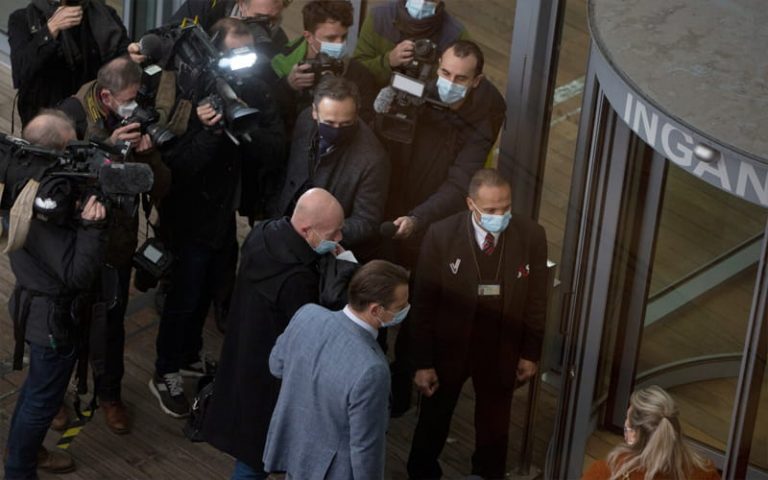
On December 3, the historical trial of Iranian diplomat Assadollah Assadi in Belgium attracted international media attention. Assadi is the first diplomat to ever be tried in Europe due to involvement in a terror attempt. Despite the Iranian government’s best efforts, which included bribery, falsely claiming diplomatic immunity, and threatening more acts of terror, the trial of Assadi and his three accomplices for attempting to blow up the 2018 Free Iran rally began on Friday in Belgium.
Beginning the Trial of the Iranian Diplomat Terrorist Assadollah Assadi
Iranian officials’ efforts to get Assadi released, rather than write him off as a rogue agent, has caused a scandal. However, the ayatollahs clearly considered the damage to be worth it for the chance of stopping the trial. It also goes some way to back up the Belgian prosecutor’s assertion that Assadi was not acting of his own volition but on the orders of his government. Not only will this case see Assadi behind bars for 20 years, if the prosecutor’s recommendation is taken into account, but it will also be a condemnation of the Iranian government and provide the perfect catalyst for all Western nations to re-evaluate their policy on Iran. The world, especially Europe, will see that the appeasement policy has only emboldened the Iranian government to commit heinous acts of violence in foreign countries, even those who have been over backward to accommodate the ayatollahs. “So many years of turning a blind eye on the regime’s terrorism have prompted the regime’s diplomat-terrorist to carry out a terrorist operation on European soil, yet claim he claims he has diplomatic immunity and should not go on trial,” the Iranian coalition opposition National Council of Resistance of Iran (NCRI) wrote. As noted in a Politico article on the subject on November 27, “the case will likely have grave ramifications for EU-Iran relations”. The world will be watching the trial and the EU’s reaction intently, waiting for a signal about how to treat Iran now. They must now choose between justice or trade and they are very unlikely to side with the mullahs after this.
Europe Must Take Iran Terror Threat Seriously
The NCRI recommended that European Countries immediately:
  • designate as terrorist organizations Iran’s Ministry of Intelligence and Security (MOIS) and the Islamic Revolutionary Guards Corps (IRGC)
  • shut down the regime’s embassies and cultural and religious centers because they are hubs for terrorism and espionage
  • make diplomatic relations contingent with the regime ending their terrorism on European soil
The trial is expected to conclude this month and all four are expected to be given long prison sentences.

Iran’s Third Major Flood in Three Years

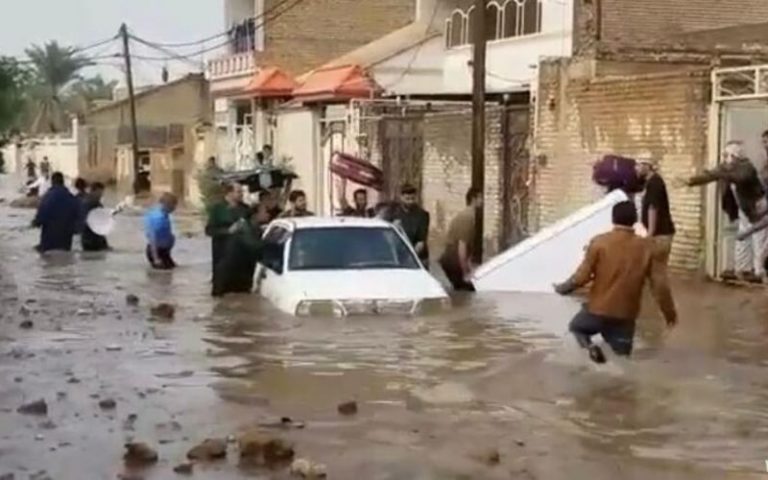
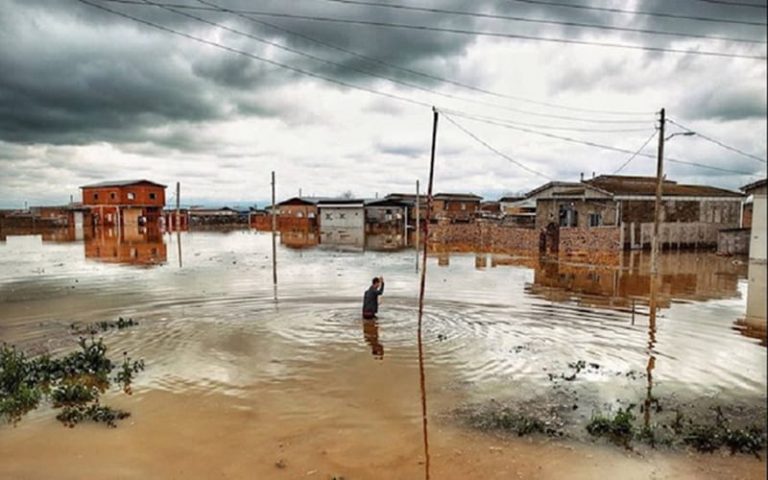
Eight Iranian provinces have suffered severe damage in recent floods and thousands of residents have been impacted across 51 cities in Bushehr, Fars, Golestan, Ilam, Khuzestan, Kohgiluyeh and Boyer-Ahmad, Lorestan, and Qazvin. In Khuzestan, floodwaters disrupted traffic in the cities of Ahvaz, Mahshahr, Omidiyeh, and Ramshir, while in the mountainous areas of Kohgiluyeh and Boyer-Ahmad province, landslides have blocked roads. “Heavy rainfalls will bring society’s health in a more dangerous situation during the coronavirus outbreak. This is while according to forecasts, we will have a lot of rain in the coming days,” said Majid Nasserinejad, MP from Khuzestan province. This is interesting because the politicians and the state-run media are eager to blame these floods solely on the rain. However, the truth is that meteorology centers began warning about this heavy rain in November. Notably, this is the third year in a row that a large number of provinces saw major floods at this time. Given that, shouldn’t the authorities have enacted some sort of evacuation plan over the past couple of months? Shouldn’t they have built better flood defenses? Shouldn’t they have done something? The sad truth is that the government is not doing anything to prevent the floods or mitigate the damage, even though they certainly have enough money stored away to do so. They are not dredging lakes or rivers, clearing the drains, or even refraining from the environmental destruction that is causing banks to burst. Even Naserinejad admitted this, warning that the floods could become more serious. And yes, they could. Two years on from the 2018 floods and those who lost their homes are still living in makeshift shanties that are at risk of being torn down by the authorities because they’re not up to code or don’t have the right permits. To add insult to injury, Defense Minister Amir Hatami announced that defense spending would be doubled in the next budget, at a time when people are struggling to make ends meet because of the irreparably broken economy. Maryam Rajavi, the President-elect of the National Council of Resistance of Iran (NCRI), expressed her deep sympathy with the people affected by the floods and asked for all Iranians to rush to their aid. She then called out the regime for its “destructive policies in wasting our nation’s wealth in unpatriotic nuclear, missile programs, [and] the export of terror and war” which has made Iranians “vulnerable” to floods, earthquakes, and the coronavirus.

The Floods Pass Through State-Backed Mafia Tunnel in Iran

0
Stunning images of floods devastation and the sinking of the Jarahi town in Mahshahr, south-western Iran, should never be considered a natural event. Such incidents, with this volume of destruction of the foundations of bio-nature, can be considered a natural event when all measures of prevention and care and climatic attention have been taken until then such catastrophes seem inevitable. The news and images of the devastating floods damage to the people, along with the cries and pleas for help of the homeless people, hurt the soul of every observer. According to Mehdi Valipour, head of the Iranian Red Crescent Society for Rescue and Relief, ‘eight provinces have been flooded in the past 72 hours.’ “The houses of Ahvaz and Mahshahr are flooded and no one cares. This repetitive series happens every year. It is not known how these credits have been spent, otherwise, areas with sewage problems and water collect in it are clear,” the state-run daily Resalat quoted Sirous Davoodi, representative of non-governmental organizations in Khuzestan province, as saying. “These losses are due to the uncertainty of how the World Bank loan is spent,” Resalat quoted Hajir Kiani, Secretary of the Khuzestan Association of Nature and Environment Lovers, as saying.
Corruption in Iran Exposed Again 
The idea that a flood or an earthquake or any natural disaster can pass through a mafia tunnel and suddenly find meaning and function other than a natural disaster is, of course, far from the mind; but there is evidence that floods in the Islamic Republic have become a mafia phenomenon. Such a mafia phenomenon has become so widespread that it has manifested itself in a report in a state-run daily. Following the devastating floods that have turned the city of Jarahi in Mahshahr county into a war-torn and devastated city, Resalat daily published an article that revealed one aspect of the state-backed financial mafia in Iran. In its December 1 edition, Resalat acknowledged the arrival of the World Bank to help ‘improve water and sewage’ in several cities in Iran. But the World Bank loan’s fate is now unclear, according to the daily. Apparently, it has suffered an ‘unknown fate.’ “It is not clear how and where the large budgets that flowed into the water and sanitation sector were spent. In 2004, a $149-million loan was allocated by the World Bank to rehabilitate and complete water and sewage in the cities of Ahvaz, Shiraz, Babol, and Sari. To date, however, there has been no written report on how it was allocated, and it appears to have met with an unknown fate.” The daily then quoted the official news agency IRNA as saying in an interview with Darvish Ali Karimi, former CEO of Ahwaz Water and Sewerage: “A $150-million-conditional loan was provided by the World Bank: with 10,000 rials for each dollar in 2004. This money could have turned the city of Ahvaz upside down in terms of water and sewage conditions. It was a five-year commitment.” In the meantime, the managing director of Ahvaz Water and Sewerage is replaced, and a person named Habibollah Moradi replaced Darvish Ali Karimi. What needs to be determined is the fate of the World Bank’s $150-million loan for Ahwaz Water and Sewerage. Moradi attributed the fate of the World Bank loan to U.S. sanctions, while from 2004 to 2009, which was the end of the project implementing commitment, there were no sanctions at all. “Two years and five or six months elapsed from the loan period, and then the sanctions canceled the World Bank projects,” Moradi said. The plundering by the financial mafia is so obvious that even Resalat daily cannot deny the contradiction. “The effective date of this loan is November 16, 2004, and the expiration date of the loan is October 1, 2009. Matching the loan execution and expiration dates with the claims about the fate of this money is in conflict,” the daily wrote. “The first is that the expiration date of this loan does not overlap with the time of imposition of sanctions, and the second is that the loan has been allocated and there is no report on the allocation of ‘part’ of this loan in the World Bank statistics,” the daily revealed.

Iran’s FM Zarif Should Be Held to Account for Terrorism

0
The trial of Iranian diplomat Assadollah Assadi and his three co-conspirators for the attempted bombing of the 2018 Free Iran rally in Paris began on Friday. Many people believe this trial should shine a light on terrorism as a whole, especially the role played by Iran’s embassies and diplomats. The Belgian court is expected to sentence the four defendants to prison before the end of December, in what would be a happy new year for all. However, Assadi is far from the first Iranian diplomat to be responsible for terrorism in Europe, he’s just the first to be held to account. This trial should be a wake-up call for Western powers about the dangerousness of trusting Iran’s diplomacy. The politicians across Europe must concede now that comprehensive changes are needed. The changes maybe include the closure of the Iranian embassies and multilateral sanctions and travel bans against leading officials, like Foreign Minister Javad Zarif. This would acknowledge that the international community’s assessment of Zarif as a ‘moderate’ was incorrect. Nonetheless, this truth can be clearly seen in his praise for the most violent officials, institutions, and policies, as well as his long history of carrying out and covering up acts of terrorism by his government and its proxies. Case in point, Zarif called it a “great honor” to visit the headquarters of the Islamic Revolutionary Guard Corps (IRGC), tour the facility, and meet with high-ranking officers just after the United States designated the IRGC as a terrorist entity. Furthermore, he has frequently bragged about his collaborative relationship with the former chief of the Quds Force (IRGC-QF) Qassem Soleimani, also designated a terrorist and killed by the U.S. in January 2020. “The developments like the Assadi terror trial reveal that Zarif is in a position to play a very substantial role in the perpetration of other such acts on foreign soil,” the National Council of Resistance of Iran (NCRI) wrote. The bomb plot would have endangered the lives of the 100,000 attendees of the Free Iran rally in Paris, including hundreds of dignitaries from across Europe, North America, and the Middle East, who would have been collateral damage if the plot to murder the NCRI President-elect Maryam Rajavi had worked. Now, we know that Assadi smuggled the bomb into Europe on a diplomatic passport and handed it over to his hired terrorists in Luxembourg – where he does not have diplomatic immunity. This makes it imperative to implicate the Foreign Ministry because there are multiple accounts of thwarted terrorist plots on European soil, just like this one, involving Iranian diplomats. Assadi is just the only one brought to trial. Each case shows evidence that is enough to expel diplomats from France, Albania, and the Netherlands. How is this not evidence enough of Zarif’s support for terrorism? Europe’s failure to hold Zarif to account means they are “courting peril” from a system desperate to “project strength” and “damage organized opposition”. “Zarif’s responsibilities have expanded greatly over more than three decades, but his role has remained much the same. As awareness about Iranian terrorism grows in the wake of the Belgian court case, the regime’s Foreign Minister will surely take the lead in denying, downplaying, and justifying his own diplomat’s crimes,” the NCRI wrote. “Before December is over, the international community will have to push his protests aside in order to hold the four aspiring terrorists accountable. Zarif himself should also be held to account not just for the 2018 plot but also for his general complicity with decades of Iranian terrorism,” the Iranian opposition added.

Trial of Iranian Diplomat and His Accomplices for Bombing Opposition’s Rally

0
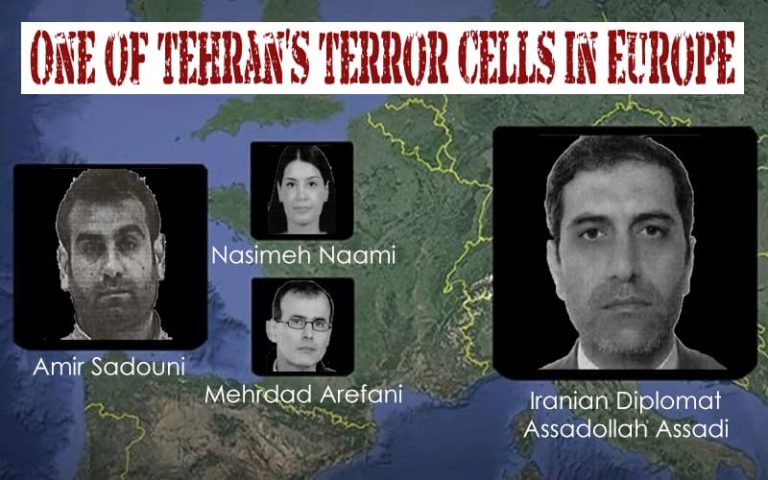
On December 3, a court in Antwerp, Belgium, held the second day of the high-profile trial of Assadollah Assadi, a Vienna-based Iranian diplomat. On July 1, 2018, European prosecutors detained Assadi for orchestrating a bomb plot against the Iranian opposition’s rally in a suburb of Paris. According to evidence, the Iranian diplomat had personally transferred 1lb of explosive material TATP from Tehran to Vienna on a commercial flight. Afterward, he delivered the device to the operative team, including Amir Sadouni, 38, Nasimeh Naami, 35, and Mehrdad Arefani, 54, in Luxemburg. Assadi’s accomplices had Belgian citizenship. On November 27, following the end of the first hearing—while Assadi as the first defendant was absent—Belgian prosecutors urged the court to sentence: -Assadollah Assadi to 20 years in prison -Amir Sadouni to 18 years in prison -Nasimeh Naami to 18 years in prison -Mehrdad Arefani to 15 years in prison Given the misuse of their Belgian nationality to facilitate the bomb attack, the prosecutors called the court to revoke the Belgian citizenship of Sadouni, Naami, and Arefani. The prosecutors also urged the court to confiscate the terrorists’ money and property because the Iranian Ministry of Intelligence and Security (MOIS) had paid the money to the defendants to carry out the terror plot.
Iran’s IRGC and MOIS Must Be Designated as Foreign Terrorist Organizations (FTO)
Assadi refused to attend the second hearing. According to the Iranian opposition National Council of Resistance of Iran (NCRI), Iranian Foreign Minister Mohammad Javad Zarif ordered Assadi not to participate in the court. Reliable evidence and undeniable documents and details obtained from Assadi’s note and communication with the operative team left no doubt over his role in the crime. On the other hand, Assadi’s absence encouraged his accomplices to lay all the blame on the Iranian diplomat. The attorneys for the defendants surprisingly highlighted Assadi’s role to evade their clients’ own responsibility. The defendants claimed that Assadi had deceived them to carry out the plot while they have received over 150,000 euros in cash and credit. In their messages, traced by European authorities, the terrorists expected more rewards. The attorneys for Naami and Sadouni also tried to downplay the role of their clients. They claimed that the defendants were unaware of the bomb’s capacity and they had believed that it would not harm anyone. Notably, during the defusing of the bomb, a police defuser robot was damaged and a police officer was wounded. Despite contradictory claims raised by the defendants and their attorneys, the court once again highlighted the Iranian high-ranking officials’ involvement in the plot. The NCRI President-elect Maryam Rajavi, who was the main target based on evidence and prosecutors’ argument, pointed out the role of Iranian Supreme Leader Ali Khamenei, President Hassan Rouhani, Foreign Minister Zarif, and Intelligence Minister Mahmoud Alavi. She also affirmed the imperative of shutting down all the Iranian government’s front centers and institutions that pave the path for terror plans under the banner of cultural or religious activities. “It is now time for an international tribunal to be set up and to prosecute the leaders of the regime, who are the true masterminds of hundreds of terrorist acts around the world,” the NCRI delegation also announced.