Home Blog Page 326

Iraq Protests Challenge Iran’s Strategic Depth

0

Major protests against Iran’s interference in Iraq and its government at the beginning of this week are a real threat to Iran’s so-called “strategic depth” and threaten Tehran’s ability to create a Shi’ite crescent across the Middle East.

This is nothing new. Last October, the Iraqi people began their “October Revolution” with the same anti-establishment sentiment. In the southern Shiite-majority provinces, people came to the streets chanting slogans against the ayatollahs and calling for their proxy groups to be dismantled.

Iranian government reacted by sending their proxy terrorist groups to assassinate Iraqi activists to try and stop the protests, which is also what they do with domestic protests because their rule is based on domestic oppression and the export of terrorism. But the protests continued because, just like in Iran, the people of Iraq are less scared of dying than living under the thumb of the ayatollahs.

Iraqis Return to al-Tahrir Square—New Flash Protests 

The Keyhan daily, known as the mouthpiece of Supreme Leader, Ali Khamenei, expressed fear on October 25 of losing control in Iraq.

“Last year, the first protests were against corruption, unemployment, and the government’s failure to provide public services. The protests overthrew several governments and overshadowed the entire Iraqi political situation,” they wrote.

How did the ayatollahs ruling Iran achieve this influence in Iraq? Well, following the power vacuum left by the second Gulf War, the ayatollahs were able to expand its influence, even paying off high-ranking politicians, like Minister of Labor Hadi-al Ameri. They’ve spent 17 years trying to occupy Iraq.

But why do this? Iranian government sees Iraq, Syria, and Lebanon, as the perfect place to expand their control over the Middle East, which is one of the reasons they prolonged the Iran-Iraq war for six years after Iraq sued for peace.

The trouble is that the Iranian government’s malign activities have resulted in increased international pressure and further isolation, so in a bid to keep power, Tehran increased its terrorist activities. Thankfully, the West was able to do one thing this year to slow the terrorism down, which was conducting a drone strike on the Revolutionary Guards (IRGC) Quds Force commander Qassem Soleimani in Iraq.

“Now, after having its puppet governments toppled one after another in Iraq, Iranian authorities fear losing control if the [terrorist proxies] or corrupt politicians are ousted. Yet, the Iraqi people have shown they will continue their protests until achieving the goal of ending the [Iranian] regime’s presence in Iraq. Thus, for the crisis-riddled regime of Iran, that faces a restive society and growing international isolation, there will be more regional pressure,” the Iranian opposition National Council of Resistance of Iran (NCRI) wrote.
Europe Must Take Iran Terror Threat Seriously

0

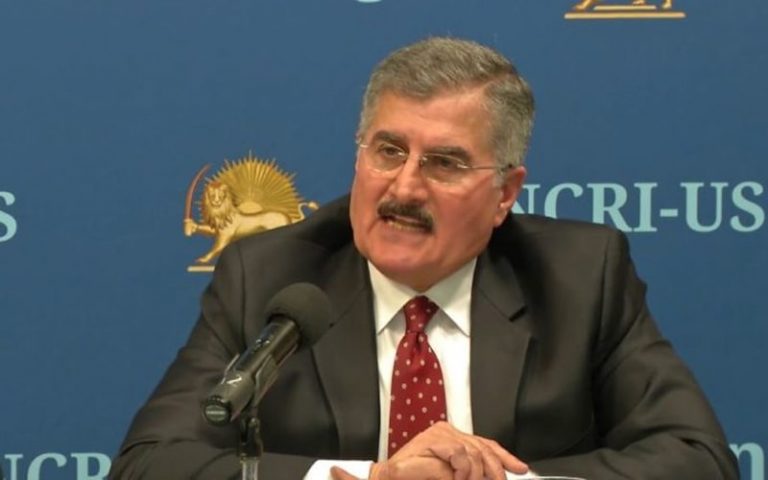
An official from the Foreign Affairs Committee of the National Council of Resistance of Iran (NCRI) has written an op-ed on Townhall regarding Iranian diplomat terrorist Assadollah Assadi and Tehran’s terrorism strategy in dozens of countries that still have an Iranian embassy.

Dr. Ali Safavi wrote that, after 41 years, an Iranian diplomat will finally stand trial for his terrorist actions in Europe, which is an important first step to convincing foreign governments to close the embassies and expel the ambassadors in order to protect their country and others from Iranian attacks. After all, he said, these embassies cannot escape that they are run by terrorists for the purpose of committing terror.

“Who can oppose [the harmonious vision of diplomatic values represented by the Vienna Convention]? Well, the rogue regime of Iran, of course. Ironically, it was in Vienna that the regime decided to express its deep-seated contempt for the Vienna Convention by stationing there one of its most notorious terrorist masterminds, Assadollah Assadi,” he added.

Iran Terrorist on Trial in Belgium

Assadi used his “diplomatic pouch” to deliver 500 grams of TATP explosives from Tehran’s airport to Austria in June 2018, before setting off on a journey across the continent to hand-deliver the bomb to a sleeper cell in Belgium, who would detonate it at the Free Iran rally in Paris, endangering the over 100,000 people in attendance.

“The regime knew the consequences: thousands dead and injured, including many high-profile former U.S. and European officials who spoke at the “Free Iran” gathering as well as innocent men, women, and children participating in the rally. In fact, it had threatened the organizers, supporters of the main opposition Mojahedin-e Khalq (MEK/PMOI), months earlier,” Safavi explained.

The Iranian government made these threats following the December 2017 uprising in Iran, with supreme leader Ali Khamenei saying the MEK would face consequences for their organizing of the protests.

The plot was foiled by German, Belgian, and French law enforcement agencies, with Assadi’s hired terrorists being arrested shortly after the drop-off and Assadi being arrested in Germany the following day.

Assadi will go on trial for terrorism on November 27, but this is far from the first time that an Iranian diplomat has been involved in terrorism in Europe. Safavi cites:

  • a car bomb plot in Albania in March 2018
  • the murder of Kurdish opponents in Vienna in 1989
  • the assassination of diplomat Dr. Kazem Rajavi near Geneva in 1990
  • the bombing at the Mykonos Restaurant in Berlin in 1992
  • the murder of NCRI representative Mohammad Hossein Naghdi in Rome in 1993

EU Must Adopt a Firm Policy Against Tehran’s Terror Attacks

“Since the Iran nuclear deal was signed in 2015, the mullahs have clearly escalated their terrorist plots in Europe, forcing even the feckless Europeans to expel at least seven ‘diplomats’…Tehran’s embassies have become nerve centers for its terrorism,” Safavi wrote.

“Many have argued for these embassies’ closure and the expulsion of Iranian agents to prevent more European deaths. Europe, whose citizens have been most affected, should lead the charge and forge a united front with the U.S. to enact a firmer policy that addresses Tehran’s terrorism. The sooner it realizes this the more lives it can save,” he concluded.

Iran Worsening Repression Under the Pretext of COVID

0

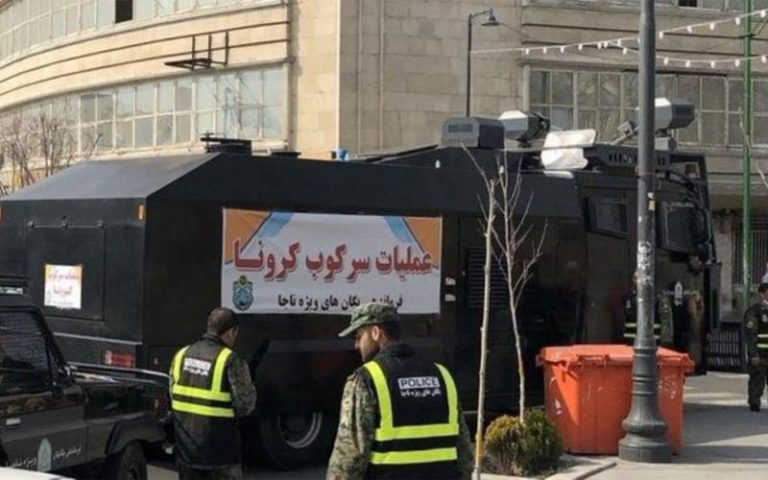
The Iranian government has amplified its repression in line with the worsening coronavirus crisis because the ayatollahs are scared that their mismanagement will lead to increased deaths and, eventually, a new protest.

On October 31, Khabar-Online website reported that Revolutionary Guards (IRGC) commander Gen. Hossain Salami ordered his troops to raid people’s homes under the pretext of combating the coronavirus.

“We will use 54,000 Basij [paramilitary forces] bases as protectors of health. We will search for sick people from house to house, and we will perform the process of separating ill people from others and referring them to treatment centers,” the website wrote.

The IRGC and its Basij subsidiary are the groups responsible for the assassination of 1,500 protesters during the nationwide November 2019 protests so it’s understandably terrifying to have them go into houses and take people away.

Also, the IRGC controls the vast majority of the country’s economy, so they could have done something to control the pandemic months ago, by releasing money so that non-essential workers could stay home and the spread would slow.

Iran -Coronavirus-Infected Workers Increase by the Day

However, that didn’t happen, and not only were people forced back to work, fearing starvation, but the government also held mass gatherings and encouraged people to attend.

In fact, when coronavirus was first found in Iran, the ayatollahs tried to hide it, insisting on holding the elections with in-person voting, in order to legitimize their sham rule. The Iranian people largely boycotted these elections but the few state supporters started spreading the virus.

Even after that, the ayatollahs downplayed the threat of the virus, instituted a lockdown that was too short and too late, and even the state-run media admitted that the government was using the pandemic as a punishment for the people who cried “Death to the dictator” in November. Even a member of the COVID-19 Task Force has called the lack of a second lockdown “political, not scientific.”

The ayatollahs fear another uprising with the virus so out of control, with Etemad daily writing that officials “should” fear that, “because when it comes, it penetrates all protections and burns roots [of the ayatollahs’ ruling system] and hopes. There will be no time to regret [years of] oblivion.”

So they’ve increased oppressive measures and set up a new headquarters to “promote public security and fight against insecurity” in Tehran’s Public and Revolutionary Courts. The Mizan news agency quoted Judiciary Chief Ebrahim Raisi as saying that this would deal with “norm-breakers”, “miscreants, and those harming the security of society and neighborhoods in Tehran.”

Bahrain Sentences Iran-Backed Militias to Prison

0

The Bahraini government sentenced 51 offenders linked to Iran’s Revolutionary Guards (IRGC) for terror activities, most of them in absentia, according to the government statement issued on November 3.

Earlier, on September 20, Bahraini authorities foiled an Iran-plotted terrorist attack in early 2020. However, this was neither the ayatollahs’ first nor their last attempt to disrupt regional peace and security.

For many years, Iranian authorities continue their atrocities across the Middle East and the world. For instance, on September 28, Saudi Arabian authorities disbanded a terrorist unit in their territory.

“Special authorities dissolved a terrorist cell, whose elements received military and field training inside IRGC’s camps in Iran,” the spokesperson of Saudi Arabia’s security forces stated.

Tehran Aims to Subvert Regional States

Tehran’s Terror Activities on European Soil

Furthermore, nowadays, a senior Iranian diplomat awaits trial in Belgium. On June 30, 2018, German law enforcement detained Assadollah Assadi, the third secretary of the Iranian embassy in Austria, due to his involvement in a terror plot against the Iranian opposition.

A few days earlier, Assadi had delivered 500g of TATP explosive material and a detonation device to a young couple to bomb the annual gathering of the National Council of Resistance of Iran (NCRI) in Villepinte, a suburb of Paris. Assadi had abused his diplomatic coverage to transfer explosives on a commercial flight from Tehran to Vienna.

In December 2018, the Albanian government expelled the Iranian ambassador Gholam-Hossein Mohammad-Nia and his first aide Mostafa Roudaki. Based on undeniable evidence, Tehran’s embassy in Tirana, the Albanian capital, had masterminded a terror attack against members of the Iranian opposition Mojahedin-e Khalq (MEK/PMOI) in March 2018.

Mohammad-Nia, Roudaki, and several other “diplomats” were identified as individuals who disrupted Albania’s national security. Albanian authorities also sealed a so-called cultural centerSaid, for recruiting local citizens to carry out espionage activities and terror attacks against the MEK members.

All instances mentioned above underline the imperative of adopting a firm and effective approach against the ayatollahs’ malign activities in the region and across the globe. For decades, Iranian authorities are employing terrorism, hostage-taking, and radical entities to blackmail the international community.

EU Must Adopt a Firm Policy Against Tehran’s Terror Attacks

International Community’s Obligation to Stop Ayatollahs’ Atrocities

The ayatollahs and IRGC’s hands are stained with the blood of hundreds of thousands of innocent people in Syria, Iraq, Lebanon, Kuwait, Argentina, and France. However, the Iranian people are the foremost victims of the world’s leading state-sponsor of terrorism.

In such circumstances, the international community must stand alongside the Iranian people’s protests against the government’s meddling in other countries. Iranian citizens demand their wealth to be spent on improving their welfare, health system, and eradicating poverty and illiteracy.

However, authorities insist on their atrocities, responding to any peaceful protests by cruel means. The ayatollahs clearly announced that they would never change their horrible policies. And when they are not ready to change themselves, someone else—the people—should. Iranians have well grasped this truth.

Iranian People Prepare for Anti-Establishment Protests

Seventy Percent of Iran’s Construction Workers Are Unemployed

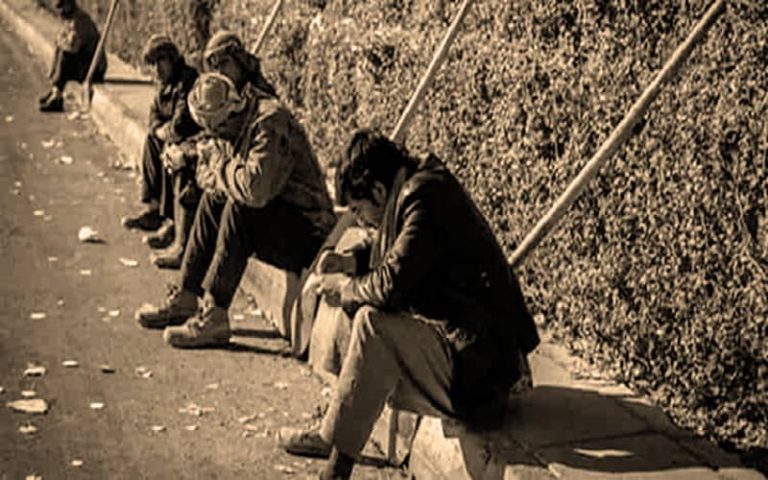
According to the vice-president of the Association of Construction Workers’ Unions Hadi Sadati, only 30 percent of construction workers in Iran are currently employed. The coronavirus has caused many Iranian construction workers to suffer from work and livelihood problems.

Hadi Sadati says that unfortunately, the coronavirus has caused that only 30 percent of construction workers go to work in the current situation and the rest of the construction workers are now unemployed and unable to make the minimum living.

Because they hoped to paint the building or repair the pipes and fixtures of the houses, they were offered less work due to the coronavirus and reduced demand. Due to this, their employment and livelihood are endangered.

“Currently, construction workers who are waiting for insurance have been identified. And if Social Security is going to carry out [Supreme Leader Ali] Khamenei‘s order, in addition to the required facilities and tools, it has the information of the insured persons,” he said.

“For those who are not insured, their statistics and information can be collected by construction workers’ associations across the country. And whenever social security wants, we provide it to the organization through the center.”

According to Sadati, construction workers’ unions are active in 450 cities and counties. This can assist in transmitting statistics and information about insured and uninsured construction workers to Social Security.

Construction Workers Are Worried

These days construction workers can pay their premiums with great difficulty. Government officials are now pursuing unilateral reforms instead of facilitating the situation for them. They are just looking to increase the income of the Social Security Administration.

The draft amendment to “Article 5 of the Construction Workers’ Insurance Law”, which was apparently signed by 30 members of Parliament (Majlis) but was actually drafted with the concurrence and participation of the Social Security Organization and is on the parliament’s agenda, has exacerbated the concerns of construction workers and their unions.

Will the “construction workers’ insurance” and the social protection of these workers be more endangered and difficult in these critical conditions of the coronavirus outbreak?

The deputy chairman of the Iranian Majlis Economic Commission acknowledged the extreme poverty of the people. Describing people’s living conditions as critical, and sharply criticizing the government’s plans he said, “many people have nothing to eat but bread and cheese.”

The Government Is Just Watching the Death and Poverty of the People

In all countries of the world, at the same time with the start of the coronavirus outbreak, the government has started providing aid packages to the people, especially the unemployed. In many countries, governments have spent billions of dollars doing this.

But in Iran, the people are starving, and the government has not provided the least help to the people. All the plans that have been announced with propaganda so far have remained just hollow words. The result of this situation is the unemployment of workers and the suicide of young people and adolescents.

Iranian Workers Are Victims of Capital Focus in the Hands of Khamenei and the IRGC

A Look Back at Last Year’s Protests in Iran

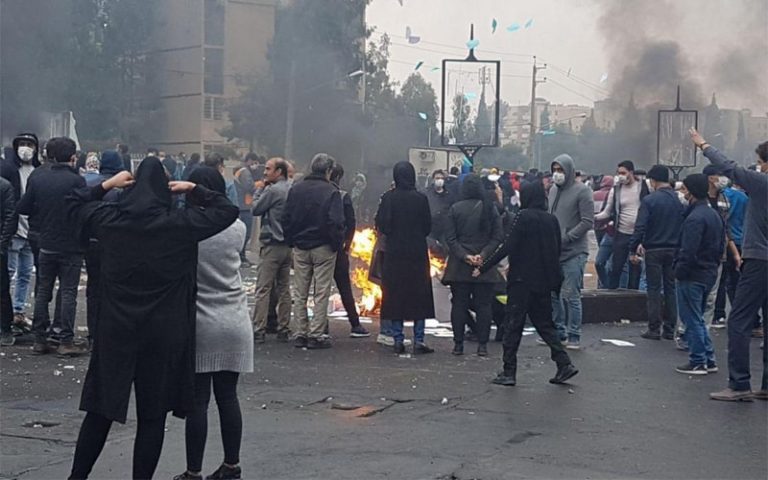
In November 2019, a protest in nearly 200 cities in all provinces across Iran shook the establishment to its core, as people came out into the streets with calls for regime change, democracy, and “death to the dictator.”

Some of the biggest areas of participation were previously thought to be ayatollahs’ strongholds, but during the protest, it became increasingly clear that there is widespread popular support for regime change.

This actually built on the previous nationwide protest in December 2017, which was the largest protest in Iran since the 1979 revolution. Both recent protests began over economic concerns—the rising cost of food and gas respectively—but quickly became about regime change, with people chanting “hardliners, reformists: the game is over” because it was obvious that the ayatollahs were the problem.

After all, they had the money to fix the issue, but they didn’t. Instead, in both instances, they cracked down violently with arrests and murders. In the November 2019 protests, they shot dead 1,500 people in the streets in just a few days.

Iranian opposition Mojahedin-e Khalq (MEK/PMOI) which helped organize the protests. This is really what the state is worried about, even going so far as to admit that the MEK was involved when for decades they have tried to pretend that the MEK has little support in Iran. In reality, the government sees the MEK as the only group capable of overthrowing it, which is why they tried to exterminate the MEK in the 1988 massacre of 30,000 political prisoners.

Iran: People No Longer Tolerate Current Governing System

“Although they would never say so explicitly, there are clear signs that Iranian officials recognize this phenomenon and are afraid of it. Among those signs are their public expressions of commitment to a violent crackdown, particularly one that is focused on resuming past efforts to destroy the MEK in its entirety,” wrote Alejo Vidal-Quadras, President of the International Committee In Search of Justice (ISJ).

This is what led to the thousands of people murdered in the streets and is still resulting in the murders of MEK members and protesters by the Iranian security forces today. But the international community is doing nothing.

“It is [ridiculous] to think that the feared international scrutiny will not expand to include the 1,500 people who were killed one year ago this month or the others who have been marked for execution since then. At least, it would be ridiculous to think these things, if not for the fact that there is a long history of Iran’s human rights abuses being ignored, especially when they involve the organized Resistance movement,” ISJ President wrote.

“No one has been held accountable in an international court for the 1988 massacre and last November’s crackdown has barely been mentioned in policy discussions in Western democracies. Sadly, it remains to be seen whether Western powers will rectify these oversights before Tehran tries again to destroy the democratic opposition,” Vidal-Quadras concluded.

Iran Government’s Heavy Debts

0

Iran’s economy has gone through a period of super-challenges and long-standing crises, and the looting officials of this government have increased their wealth and property as much as they can and taken the rest abroad.

They brought debt to the country and, in fact, plunged the deprived nation into a debt crisis in which they themselves had no part in deciding. Today, the volume of these debts has skyrocketed, and it can no longer return to zero. For this government, there is only one way: more debts.

Iran: Multi-Billion-Dollar Debts, Luxury Lives, and Millions of Hungry People

Increasing the Debts of the Government and Banks

In a report, the Central Bank of Iran (CBI) announced the amount of debt owed by the government and banks to the CBI. By the end of September this year, these debts have increased by 26.1 and 16.7 percent, respectively. The government debt to the CBI in the period under review was equal to 13.96 quadrillion rials [$64.533 billion]. The total debt of banks to the CBI has increased by 16.7 percent to 1.291 quadrillion rials [$4.3 billion], while last year the total debt of public and private banks had decreased.

“On the other hand, the debt of banks and non-bank credit institutions to the CBI at the end of September this year has increased by six percent to 1.291 quadrillion rials [$4.3 billion]. The amount of debt of commercial banks to the CBI was 9.6 quadrillion rials [$32 billion], which shows a 139 percent increase compared to September last year. The amount of debt of specialized banks to the CBI during this period was 446 trillion rials [$1.486 billion], which is equivalent to eight-tenths of a percent less than in September last year,” Arman-e-Eghtesadi daily wrote on November 4.

Although the CBI has not published detailed government budget statistics since December 2018, its recent report reveals dense corners of the government spending crisis. The government’s debt to the banking system has almost doubled in two years. The issue that the International Monetary Fund also mentioned in its October report is the large volume of debt.

This figure amounts to $260 billion, which is equivalent to 44 percent of the country’s gross domestic product. This debt is more than double the debt of the last two years. The only chance that the government has brought is its $11 billion foreign debt, which, of course, is due to its discredit from taking any loans and receiving foreign currency. An example of this was the request for a $5 billion loan from the International Monetary Fund, which was not approved.

Smuggling Gang Received $36Bn & 80 Tons of Gold by Presidential Order: Iranian MP

Debt Reflection on Liquidity Growth and Inflation

Are the huge debts of the government only reflected in the bookkeeping accounts or in the computer of the CBI? Unfortunately, not. These astronomical debts show themselves in the growth of liquidity and the crushing inflation rate. To compensate for the deficits and to meet its needs, the Rouhani government eventually resorted to the CBI printing house, sending unsupported banknotes to the market, as well as adding fuel to the high prices of the essential goods of the poor and helpless people of Iran.

In its report in September of this year, the CBI had announced the amount of liquidity as 28.96 quadrillion rials [$96.533 million]. This amount of liquidity has increased by 13 percent compared to last year. The statistics center also says that the inflation rate has reached 41 percent, which only five countries are ahead of Iran.

A careful analysis of the budget situation of the governments in power in Iran in the last decades and their persistent deficits and the relationship between these two important economic issues and the amount of debt of these governments makes it clear that these relations are twin and affect each other.

“From the day the new budgeting system was established in Iran until today, the problem of the budget deficit has grown bigger and bigger along with this newborn. Interestingly, as government revenues increased at different times, not only was the budget deficit not resolved, but it also emerged surprisingly on a larger scale than the year before. It is as if they have cut the navel string of our economy with the budget deficit,” claimed the official website of Iran’s Ministry of Industry, Mine, and Trade on November 2.

Why Iranian Protesters Are Setting Banks on Fire

Iran Hostage-Taker Defends Massacre of Protesters

0

One of the people responsible for taking U.S. embassy staff hostage in 1979 has, frankly unsurprisingly, defended the arbitrary murders of pro-democracy protesters in the November 2019 uprising.

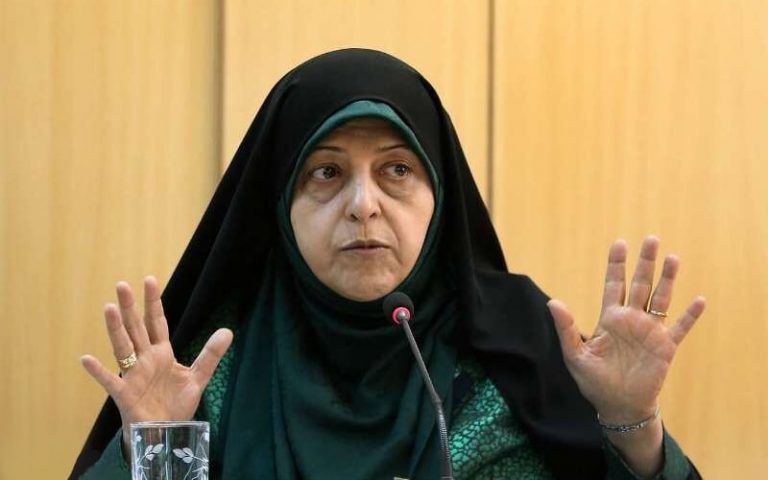
The Vice President for Women and Family Affairs, Masoumeh Ebtekar, who served as the spokesperson for the hostage-takers 41 years ago today, defended the Governor of Quds Town, near Tehran, for ordering the security forces to open fire on peaceful protesters because they were “terrorists” who had “stormed the governorate.”

The so-called “reformist” official,  was known as “Sister Mary” during the hostage crisis, a real example of terrorists storming a government building, which she called a “unique and special” action. Ebtekar then proceeded to portray the security of the government as the security of the people in her defense of the indefensible.

Iran’s Hostage-Taking Government Only Responds to Firmness

“In that incident, there were a number of protesters and a limited number of terrorist gunmen who attacked the arsenal and the city defense center. She [the Quds governor] said: ‘I should defend people’s privacy and security,’” Ebtekar said.

Of course, the people were not in danger from protesters – they were the protesters. The only thing in danger was the continued rule of the Islamic Republic; after all, protesters were chanting “Death to the dictator” and marching on oppressive centers during a protest that began over a fuel price-hike. It was very clear that they were targeting the ayatollahs, who had essentially spent 40 years covering the country in gasoline before dropping a lit match on it.

Some 1,500 protesters across the country were killed in the streets by security forces in just a few days after Supreme Leader Ali Khamenei ordered the Revolutionary Guards (IRGC) and the State Security Forces (SSF) to open fire, something first reported by the Iranian Resistance and then confirmed by Reuters.

Ebtekar’s comments, alongside authorities’ other recent actions, like appointing ruthless SSF commander Colonel Alireza Daliri, who massacred the people of Kurdistan in the 1980s, as SSF head in Kermanshah province, show that the government is terrified of another round of nationwide protests. They are using oppression to counter rebellion, often under the pretext of coronavirus protections.

IRGC commander Hossein Salami recently ordered his troops to “search all houses” to find and isolate those with Covid-19 but in essence, this was about arresting and/or scaring potential protesters.

“The regime has not been able nor willing to resolve the economic and social crisis, which resulted in the November 2019 uprising. Now the COVID-19 crisis and its rising death toll, which is a byproduct of the regime’s inaction and cover-up, has increased the society’s restiveness,” the Iranian opposition National Council of Resistance of Iran (NCRI) wrote.
Iran: People No Longer Tolerate Current Governing System

Iraqis Return to al-Tahrir Square—New Flash Protests 

0

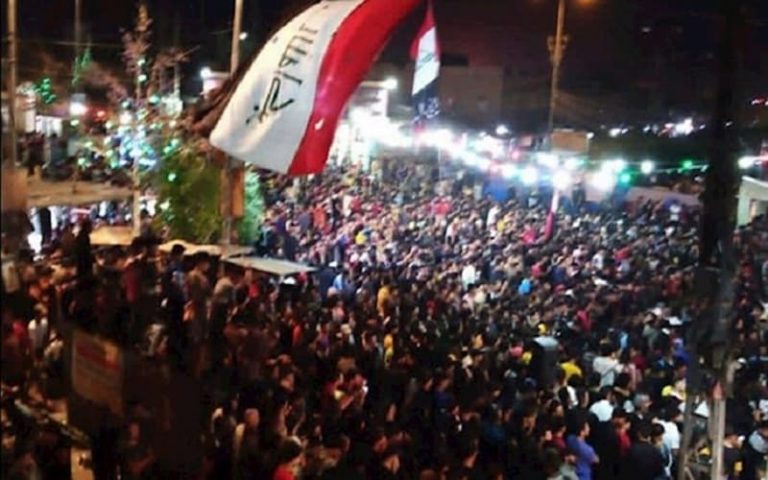
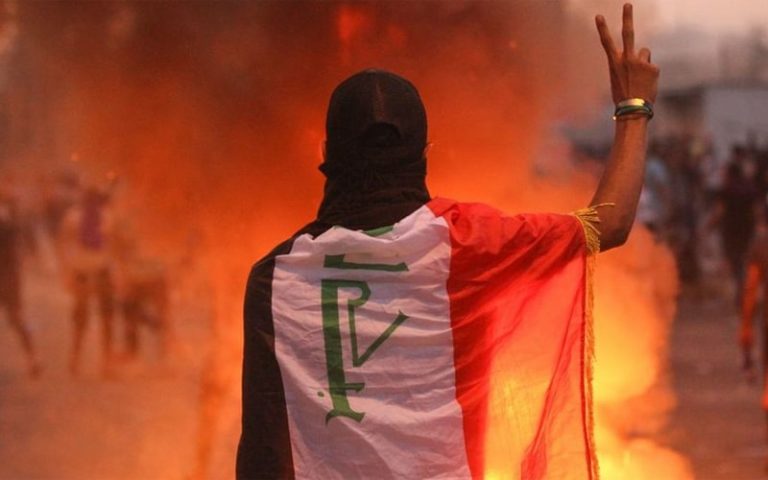
Tired from corrupt politicians and bad livelihood as well as Iran’s guided militias and their terror operations, Iraqi people took to the streets again. On the first anniversary of the October 2019 protests, Iraqi demonstrators heat up the protests called the “October Revolution.” Various cities are witnessing anti-establishment rallies demanding an account of the corrupt and murderers of the demonstrators.

In the cities of KutHilla, and Nasiriyah, slogans were chanted calling for the trial of those who killed more than 600 people. The scene in the southern city of Basra was more violent. The skirmish between the two sides lasted for several hours. 

Following the security forces’ attacks against protesters and burning their tents in various Iraqi cities, youths returned to al-Tahrir Square in Baghdad, chanting slogans against Tehran and its militias.

They reaffirmed their determination to fan the flames of the uprising. Demonstrations by Iraqi youth resumed in addition to al-Tahrir Square and other cities in the south and center of the country, including Basra, Nasiriyah, Amara, Kut, Najaf, Karbala, Muthanna, Diwaniyah, and Hilla, and continued with slogans against Iranian-affiliated parties and militias. 

The Escalation of Developments in Iraq to the Detriment of Iran’s Government

The demonstrations in Nasiriyah were more powerful than ever. Most of the clashes and fighting were in Basra. Security forces cordoned off the protest square in Basra and police forces blocked the way of the protesters. But the youth continued their demonstrations until late at night.

According to social media reports, about 50 demonstrators were arrested in Basra. It is said that police forces used live ammunition to disperse rallies, leaving several wounded among demonstrators.

In Basra, clashes between youths and government forces and Iran’s controlled militias continued into the night. Iraqi protesters in Nasiriyah, Najaf, Wasit, and Muthanna condemned the crackdown on demonstrators in Basra and al-Tahrir Square and warned of the consequences of continuing attacks on protesting squares. 

“We will not retreat, and we will not move from our places, until our legitimate demands are met, and we will not give in to any attempt to break up the sit-in by force,” protesters chanted. “Attacking the demonstrators and the protest squares makes us just more determined.” 

Assassination of a Sheikh in Al-Amara and a Christian Lawyer by Iran’s Militias 

In Al-Amara, militants assassinated Sheikh Abdul Nasser al-Tarfi, a supporter of the protesting people. Previously, in a clip al-Tarfi was posted on social media, sending a message against Qassem Soleimani, Iran’s eliminated Revolutionary Guards (IRGC) Quds Force commander. Iran’s militias also stormed the office of a Christian lawyer and assassinated him. Hwas injured.  

“The evil Iranian regime must be told that it has no place in Iraq. The next step is to end the corrupt system and form an interim independent national government,” protesters posted on their Facebook page.

The Assassination of Two Iraqi Activists by Iran-Backed Terror Squads

Al-Tahrir Square in Baghdad witnessed demonstrations demanding their fulfillment of three main demands: the prosecution of the perpetrators of the protesters’ assassination, the transformation of the Iraqi government into a presidential system, and the dissolution of Parliament. 

At 7 pm on November 3, security forces called on the demonstrators to disperse as the demonstration permit expired. Security forces also made the upcoming demonstrations in al-Tahrir Square conditional on obtaining permission from the Interior Ministry.

Iran: Human Rights Situation in October 2020

As with every month, Iran Human Rights Monitor compiled a report on human rights abuses in Iran in October and we have summarised it but the full report can be accessed here.

During the past month, the State Security Forces became increasingly violent against Iranians, even torturing them in broad daylight, as happened in these cases:

  • Mehrdad Sepehri, who was tied to a pole in Mashhad and tortured with stun guns and pepper spray until he suffocated

Iran: Security Forces Murder Young People in Streets

  • Mohsen Minbashi, who was shot and then beaten in Esfarayen
  • An unidentified woman in Abadan, who was already bloody by the time the video clip began and is seen on the ground while Jahan-Nejadian, a high-ranking manager of Abadan Oil Refinery and an operative of the Revolutionary Guard Corps (IRGC), puts his foot on her chest

Of course, the government has shown no remorse for this. Judiciary chief Ebrahim Raisi told the SSF earlier this month not to show “weakness” against those who threaten the country’s security, by which he means political prisoners, who are charged with national security crimes. While Supreme Leader Ali Khamenei praised the SFF giving them a green light for violence against Iranians.

The country is in a volatile state right now, on the eve of the anniversary of the November 2019 protests, so the authorities seek to suppress any sort of dissent, which included the arrest of at least 2,140 people last month.

A Quick Breakdown of the Ayatollahs’ Other Human Rights Abuses in October

Executions

The Iranian authorities executed at least 19 people in October, including:

  • Shahrouz Kazemi, 28, who had committed an armed robbery but not killed anyone
  • Razieh, 37, who was described as “desperate”, and murdered because of poverty

It should be noted that fair trials are not really a thing in Iran and many are tortured into making false confessions, without access to a defense lawyer.

Iran Issues More Execution Sentences

Arbitrary Murders

The SSF’s violence led to at least ten deaths last month, including 17-year-old porter Ashkan Azizi, as well as those mentioned above.

Torture

Torture is an ongoing facet of the government, with several instances reported in October. This included:

  • The sentencing of Arash Ali Akbari to have four fingers on his right hand cut off
  • The sentencing of Hadi Rostami (33), Mehdi Sharfian (37), Mehdi Shahivand (42), and Kasra Karami (40), to have their hands amputated
  • The flogging of Christian convert Mohammad Reza (Youhan) Omidi for drinking wine during Holy Communion
  • The lashing of four young prisoners, two who were identified as Behrouz Momeni and Mohsen Torkashvand